Your shopping cart is empty!
Welcome visitor you can login or create an account.
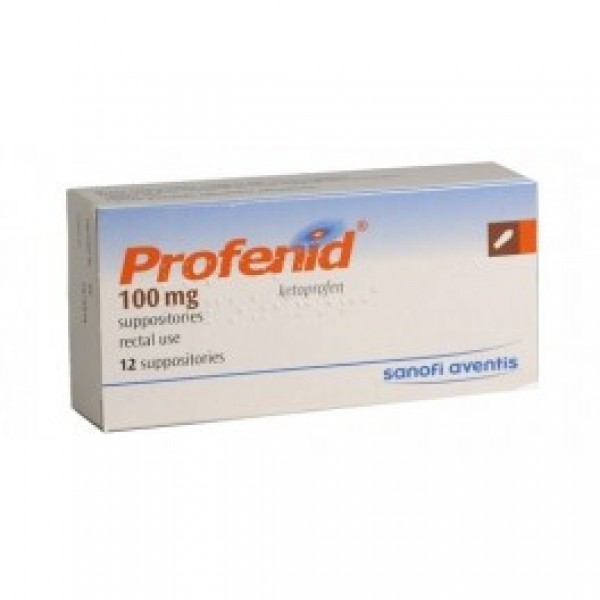
Profenid 100 mg.
Product Code: Profenid 100 mg.
Availability: In Stock
Product viewed: 3630


Profenid 100 mg.

Qualitative and quantitative composition
Profenid 100 mg suppositories:
Active substance: ketoprofen 100 mg suppository
Excipients: hydrophobic silicate solid semisynthetic glycerides.
formulation
Profenid 100 mg: suppositories-pack of 12
Pharmacotherapeutic group
NSAIDs (M: Musculoskeletal)
WHEN TO USE THIS MEDICINE Therapeutic indications
They stem from the anti-inflammatory effect of ketoprofen, the importance of the symptoms of intolerance to drug and raises his place among the various agents that are available now. They are limited in adults and children over 15 years: Symptomatic treatment of: inflammatory forms of chronic rheumatism, including rheumatoid arthritis, ankylosing spondylarthritis (or related diseases, such as syndrome Faysinger-Leroy-
Reiter and psoriatic rheumatism); some painful and debilitating osteoarthritis.
Short-term symptomatic treatment of acute attacks of:
extra-forms of arthritis, such skapulohumeralni (shoulder) periarthritis, tendinitis, bursitis,
microcrystalline arthritis, osteoarthritis, lumbago (lower back pain), radicular pain, acute posttraumatic benign diseases of the joints,
CAUTION
WHEN NOT TO USE THIS DRUG (Contra)
Profenid 100mg, suppositories SHOULD NOT BE USED in the following cases: after b-th month of pregnancy; history of allergy or asthma due to this drug, or similar drugs, especially non-steroidal anti-inflammatory drugs including aspirin; active gastric ulcer or duodenal ulcer; severe liver disease; severe kidney disease; children under 15 years.
- Profenid 100 mg suppositories SHOULD NOT BE USED in the case of recent inflammation of the rectum or bleeding (contraindication related to the route of administration). Basically, Profenid lOOmg, suppositories SHOULD NOT BE USED, unless recommended by your doctor, in combination with: oral anticoagulants, other NSAIDs (including aspirin in high doses: 3 g or more per day in adults); heparin; lithium; methotrexate at high doses (15 mg or more per week); ticlopidine (see "Interactions with other medicaments and other forms of interaction"). If you are unsure, contact your doctor or pharmacist.
special warnings
This medication should be taken under medical supervision.
Upon infection, the medical monitoring should be intensified.
When treated with anticoagulants require special monitoring if the digestive symptoms occur (see "Undesirable effects").
When bleeding from the digestive tract must immediately stop.
Precautions for use
Keep out of reach of children.
Due to the need for dose adjustment, it is important to tell your doctor writing the prescription that a history of gastrointestinal disorders (previous gastric or duodenal); heart, liver or kidney disease; asthma (in some patients, asthma attack may be due to an allergy to aspirin or nonsteroidal anti-inflammatory drug: in this case, this drug is contraindicated); use of an intrauterine contraceptive device. If you are unsure, contact your doctor or pharmacist.
Interactions with other medicaments and other forms of interaction
To avoid possible interactions with other drugs, especially other NSAIDs, including aspirin in high doses, oral contraceptives, heparin, lithium, ticlopidine, methotrexate, pentoxifylline, diuretics, zidovudine, you should tell your doctor or pharmacist about any treatment which conduct the same time.
Pregnancy and lactation
In case of pregnancy and lactation, you should always consult your doctor for advice before
starting treatment.
pregnancy:
during the first 5 months of pregnancy, your doctor may decide to prescribe this medication as necessary. Six months of pregnancy, UNDER NO CIRCUMSTANCES SHOULD NOT TAKE THIS MEDICINE OF YOUR OWN, as the effects on your child may have serious consequences for renal and vascular nature, even in a single dose, even when the baby is at term.
Your obstetrician may nevertheless decide in very special circumstances, to prescribe
this medicine. Therefore, you should carefully follow your doctor's prescription.
lactation
this medicine passes into breast milk. As a precaution, should be avoided by nursing mothers.
Driving and using machines
In rare cases, use of this drug may cause dizziness and drowsiness.
HOW TO USE THIS MEDICINE
dosage
Dosage depends on the indication.
Profenid 100 mg, suppositories: 1 to 3 suppository daily (ie, 100 to 300 mg daily). In all cases, strictly follow the doctor's prescription.
Input method
Profenid 100 mg suppositories: rectal.
When and how often to take this medicine
Profenid 100 mg suppositories: the dose should be divided into 1 to 3 suppositories dnevnoLri all cases, strictly follow the doctor's prescription.
Duration of treatment
Profenid 100 mg suppositories: rectal routes of administration should be used as
the shortest period, the risk of local toxicology.
In all cases, strictly follow the doctor's prescription.
Action overdose
In case of overdose or accidental intoskikatsiya, immediately contact a doctor. Undesirable effects
As any active product, this drug may result in more or less adverse effects.
During treatment may occur:
Skin allergic reactions: skin rash, itching, worsening of chronic urticaria
photosensitivity (severe skin reactions following UV exposure).
Respiratory allergic reactions: asthmatic attacks or general type: rarely angioedema (type of urticaria with sudden infiltration of the face and mucous fluid) and anaphylactic shock (a severe hypersensitivity reaction).
Exceptionally bullous lesions (blisters type) extending throughout the body, and sometimes mucous membranes. You should stop the treatment and tell your doctor. In some rare cases: bleeding from the digestive tract (discharge of blood in the mouth or in the stool, black stools). It is more common with use of high doses. You should stop the treatment and tell your doctor.
Possible gastrointestinal disorders: nausea, vomiting, diarrhea, constipation, abdominal pain, gastrointestinal discomfort; headache, dizziness, drowsiness, tinnitus, visual disturbances, edema. You should tell your doctor.
Observed rare cases of gastrointestinal ulceration and perforation and exceptional cases of hepatitis.
Some laboratory abnormalities may necessitate blood, kidney and liver tests:
• impairment of renal function in case of preexisting disorder.
• In exceptional cases an abnormally low number of certain elements of the blood can be expressed with pallor and fatigue (abnormally low number of red blood cells), signs of infection or unexplained fever without serious consequences (abnormally low number of white blood cells)
• Very frequent violations of liver function, which are transient and reversible.
Can be observed local effects associated with the route of administration. They become more frequent and more severe with increasing duration of use, frequency of use and dose. In Profenid 100 mg suppositories may occur rectal burning irritation.
Do not hesitate to contact your doctor or Pharmagen {EBT for advice and to report any
side effects not listed in this leaflet.
STORAGE
Refer to the expiry date stated on the carton. Keep out of reach of children.
Special precautions for storage
Store at temperatures below 25 C.
Write a review
Your Name:Your Review: Note: HTML is not translated!
Rating: Bad Good
Enter the code in the box below:
Related Products


Profenid powder and solvent for solution for injection 100 m..
149.00€