Your shopping cart is empty!
Welcome visitor you can login or create an account.
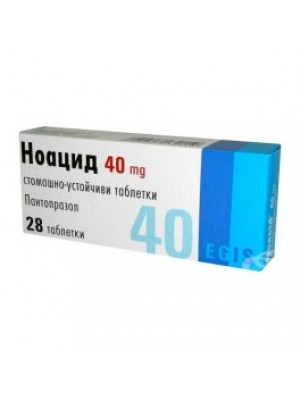
Noacid 40mg. 28 tablets

Product viewed: 2743


WHAT NOACID 40 mg IS AND WHAT IT IS USED FOR?
Noacid 40 mg is a medicinal product that reduces the production of gastric acid (a selective proton pump inhibitor).
Pantoprazole is used:
- in combination with antibiotics for the treatment of duodenal and gastric ulcers. This treatment involves the eradication of Helicobacter pylori, a disease-causing micro-organism, the cause of gastric and intestinal ulcer
- to treat moderate and severe forms of reflux oesophagitis (inflammation of the esophagus) and prevent it from recurring.
- for the treatment of stomach ulcers
- for the treatment of duodenal ulcers
- for prolonged treatment of conditions where too many heartburns are produced.
2. BEFORE YOU TAKE NOACID 40 mg
Do not take Noacid 40 mg:
- if you are allergic to pantoprazole or any of the other ingredients of Noacid.
- if you are taking medicines containing the active substance atazanavir (for the treatment of HIV infection)
Take special care with Noacid 40 mg
- if you suffer from a severe liver disorder, tell your doctor who will decide if your dose should be adjusted.
- if you have a reduced body weight of vitamin B12, tell your doctor who can test you for B12 levels.
- if you take Noachid 40 ml for eradication of Helicobacter pylori (together with antibiotics), carefully read also the antibiotic patient leaflets.
- if you have recently lost weight or suffer from prolonged vomiting, swallowing or vomiting pain, or blood in stools or very dark stools, talk to your doctor. He can do additional diagnostic tests. Also tell your doctor if the symptoms persist despite the appropriate treatment with this medicine.
Children under 12 years of age:
Noacid 20 mg should not be given to children under 12 due to lack of experience in children.
Taking other medicines
Tell your doctor or pharmacist if you are taking or have recently taken any medicines, including medicines obtained without a prescription.
Tell your doctor if you are taking any of the following medicines:
- Medicines for the treatment of fungal infections (eg ketoconazole or itraconazole) and other medicines known to have their blood concentration levels dependent on acidic secretion in the stomach.
- Blood thinners (coumarin derivatives such as phenprocoumon or warfarin), in which case your doctor should check the blood clotting parameters.
- Atazanavir for the treatment of HIV infection that you should not take concurrently with Noacid 20 mg.
Pregnancy and breastfeeding
Ask your doctor or pharmacist for advice before taking any medicines.
There are no data on the use of pantoprazole in pregnant women.
Driving and using machines
Noacid 40 mg has no influence on the ability to drive and use machines.
However, the occurrence of side effects such as dizziness and blurred vision may affect your reactions, which in turn may impair your ability to drive and use machines.
Important information about some of the ingredients of Noacid 40 mg
If you have been told by your doctor that you have an intolerance to some sugars, you should contact your doctor before taking this medicinal product.
3. HOW TO TAKE NOACID 40 mg
Always take the medicine exactly as your doctor has told you. If you are not sure, talk to your doctor or pharmacist.
Instructions for use:
If you take antibiotics to destroy Helicobacter pylori, you should take your second Noacid 40 mg tablet before dinner.
Unless your doctor prescribes otherwise, the usual dose is:
Adults and adolescents at and above 13 years of age:
Treatment of reflux oesophagitis
1 gastro-resistant tablet daily. If you have not responded to another drug to date, the dose may in some cases be increased to 2 gastro-resistant tablets.
Adults:
treatment of duodenal and gastric ulcers for the eradication of Helicobacter pylori microbes if you are also treated with antibiotics:
The following combinations are recommended:
In the morning - 1 tablet and 1 tablet a night
1000 mg amoxicillin and 1000 mg amoxicillin
500 mg clarithromycin and 500 mg clarithromycin
or
In the morning - 1 tablet and 1 tablet a night
400-500 mg metronidazole and 400-500 mg metronidazole
250-500 mg clarithromycin and 250-500 mg clarithromycin
or
In the morning - 1 tablet and 1 tablet a night
1000 mg amoxicillin and 1000 mg amoxicillin
400-500 mg metronidazole and 400-500 mg metronidazole
Treatment of duodenal ulcers, stomach ulcers
1 gastro-resistant tablet daily.
Long-term treatment of patients with conditions where too much heartburn is produced. Recommended
Long-term treatment of patients with conditions where too much heartburn is produced. The recommended dose is 2 gastro-resistant tablets Noacid 40 ml daily.
Patients with severe hepatic impairment
If you fall into this group, you should contact your doctor who will decide if a dose reduction is required. as a rule, such patients should be treated with 40 mg of Noacid 40 mg a day.
Patients with impaired renal function
If you fall into this group of patients, you should contact your doctor. However, dose adjustment or dose modification is usually not required.
Elderly patients
As a rule, the daily dose of 1 gastro-resistant tablet should not be exceeded.
If you take more Noacid than you should
There is no evidence of overdose in humans. However, if you notice signs of intoxication, tell the doctor. Depending on the dose taken and / or the type of symptoms, the doctor will decide what measures to take.
If you forget to take Noacid
Do not take a double dose to make up for the missed dose. Accept the next dose at the time specified.
If you stop taking Noacid 20 mg
Always tell your doctor before stopping treatment with Noacid on his own initiative. If you have any further questions on the use of this medicine, ask your doctor or pharmacist.
How long should I take Niacid 40 mg tablets?
If you also have antibiotic treatment, you should take 2 Niacin 40 mg daily for 7 days to a maximum of two weeks. You should then take one tablet daily until your ulcer is completely healed.
Duodenal ulcers usually heal within two weeks. If the two-week course of treatment is not sufficient, healing is achieved in almost all cases after two weeks of additional treatment.
For stomach ulcers and reflux oesophagitis, in most cases, a four-week course of treatment is required.
If you do not respond to treatment after 4 weeks, you should contact your doctor.
4. POSSIBLE SIDE EFFECTS
Like all medicines, Noacid 20 mg can cause side effects, although not everyone gets them.
Serious side effects
Stop taking Noacid 40 mg immediately and go to your doctor if you experience any of the following symptoms:
- Swelling of the face, tongue and throat
- difficulty swallowing
- Skin reactions with blistering or ulceration and urticaria;
- Difficulty breathing
- Severe dizziness with rapid heartbeat and sweating.
Other possible side effects
Common side effects - headache, upper abdominal pain, diarrhea, constipation, ulcer, and gas.
Uncommon side effects
Dizziness and visual disturbances such as blurred vision, nausea and vomiting, allergic reactions.
Rare
Dry mouth, joint pain, depression, hallucinations
Write a review
Your Name:Your Review: Note: HTML is not translated!
Rating: Bad Good
Enter the code in the box below:
Related Products