Your shopping cart is empty!
Welcome visitor you can login or create an account.
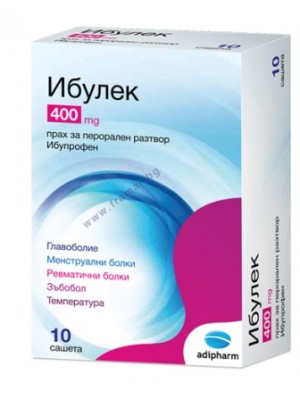
Ibulek 600 mg. 10 sachets

Product viewed: 2796


What Ibubek is and what it is used for
Medicine name is Ibulek, and its active ingredient is ibuprofen. It belongs to a group of medicines called non-steroidal anti-inflammatory drugs. They alleviate pain, restrict inflammation and lower the high temperature.
The ibuprofen contained in your medicine is in the form of ibuprofen lysine, which is rapidly released into the body, passes into the bloodstream and reaches the source of pain and inflammation.
Ibulek is used after a doctor's appointment in adults and children over 12 years of age for:
Relieving pain and reducing inflammation in rheumatic diseases affecting the joints, spine and tissues around them, edema associated with injuries and injuries;
Management of mild to moderate headache pain (including migraine), toothache, incl. After tooth extraction, painful menstruation, fever.
2. What you need to know before you take Iblek
Do not take Ibulek:
If you are allergic to ibuprofen or any of the other ingredients of this medicine (listed in section 6);
If you are allergic to acetylsalicylic acid and other non-steroidal anti-inflammatory drugs. The manifestations of allergy may be various skin rashes, urticaria (hives), itching, difficulty in breathing, runny nose, asthma, swelling of the face or throat;
If you suffer from ulcer or bleeding of the stomach and duodenum or if you have had such complaints before;
If you have had bleeding or other complications (such as perforation) of the stomach or intestines associated with previous intake of non-steroidal anti-inflammatory drugs;
If you currently have bleeding, including in the brain;
If you have bleeding disorders or blood cell formation;
If you suffer from liver, kidney or heart disease;
If you have severe dehydration, for example after prolonged vomiting or diarrhea or inadequate fluid intake;
If you are pregnant in the last three months of pregnancy.
This medicine should not be used in children under 12 years of age or those weighing less than 40 kg.
Warnings and precautions
Talk to your doctor, pharmacist or nurse before taking Ibulect.
It is especially important to know that:
Before you start taking this medicine, you should tell your doctor if you have or have had a history of:
Renal or hepatic disease;
Asthma;
Hay fever, polyps in the nose or any lung disease;
Systemic lupus erythematosus (immune system disorder) or other connective tissue diseases;
Disorders of blood clotting or blood cell formation;
Crohn's disease or persistent colitis (inflammation of the intestine).
If any of the above applies to you, your doctor will consider whether regular liver and kidney function monitoring, blood tests for blood tests and other indicators, or any further studies are required.
During treatment, you should immediately inform your doctor:
If abdominal pain or gastric or intestinal complaints occur, vomiting of blood or dark particles with the appearance of a coffee slurry or changes in stool color (bright red or tar black).
This may be bleeding or other complications from the stomach or intestines that require urgent treatment.
You should know that such complications may occur at any time of treatment, more frequent in the elderly, and with concomitant administration of drugs that have an irritant effect on the stomach and intestines as well as high doses of ibuprofen or Prolonged treatment with it. In order to avoid such complications, the physician may prescribe medication that protects the stomach and intestine from the action of ibuprofen.
If redness, blistering or any damage to the skin or mucous membranes occurs.
These manifestations may be signs of severe skin reactions (see section 4) and most often occur at the start of treatment. You should immediately stop taking the medicine and contact your doctor.
If you get skin rashes and itching, difficulty in breathing or wheezing, your asthma gets worse.
In these cases, stop taking the medicine and contact your doctor immediately as these may be signs of allergy.
If you get sick with chicken pox.
Medicines such as Ibuplec may be associated with a slightly increased risk of a heart attack ("myocardial infarction") or stroke. Any risk is more likely at high doses and prolonged treatment. Do not exceed the recommended doses and duration of treatment.
If you have a heart problem, you have a stroke or think you may be at risk of developing it (for example, if you have high blood pressure, diabetes, elevated cholesterol or you are a smoker) you should discuss treatment with your doctor or pharmacist.
Other important information
Prolonged use of analgesic medications in connection with headaches may make it worse. If you have frequent or daily headaches, despite the regular use of painkillers, consult your doctor.
Frequent intake of analgesics, especially more than one, can lead to permanent kidney damage. The risk increases with physical effort associated with a large loss of fluid and salt, so the intake of painkillers in individuals carrying out daily, heavy physical efforts should be avoided;
The risk of adverse drug reactions may be reduced by using the lowest possible dose and the shortest possible time of treatment. You should strictly follow the instructions of your doctor and pharmacist.
Children and adolescents
This medicine should not be used in children under the age of 12 years (body weight less than 40 kg).
Other medicines and Ibubek
Tell your doctor or pharmacist if you are using, have recently used or are likely to use other medicines.
When concomitant administration of ibuprofen with:
Medicines to prevent clotting or to thin the blood (aspirin, warfarin, ticlopidine) increase the risk of bleeding;
Corticosteroids (cortisone, prednisolone, methylprednisolone, etc.), acetylsalicylic acid, non-steroidal anti-inflammatory drugs, some medicines to treat depression increase the risk of stomach and intestinal damage;
Some antibiotics increase the risk of seizures (quinolones) or kidney or hearing damage (aminoglycosides);
Medicines to treat high blood pressure (beta-blockers, ACE inhibitors, angiotensin II antagonists) and / or detoxifying agents (diuretics) may reduce their effect and increase the risk of kidney damage;
Medicines for the treatment of diabetes (sulphonylurea), their action may be altered;
Lithium-containing medicines (for the treatment of depression), those for the treatment of heart failure (digoxin), the treatment of epilepsy (phenytoin) or the treatment of tumors or rheumatism (methotrexate), potentiate their action;
Gout products (sulfinpyrazone, probenecid), it is possible to delay their release from the body;
Medicines to suppress the immune system (cyclosporin, tacrolimus) are possibly kidney damage;
Zidovudine (a medicine used to treat AIDS / HIV) increases the risk of bleeding in the joints and skin.
Ibulek with food, beverages and alcohol
This medicine can be taken with or without food. Food reduces the likelihood of gastrointestinal problems but may slow down its action.
Alcohol and smoking are inappropriate during treatment.
Pregnancy, breastfeeding and fertility
If you are pregnant or breast-feeding, think you may be pregnant or are planning to become pregnant, ask your doctor or pharmacist for advice before taking this medicine.
Pregnancy
This medicine should not be used during the last three months of pregnancy. Other periods may only be used after appointment by a physician.
Breastfeeding
During breastfeeding, the use of the drug is possible for a short period as ibuprofen passes into breast milk in small amounts. If prolonged use is required, it is advisable to consult your doctor.
Fertility
Non-steroidal anti-inflammatory drugs, including ibuprofen, may reduce female fertility (ability to conceive). The effect is reversible upon discontinuation of the intake. Irregular administration is unlikely to affect your chances of becoming pregnant.
However, before taking this medicine, ask your doctor if you have problems getting pregnant.
Driving and using machines
Ibulek may cause dizziness, fatigue or visual disturbances and may affect the ability to drive and use machines. If such complaints occur, do not drive or use machines.
3. How to take Ibulek
Always use this medicine exactly as described in this leaflet or as your doctor or pharmacist has told you. If you are not sure, ask your doctor or pharmacist.
The recommended dose is:
Adults and the elderly
The recommended daily dose is 2-3 sachets (1200-1800 mg ibuprofen). This dose should be divided into several equal doses and the interval between them should not be less than 6 hours.
In some patients, a smaller daily dose is sufficient to control the disease's manifestations - 1-2 sachets (600-1200 mg ibuprofen).
In some cases (in cases of very severe pain and inflammation), your doctor may prescribe the medicine at a dose higher than the above.
The maximum daily dose of 4 sachets (2400 mg ibuprofen) should not be exceeded.
Children
In children, the doctor will determine the exact dose based on body weight.
This medicine should not be used in children under the age of 12 years (body weight less than 40 kg).
Mode of application
The contents of a sachet dissolve in a cup of sufficient quantity of potable water at room temperature and mix well to obtain a homogeneous solution that is taken orally.
Food intake may slow the uptake of ibuprofen to the blood and the onset of the effect but, on the other hand, improves gastrointestinal tolerance.
If you take more Ibulec than you should
The main manifestations of overdose are vomiting, nausea, stomach pain, bleeding from the stomach or intestines, diarrhea, headache, dizziness or drowsiness. In rare cases, there may be low blood pressure, delayed breathing, loss of consciousness.
If you take a larger dose than you should, you should immediately contact a doctor or seek immediate medical attention. Bring the medicine pack with you so the doctor knows what medicine you have taken.
If you forget to take Ibulek
If you forget to take a dose, do so as soon as you remember. If the next regular dose is recent, skip the missed dose and apply the next dose at the usual time.
Do not take a double dose to make up for the missed dose.
If you have any further questions on the use of this medicine, ask your doctor, pharmacist or nurse.
4. Possible side effects
Like all medicines, this medicine can cause side effects, although not everyone gets them.
The likelihood of occurrence of side effects is greater in adults as well as in those who have or have suffered from stomach or duodenal ulcer in the past, especially in the event of bleeding, perforation or other complications.
Ibuprofen may cause serious side effects such as:
Allergic reactions with skin rash, pruritus, urticaria (hives), asthenia, difficulty in breathing and unexplained wheezing, swelling of the face or throat, decrease in blood pressure;
Gastrointestinal complications, incl. Perforation or bleeding, which are abdominal pain and malaise, vomiting of blood or dark particles with the appearance of a coffee slurry, changes in stool color (bright red or tar black);
Flushing, blistering or skin or mucosal disorders that may be severe skin injuries.
If you notice any of these abnormalities, you should immediately stop taking the medicine and contact your doctor.
Possible side effects are listed below according to their frequency:
Very common (affects more than 1 user in 10) - nausea, vomiting, heartburn, diarrhea, constipation, gas;
Common (affects less than 1 in 10 patients) - abdominal pain and mild bleeding from the stomach and / or intestines;
Uncommon (affects less than 1 in 100 patients) - headache, dizziness, dizziness, insomnia, urticaria, itching, anxiety, irritability or fatigue, vision problems, skin rashes, asthma attacks, ulceration, perforation of the stomach lining And / or intestines (abdominal pain and malaise) and bleeding (vomiting of blood or dark particles with the appearance of coffee grounds, bright red or tar black stools), worsening of bowel disease (Crohn's disease, etc.);
Rare (affects less than 1 in 1,000 patients) - heart failure, vision impairment and blurred vision, blurred vision, aseptic meningitis (nausea, headache, vomiting) usually in people suffering from systemic lupus erythematosus, tinnitus, Hepatic function abnormalities;
Very rare (affects less than 1 in 10,000 patients) - difficulty breathing, asthenia, inflammation of the esophagus or pancreas, narrowing of the intestine, blood clotting disorders and blood cell formation (fever, sore throat, Mucosal symptoms, severe fatigue, nose and skin bleeding), fluid and salt retention, depression, emotional instability, palpitations, heart or brain stroke, elevated or decreased blood pressure, inflammation of the bladder and blood in Rina, edema, renal dysfunction, which may lead to acute renal failure, liver damage and liver inflammation, severe skin lesions accompanied by blistering of the skin, mouth, eyes and genitals, hair loss.
How to Store Ibulek
Keep out of the reach and sight of children.
At temperatures below 25 ° C.
Do not use this medicine after the expiry date which is stated on the carton or sachet after "EXP" The expiry date refers to the last day of that month The contents of the sachet should not be accepted if you notice a change in appearance or integrity The sachet is broken.
Do not dispose of medicines in the sewers or in the household waste container. Ask your pharmacist how to dispose of medicines you no longer use. These measures will help to protect the environment.
6. Package Contents and Additional Information
What Ibube contains
The active substance in one sachet is: ibuprofen 600 mg as ibuprofen lysine.
The other ingredients are maltodextrin, betaxide, sodium hydrogen carbonate, saccharin sodium (E954), aspartame (E951), silica, colloidal anhydrous, peppermint flavor, lemon flavor.
What Ibulek looks like and what the package contains
Powder (white or off-white powder with mint flavor) for oral solution 6.0 g in a paper / aluminum / polyethylene sachet.
Each box contains 6, 8, 10, 20, 30, 40 or 50 sachets and a leaflet for the patient.
Not all pack sizes may be marketed.
Write a review
Your Name:Your Review: Note: HTML is not translated!
Rating: Bad Good
Enter the code in the box below:
Related Products
IBALGIN fast table. 400 mg. 12 table WHAT IBALGIN Fast AND ..
9.00€