Your shopping cart is empty!
Welcome visitor you can login or create an account.
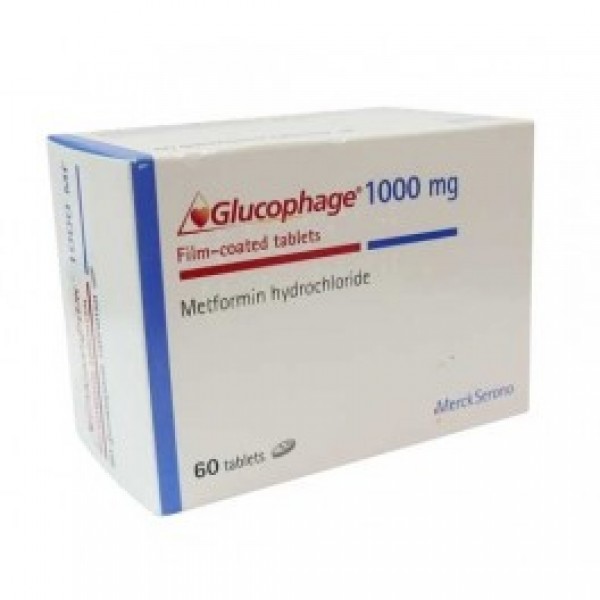
GLUCOPHAGE. 1000 mg. 60 tablets
Product Code: GLUCOPHAGE. 1000 mg. 60 tablets
Availability: In Stock
Product viewed: 543


GLUCOPHAGE. 1000 mg. 60 tablets

GLUCOPHAGE WHAT IS AND WHAT IT IS USED
What is Glyukofazh
GLUCOPHAGE comprises metformin , a drug for treatment of diabetes . It belongs to a group of medicines called biguanides .
Insulin is a hormone produced by the pancreas that helps the absorption of glucose (sugar ) from the blood. Your body uses glucose to produce energy or to store it as a reserve. If you have diabetes , your pancreas does not produce enough insulin or your body can not make full use of the insulin it produces . This leads to increased levels of glucose in the blood. Glyukofazh helps reduce blood glucose to normal levels.
In adult patients with obesity, prolonged intake of Glyukofazh also helps to reduce the risk of complications associated with diabetes .
Adopting Glyukofazh is associated with the stabilization or moderate decrease in body weight .
What is it used GLUCOPHAGE
Glyukofazh used to treat type 2 diabetes (also called insulin - dependent diabetes) , when diet and exercise are not sufficient to control the level of glucose in the blood . In particular use in obese patients .
Elderly patients may take Glyukofazh alone or with other antidiabetic agents ( medicines taken by mouth or insulin).
Children of 10 years or older adolescents may adopt Glyukofazh alone or in combination with insulin .
2 . BEFORE YOU USE GLYUKOFAZH
Do not use Glyukofazh
if you have an allergy (hypersensitivity) to metformin or any of the other ingredients of this medicine (see " What does Glyukofazh " in Chapter 6 ) ;
if you have impaired kidney or liver function ;
in the case of uncontrolled diabetes such . severe hyperglycaemia or ketoacidosis. Ketoacidosis is a condition in which blood accumulates substances called " ketone bodies " . Symptoms include stomach pain , rapid and deep breathing , sleepiness or unusual fruity breath ;
at high fluid loss ( dehydration) , and due to long-term or severe diarrhea and vomiting after continuously . Dehydration can lead to kidney complications that increase the risk of lactic acidosis (see " Take special care with Glyukofazh " ) ;
in case of severe infection , eg . pulmonary , bronchial or renal . Severe infections can lead to kidney problems , which increase the risk of lactic acidosis (see " Take special care with Glyukofazh " ) ;
in case of heart failure or recent myocardial infarction, circulatory problems or serious breathing difficulties . This can lead to insufficient supply of tissues with oxygen, which increase the risk of lactic acidosis (see " Take special care with Glyukofazh " ) ;
with increased consumption of alcoholic beverages;
during lactation .
If any of the above conditions apply to you , talk to your doctor before you start taking this medicine.
Talk to your doctor :
if you are an x-ray or scan associated with intravenous administration of contrast media containing iodine ;
if you have a surgery .
We need to stop using Glyukofazh for some time before and after the examination or surgery.
Your doctor will decide whether you need treatment. It is always important to perform strict instructions of your doctor.
Take special care with Glyukofazh
Glyukofazh can cause a very rare but serious complication called lactic acidosis, especially if you have impaired kidney function. Symptoms of lactic acidosis are vomiting, abdominal pain with muscle spasms , feeling generally unwell with fatigue and difficulty breathing. If you notice these signs , you may need urgent treatment. Immediately stop taking Glyukofazh and immediately call your doctor.
If taken alone, Glyukofazh not produce hypoglycaemia (too low blood glucose ) . But if you take Glyukofazh with other antidiabetic agents , leading to hypoglycemia (sulfonylureas , insulin , glinides ) , the risk of hypoglycemia increases. If you experience symptoms of hypoglycemia such as weakness , drowsiness , increased sweating, increased heart rate , visual disturbances and difficulty concentrating are advised to take fluids or food containing sugar.
Using other medicines
If you are the intravenous administration of contrast media containing iodine , for example, x-rays or scans should stop taking Glyukofazh for some time before and after the study ( see " Talk to your doctor " above ) .
Tell your doctor if you take apart Glyukofazh and any of the following medicines. May require more frequent tests your blood sugar , or change the dose of Glyukofazh ;
angiotensin converting enzyme (used for the treatment of various cardiovascular disorders such as hypertension or heart failure, and others. )
diuretics (used to remove the water from the body by increasing the amount of urine ) ;
beta-2 agonists, such as salbutamol or terbutaline (for the treatment of asthma ) ;
corticosteroids (used to treat a number of conditions , e. severe skin inflammation or asthma ) .
Please tell your doctor or pharmacist if you are taking or have recently taken any other medicines, including medicines obtained without a prescription.
Use of Glyukofazh with food and drink
Do not drink alcohol while taking this medicine. Alcohol can increase the risk of lactic acidosis , particularly if you have liver problems or suffer from malnutrition. It also relates to products containing alcohol .
Pregnancy and lactation
During pregnancy, diabetes treated with insulin . Tell your doctor if you are pregnant, planning to become pregnant or to be adjusted treatment. Do not take this medicine while breast-feeding or if you are breast-feeding.
Driving and using machines
If taken alone, Glyukofazh not produce hypoglycaemia (too low blood glucose ) . This means that it will not affect your ability to drive and use machines.
However, caution is needed if you are taking Glyukofazh with other antidiabetic drugs , leading to hypoglycemia (sulfonylureas , insulin , glinides ) . Symptoms of hypoglycemia include weakness , drowsiness , increased sweating, increased heart rate , visual disturbances and difficulty concentrating . If you experience these symptoms , do not drive or operate machinery.
3 . HOW TO USE GLUCOPHAGE
Always take Glyukofazh as prescribed by your doctor. If you are not sure, ask your doctor or pharmacist.
Glyukofazh can not replace a healthy lifestyle .
Continue to follow the diet that is recommended by your doctor and do regular exercises.
usual dose
The usual starting dose for children and adolescents 10 years is 500 mg or 850 mg once daily Glyukofazh . The maximum daily dose is 2,000 mg, divided into two or three doses .
Treatment of children between 10 and 12 years are recommended only after a prescription , as clinical experience in this population is limited.
The usual starting dose for adults is 500 mg or 850 mg of Glyukofazh two or three times daily. The maximum daily dose is 3000 mg, divided into 3 doses. If you are taking insulin , your doctor will tell you how to start treatment with Glyukofazh .
control
Your doctor will adjust the dose of Glyukofazh by the level of sugar in your blood. Regularly consult with your doctor. This is especially true for children , adolescents or the elderly ;
At least once a year, your doctor will monitor your kidney function and . May require more frequent tests if you are elderly or if you have kidney problems .
How to use Glyukofazh
Swallow the tablets with or after a meal. This will avoid the side effects affecting your digestion . Do not crush or chew the tablets. Swallow each tablet with a glass of water.
If you are taking one dose a day, I'll take it in the morning ( breakfast ) ;
If your dose is administered twice , take them in the morning ( breakfast ) and dinner ( dinner) ;
If your dose is divided into three doses , take them in the morning ( breakfast ) , noon ( lunch ) and dinner ( dinner) .
If after a while you decide that the effect of Glyukofazh is too strong or too weak, talk to your doctor or pharmacist.
If you take more dose Glyukofazh
If you take more dose Glyukofazh may experience signs of lactic acidosis. Symptoms of lactic acidosis are vomiting, abdominal pain with muscle cramps , malaise with a sense of fatigue and difficulty breathing. Immediately contact your doctor or pharmacist.
If you forget to take Glyukofazh
Do not take a double dose to make up for a forgotten tablet. Take the next dose at the usual time .
If you have any further questions on the use of this product, ask your doctor or pharmacist.
4 . POSSIBLE SIDE EFFECTS
Like all medicines Glyukofazh can cause side effects, although not everybody gets them . May experience the following side effects :
Very common side effects (in more than 1 patient in 10 ):
gastrointestinal disturbances such as nausea ( feeling sick ) , vomiting, diarrhea or abdominal pain and loss of appetite. These side effects occur most frequently at the beginning of treatment Glyukofazh . Useful in these cases would be to distribute doses during the day and take the tablets with or immediately after meals. If these symptoms persist, stop taking Glyukofazh and consult your doctor.
Common side effects (in less than 1 in 10 patients):
flavor changes .
Very common side effects (in less than 1 in 10 000 patients):
lactic acidosis. This is a very rare but serious complication , especially if your kidney function is impaired . If you receive such a complication will require urgent treatment.
Symptoms of lactic acidosis are vomiting, abdominal pain with muscle spasms, a general feeling of malaise with a sense of fatigue and difficulty breathing.
If these symptoms occur , stop taking Glyukofazh and tell your doctor immediately .
skin reactions such as skin redness (erythema ) , itching or hives (urticaria) ;
low level of vitamin B12 in the blood.
The incidence of these adverse reactions is not known :
abnormalities in liver function tests or hepatitis ( inflammation of the liver , causing fatigue , loss of appetite , weight loss, with or without the yellowing of the skin or eyes) . If this happens, stop taking the drug.
Children and adolescents
Limited data from the treatment of children and adolescents have shown that adverse reactions were similar in type and severity to those observed in adult patients.
If any of the side effects gets serious , or you notice other effects not listed in this leaflet , please tell your doctor or pharmacist.
5 . HOW TO STORE GLUCOPHAGE
Keep out of reach of children. If a child is treated with Glyukofazh parents and his relatives should monitor how the medicine .
This medicinal product does not require any special storage conditions.
Glyukofazh not use after the expiry date stated on the carton and blister after " EXP " . The expiry date refers to the last day of that month.
Medicines should not be disposed of via wastewater or household waste. Ask your pharmacist how to dispose of medicines no longer required . These measures will help to protect the environment.
6 . FURTHER INFORMATION
What does Glucophage
The active agent is metformin hydrochloride. One tablet Glyukofazh 1000 mg contains 1000 mg metformin hydrochloride equivalent to 780 mg metformin base.
The other ingredients are povidone K30 , magnesium stearate , hypromellose , macrogol 400 and macrogol 8000 .
Glucophage looks like and contents of pack
Glucophage 1000 mg film-coated tablets are white, round, convex , scored on both sides, on one of which is imprinted with " 1000 " . The tablet can be divided into equal halves.
The tablets are packaged in blisters or bottles made of plastic 1 ( x30 ) , 20, 30, 50 , 60, 90, 100 , 120, 180 or 600 tablets in plastic bottles containing 30 , 60, 200, 300 or 600 tablets.
Not all pack sizes may be marketed.
Write a review
Your Name:Your Review: Note: HTML is not translated!
Rating: Bad Good
Enter the code in the box below:
Related Products