
Your shopping cart is empty!
Welcome visitor you can login or create an account.
FEMOSTON 2/10 mg. 84 tablets
Product Code: FEMOSTON 2/10 mg. 84 tablets
Availability: In Stock

Product viewed: 1859


FEMOSTON 2/10 mg. 84 tablets
WHAT FEMOSTON AND WHAT IT IS USED FOR?
Femoston is "sequential" hormone replacement therapy (HRT), which is taken every day without interruption. Femoston is suitable in postmenopausal women up to six months after the last cycle.
Femoston contains two hormones: estrogen called estradiol progestogen called dydrogesterone.
Estradnolat in Femoston is produced from plant material. Dydrogesteron form progestogen very similar to the natural in women.
What applies Femoston?
For the treatment of the symptoms of menopause. These symptoms vary in different women. These may include hot flashes, night sweats, sleep problems, vaginal dryness, urinary problems.
- For the prevention of thinning of the bones (osteoporosis) if you have a high risk of future fractures and are unable to take other medicines for the prevention of osteoporosis. How does Femoston?
Hormones in Femoston replace those that are produced in the ovaries after puberty to menopause.
Estradiol control menopausal symptoms and prevent osteoporosis.
Dydrogesteron prevents the growth of the uterine lining. Women who have a uterus must normally take some form of progestogen (such as dydrogesterone). These women taking estrogen alone may have problems due to abnormal thickening of the uterine lining.
Do not take Femoston if any of these apply to you. If you are not sure, talk to your doctor or pharmacist before taking Femoston. Do not take Femoston if:
You are allergic (hypersensitive) to estradiol, dydrogesterone or to any of the excipients of Femoston (listed in pt. 6)
- Have you or your doctor thinks that you have breast cancer
- You or your doctor thinks that you might have a tumor dependent of estrogens, such as cancer of the uterine lining (endometrial cancer)
- You or your doctor thinks you might have a tumor that is dependent progestogens, such as a brain tumor (meningioma)
You have bleeding from the genitals of unknown cause
Do uterine lining which is thicker than normal (endometrial hyperplasia), which is not treated
- Do you have or have had blood clots in the veins (venous thromboembolism) in the legs (deep vein thrombosis) or lungs (pulmonary embolism)
Have a bleeding disorder (thrombophilic disorders such as protein C, protein S, or antithrombin deficiency)
- Do you have or recently have had a disease caused by blood clots in the arteries, such as chest pain or heart attack (myocardial infarction)
Have or have had liver disease, which is not fully recovered
You have a rare blood problem which has betrayed the family (hereditary) called "porphyria".
Take special care with Femoston:
Before you start or continue after the break to take HRT? Your doctor will ask about your own and your family's medical history. Your doctor may decide to examine you. This may include a review of breast and gynecological examination.
Screening tests, including appropriate imaging methods, incl. mammogram (breast x-ray) should be conducted according to current guidelines. Your doctor will tell you how often you need to conduct these reviews.
When you start taking Femoston, you should see your doctor for regular check-ups (at least once a year). Your doctor will tell you how often you need to conduct these reviews. You may need more frequent checks if you have any of the conditions listed below or if some of them have deteriorated during pregnancy or previous hormone therapy. Please note that these conditions may worsen or reappear on HRT:
Raztrastvane of the uterine lining inside the uterus (uterine fibroids or leiomyoma) or outside (endometriosis)
Risk factors for blood clots (thromboembolic disorders) Risk factors for cancer that is dependent on estrogens (and if you have close relatives - mother, sister or grandmother who had breast cancer) Increased blood pressure (hypertension) Diseases of the liver diabetes
Gallstones (cholelithiasis) Migraine or severe headache
Immune system disease that affects many organs (systemic lupus erythematosus)
History of thickening of the womb lining (endometrial hyperplasia)
Seizures (epilepsy)
Asthma
Disease affecting the eardrum and hearing (otosclerosis).
Stop taking Femoston is call the doctor immediately if you notice the following while on HRT:
- Any of the conditions mentioned in section 'Do not take'
- Yellowing of the skin and whites of the eyes (jaundice). This may be a sign of liver disease.
- High blood pressure.
- Like migraine headaches, which appears for the first time.
- If you become pregnant.
Femoston and cancer
Morbid thickening of the uterine lining (endometrial hyperplasia) and cancer of the uterine lining (endometrial cancer)
Women with an intact uterus, who took only estrogen HRT for a prolonged period of time are at risk of a pathological thickening of the uterine lining (endometrial hyperplasia) and cancer of the uterine lining (endometrial cancer)
Adding progestogen in addition to estrogen as in Femoston, helps to reduce this risk.
Interim bleeding or spotting
You may have intermediate bleeding or spotting during the first few months of HRT. But if it lasts longer than 1-2 months, appeared for a time while you are on HRT or continues after stopping HRT
> Call your doctor as soon as possible.
Your doctor will examine the cause of bleeding or spotting. This may include a biopsy of the endometrium in order to discover whether you have a cancer of the lining.
Compare
About 5 per 1000 women who have preserved uterus and not taking HRT will be diagnosed with endometrial cancer.
For women who still have a uterus and who take estrogen-only HRT, the number of additional cases can vary between 5 and 55 per 1000 HRT aged between 50 and 65, depending on the dose and the duration of administration. The addition of progestogen to estrogen substantially reduces the risk of endometrial cancer.
Breast Cancer
Evidence shows that taking estrogen-progestogen and estrogen can only HRT increases the risk of breast cancer. It depends on the duration of intake of HRT. The additional risk is visible after about 3 years. However, it returns to normal after a few years (at most 5) after stopping treatment.
Compare
For women aged 50 to 65 years, not taking HRT, on average 9 to 12 of 1,000 women will be diagnosed with breast cancer over a 5 year period. For women aged 50 to 65 who take estrogen-progestogen HRT for five years, there will be six extra cases per 1000 HRT.
For women aged 50 to 79 years who do not take HRT, an average of 14 in 1000 will be diagnosed with breast cancer over a 5 year period. For women aged 50 to 79 years who take wort progestagen HRT for five years, there will be four extra cases per 1000 users.
Be sure that:
- Regularly check your breasts and tell your doctor if you notice changes. Your doctor will tell you what signs to look for.
- Walk regular breast screening. Your doctor will tell you how often you should do it.
Ovarian Cancer
Ovarian cancer is much rarer than breast cancer. It is believed that prolonged intake (at least 5 to 10 years) estrogen alone as HRT carries a slightly increased risk of ovarian cancer. Some studies have shown that long-term use of combined HRT may have similar or slightly lower risk.
Compare
For women who used HRT for five years, there will be one additional case of 2500 users.
Femoston effect on the heart and circulation
Blood clots in the veins (venous thromboembolism - VTE)
HRT increases the risk of blood clots in the veins 1.3 to 3 times, especially during the first year of intake.
More likely to get a blood clot in the veins if one or other of the following apply to you:
• premiums estrogens
• Are you able to walk or stand a long time because of major surgery, injury or illness (prolonged immobilization) (if surgery is planned, tell your doctor that you are taking HRT well before surgery. Treatment may need to be stop as a precaution and to begin prevention. Your doctor will tell you when to start taking HRT again).
• You or one of your close relatives ever had a blood clot in the legs, lungs or other organs.
• You are older.
• Do you seriously overweight.
• You are pregnant or have recently given birth.
• You have systemic lupus erythematosus (SLE).
• You have cancer.
Compare
For women in their 50 years, not taking HRT, on average 4 in 1000 is expected to get a blood clot in a vein over a 5 year period.
For women in their 50 years who took HRT for over 5 years, there will be 5 extra cases per 1000 users.
If you get painful swelling of a leg, sudden chest pain or have difficulty breathing:
- Call your doctor immediately.
> He take more HRT until your doctor tells you that it is allowed.
This may be a sign of a blood clot.
If you are on long-term treatment with medication to reduce the formation of thrombi (blood clots), your doctor should pay special attention to the benefits and risks of HRT use.
Coronary artery disease
There is no evidence that HRT will help in the prevention of heart disease. In women taking estrogen-progestogen HRT is slightly more likely to develop heart disease by not taking HRT. The risk of heart disease depends strictly on age. The number of additional cases of heart disease by estrogen-progestogen HRT is very low in healthy women close to menopause. The number of additional cases increases with age.
If you get chest pain that spreads to the head and neck:
> Go to the doctor immediately
> Do not take any more HRT until your doctor tells you that it is allowed.
This pain can be a sign of heart disease.
Stroke
Combined estrogen-progestogen HRT or estrogen-only HRT increases the risk of stroke by 1.5 times. The relative risk for receiving therapy, versus those who were not treated, does not change with age or time since menopause.
The risk of stroke is strongly dependent on age. This means that the overall risk of stroke in women who use HRT will increase with age.
Compare
For women in the fifties, not taking HRT, on average 8 of 1000 is expected to have a stroke over a 5 year period. For women in the fifties who take HRT, there will be three additional cases per 1000 people for five years.
If you have severe and unexplained headache or migraine (which may include blurred vision):
> Call your doctor immediately
> Do not take any more HRT until your doctor tells you that it is allowed.
This can be an early warning of a stroke. Other conditions
HRT does not improve mental abilities such as thinking, remembering and reasoning. Women who start HRT after the age of 65 years may have a higher risk of partial loss of mental abilities (dementia).
Tell your doctor if you have or have had any of the following:
> Heart Disease
> Renal impairment
> Higher than normal levels of certain fats in the blood (hypertriglyceridemia).
Femoston not a contraceptive and is not intended for use in women who may become pregnant. Please ask your doctor for advice.
Taking other medicines
> Please tell your doctor if you are taking or have taken any other medicines, including medicines obtained without a prescription.
Tell your doctor if you are taking medicines, especially the following:
The following medicines may reduce the effect of Femoston and lead to bleeding or spotting:
- Medicines for epilepsy (such as phenobarbital, carbamazepine, phenytoin)
- Medicines for infections (such as rifampicin, rifabutin, neviparin, efavirenz)
- Drugs for AIDS (such as ritonavir, nelfinavir)
- Herbal preparations containing St. John's Wort.
When taking Femoston can receive dangerously high blood levels of these drugs:
- Tacrolimus, cyclosporine - used, for example, organ transplantation
- Fentanyl - a painkiller
- Theophylline - used for asthma and other breathing problems.
For this reason, it is necessary to carefully monitor for a while, it may be necessary to decrease their dose.
Blood tests
Tell your doctor that you are taking HRT, if you need to have blood tests. HRT may reduce the levels of certain proteins and hormones into the blood.
Taking Femoston with food and drink
Femoston can be taken with or without food.
Children
Femoston applies only in post-menopausal women.
Pregnancy and lactation
Femoston applies only in post-menopausal women. Do not take if you are pregnant or breast-feeding.
If you are pregnant or think you are pregnant,> stop taking Femoston and call your doctor.
Driving and using machines
The effect of Femoston on driving and operating machinery has not been studied. Effect on these activities is not likely.
Important information about some of the ingredients of Femoston
Femoston contains milk sugar (lactose). If your doctor has told you that you can not tolerate or digest certain sugars
Tell your doctor before taking this medicine.
This includes some rare hereditary diseases that are transmitted in the family and affect the use of lactose from the body (such as the Lapp lactase deficiency or glucose-galactose malabsorption).
3. HOW TO TAKE FEMOSTON?
Always take Femoston as you have been told by your doctor.
When you start taking Femoston?
Do not start taking Femoston unless there are at least 6 months after your last natural menstruation.
You can start taking any convenient day for you if:
• not taking any HRT
• switch from "combined HRT product, which is considered permanent." This is, after taking a tablet or you used patch containing estrogen and progestogen every day.
Start taking Femoston the day after the 28-day cycle if:
• switch from 'cyclic' or 'sequential' HZ product. This is, after taking a tablet or you used patch containing estrogen for the first part of your cycle. Then you have taken a tablet or patch you used that contain estrogen and progestogen for 14 days.
How to take Femoston?
• Swallow the tablet with water.
• You can take the tablet with or without food
• Try to take your tablets at the same time each day. This will ensure that a constant amount of drug in your body. This will help you to remember that you have to take the tablets.
• Take your tablets every day, without a break between packs. Blisters are marked with the day of the week. This makes it easy to remember when to take your tablet.
How much to take
Your doctor will aim to give the lowest dose for the shortest period of time to treat your symptoms. It may increase the dose, if necessary.
• If you take Femoston for the prevention of osteoporosis, your doctor will adjust the dose so that it is suitable for you. This will depend on your bone mass.
• Take a brick-red tablet daily for the first 14 days. Then take each day one tablet yellow after 14 days. This is shown on a 28-day calendar pack.
If you take Femoston more than you need
If you (or someone else) take many tablets Femoston is not likely to hurt. You may be sick (feel sick), you sleepy or dizzy and vomit. No treatment is necessary, but if you are worried, call your doctor for advice.
If you forget to take Femoston
Take the missed tablet as soon as you remember. If more than 12 hours from the time you had to take your tablet, take the next dose at the normal time, without taking the forgotten tablet. Do not take the forgotten tablet. You may have bleeding or spotting if you miss a dose.
If you stop taking Femoston
Do not stop taking without talking to your doctor.
> If you have any other questions about the medicine, ask your doctor.
4. POSSIBLE SIDE EFFECTS
As with all drugs, Femoston can lead to side effects, although not everyone gets them. These effects may occur with this drug:
Common (affect between 1 and 10 in 100 patients:
- Migraine headaches. If you like a migraine headache for the first time, stop taking Femoston and contact a doctor immediately.
- Nausea, abdominal pain, gas, abdominal muscle cramps in legs, tenderness and breast tenderness, bleeding and spotting, pelvic pain
- Weakness (asthenia)
- Weight changes (up or down). Uncommon (affecting between 1 and 10 of 1000 patients):
Write a review
Your Name:Your Review: Note: HTML is not translated!
Rating: Bad Good
Enter the code in the box below:
Related Products
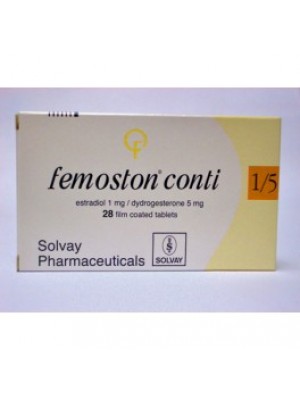
FEMOSTON CONTI 1/5 mg. 28 tabletsFormulationFilm coated tabl..
23.00€