Your shopping cart is empty!
Welcome visitor you can login or create an account.
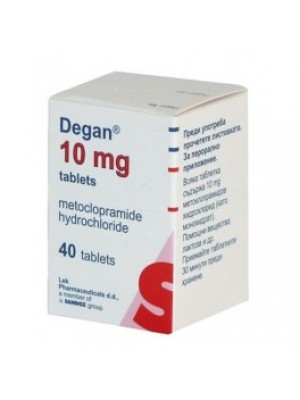
Degan 10 mg. 30 tablets
Product Code: Degan 10 mg. 30 tablets
Availability: In Stock

Product viewed: 2817


Degan 10 mg. 30 tablets
WHAT Degan AND WHAT IT IS USED
Degan was an antiemetic. It contains metoclopramide. It acts in a certain place in your brain by preventing nausea and vomiting.
Adults
Indigestion be used in patients:
To prevent appearing later nausea and vomiting which may occur after chemotherapy;
To prevent nausea and vomiting caused by radiotherapy;
For the treatment of nausea and vomiting, including nausea and vomiting which may occur in migraine. In the case of migraine, metoclopramide can be taken with oral painkillers to increase the effectiveness of painkillers.
Paediatric population
Indigestion use in children (aged 1-18 years) if other treatment does not work or can not be used to treat appearing later nausea and vomiting after chemotherapy.
2. WHAT YOU SHOULD KNOW BEFORE YOU TAKE Degan
Do not take Degan if:
you are allergic to metoclopramide or any of the other ingredients of this medicine (listed in section 6);
you have bleeding, blockage or rupture of the stomach or intestines;
You have a rare tumor of the adrenal gland, which is located near the kidney (pheochromocytoma);
ever had involuntary muscle spasms (tardive dyskinesia) during treatment with the drug;
have epilepsy;
suffer from Parkinson's disease;
taking levodopa (a medicine for the treatment of Parkinson's disease) or dopaminergic agonists (see below "Other medicines and Indigestion");
ever had abnormal levels of blood pigments (methemoglobinemia) or deficiency of NADH cytochrome-b5;
Do not give Degas children under the age of 1 year (see below "Children and adolescents").
Warnings and Precautions
Talk to your doctor, pharmacist or nurse before taking Indigestion if:
have a history of abnormal heart rhythm (QT prolongation) or other heart problems;
You have problems with levels of salts in the blood, such as potassium, sodium and magnesium;
taking other medications known to affect heart rhythm
have neurological (brain) disease;
have liver damage or kidney. The dose may be reduced (see section 3).
Your doctor may do blood tests to track levels of blood pigments. In the event of abnormal levels (methemoglobinemia), treatment should be stopped immediately.
Wait at least 6 hours between each dose of metoclopramide, even in case of vomiting and rejection of the dose to avoid overdose.
Children and adolescents
Uncontrollable movements (extrapyramidal disorders) can occur in children and adolescents. This drug should not be used in children under the age of one year due to increased risk of uncontrolled movements (see above "Do not take if Indigestion").
Other medicines and Indigestion
Tell your doctor, pharmacist or nurse if you are taking, you have recently taken or might take any other medicines. This is because some medicines can influence the Degas or Indigestion can affect the action of other drugs. These drugs include the following:
Levodopa or other medicines to treat Parkinson's disease (see above "Do not take if Indigestion");
Anticholinergic drugs (drugs that relieve stomach cramps or spasms);
Morphine derivatives (drugs for the relief of severe pain);
Sedatives (soothing);
Medicines used to treat mental health problems;
Digoxin (medicine to treat heart failure);
Cyclosporine (a medicine to treat certain problems with the immune system);
Mivakurium and suxamethonium (drugs for muscle relaxation);
Fluoxetine and paroxetine (medicines for treating depression).
Avoid alcohol while taking these drugs.
As Indigestion affect the time of passage of food through the gastrointestinal tract and thereby the rate of resorption may be required dose adjustment of oral antidiabetic agents and insulin.
Taking Degan food, beverages and alcohol
Take the tablets 30 minutes before meals. It is not recommended to drink alcohol during treatment with metoclopramide, because alcohol can increase the sedative effect Degan.
Pregnancy, lactation and fever
Ask your doctor or pharmacist before taking any medicine.
If you are pregnant or breast-feeding, you think you may be pregnant or planning to become pregnant, ask your doctor or pharmacist before taking this medicine. If necessary, Indigestion can be taken during pregnancy. Your doctor will decide whether to prescribe this medicine.
Not recommended intake of Degas while breastfeeding because metoclopramide can pass into breast milk and harm your baby.
Driving and using machines
You may feel sleepy, dizzy or have uncontrollable twitching, spasms or convulsions and abnormal muscle tone causing distortion of the body after use Degas. This can disturb your vision and also interfere with the ability to drive and use machines.
Important information about some of the ingredients
Each tablet contains 90 mg lactose. If your doctor has told you have an intolerance to some sugars, consult him before taking the drug.
3. HOW TO TAKE Degan
Always take Indigestion just as you have been told your doctor. If you're not sure, ask your doctor.
All therapeutic indications (adults):
The recommended single dose is 10 mg, taken up to three times daily. Take a tablet 30 minutes before eating.
The maximum recommended dose is 30 mg or 0,5 mg / kg of body weight per day.
The maximum recommended duration of treatment is five days.
To prevent appearing later nausea and vomiting after chemotherapy (children aged 1-18 years)
Recommended dosage 0,1 to 0,15 mg / kg body weight, taken 3 times daily, taken by mouth (oral route of administration).
The maximum dose per 24 hours is 0,5 mg / kg body weight.
Dosing table
Age Body Weight Dose Frequency
1-3 years, 10-14 kg 1 mg to 3 times per day
3-5 years, 15-19 kg 2 mg to 3 times per day
5-9 years, 20-29 kg 2,5 mg to 3 times per day
9-18 years 30-60 kg 5 mg to 3 times per day
15-18 years Over 60 kg 10 mg to 3 times per day
Instructions for use
You should not take this medicine for more than five days to prevent appearing later nausea and vomiting after chemotherapy.
Indigestion is not suitable for use in children who weigh less than 61 kg.
Other formulations / compositions may be more suited to the application.
Elderly
You may need dose reduction, depending on the problems with the kidneys, liver and overall health.
Adults with kidney problems
Tell your doctor if you have kidney problems. The dose should be reduced if you have moderate or severe renal impairment.
Adults with liver problems
Tell your doctor if you have liver problems. The dose should be reduced if you have severe liver damage.
Children and adolescents
Metoclopramide should not be used in children younger than 1 year (see. Section 2).
If you take more than the amount Indigestion
Immediately contact your doctor or pharmacist. You may have uncontrolled movements (extrapyramidal disorders), you feel sleepy, have a disturbance of consciousness, to be confused, to have hallucinations and cardiac disorders. If necessary, your doctor may prescribe treatment for these symptoms.
If you forget to take Indigestion
If you forget to take a dose, take it as soon as you remember.
Do not take a double dose to make up for a missed dose.
If you have any further questions on the use of this medicine, ask your doctor, nurse or pharmacist.
4. POSSIBLE SIDE EFFECTS
Like all medicines, Indigestion can cause side effects, although not everybody gets them.
Immediately stop treatment and contact your doctor, pharmacist or nurse if you have any of these symptoms while taking this medicine:
Uncontrolled movements (often involving the head or neck). They can occur in children or young people, particularly with the use of higher doses. These symptoms usually occur early in treatment and even after a single administration. These movements will stop after appropriate treatment;
Fever, high blood pressure, convulsions, sweating, salivation. These may be signs of a condition called neuroleptic malignant syndrome;
Itching or skin rashes, swelling of the face, lips or throat, difficulty in breathing. These may be symptoms of allergic reaction which may be severe.
Assessment of adverse reactions based on information on the frequency:
Very common: affects more than 1 in 10 users;
Common: affects 1 to 10 users in 100;
Uncommon: affects 1 to 10 users of 1000;
Rare: affects 1 to 10 users in 10 000;
Very rare: affects less than 1 user in 10 000;
Not known: can not be estimated from the available data.
Very common (may affect more than 1 in 10 people):
feeling drowsy.
Common (may affect up to 1 in 10 people):
depression;
involuntary movements such as twitching, shaking, twisting movements or muscle contractures (stiffness, muscle rigidity);
symptoms similar to Parkinson's disease (rigidity, tremor);
anxiety;
low blood pressure (especially intravenous);
diarrhea;
a feeling of weakness.
Uncommon (may affect up to 1 in 100 people):
elevated blood level of a hormone called prolactin, which may cause: separation of milk in men and women who are not breast fed;
irregular menstruation;
hallucinations;
depressed level of consciousness;
slow heartbeat (especially intravenous);
alergy.
Rare (may affect up to 1 in 1000 people):
confusional state;
convulsions (especially in patients with epilepsy).
Not known (frequency can not be estimated from available data):
variation in levels of blood pigments, which can change the color of your skin;
breast enlargement in men (gynecomastia);
involuntary muscle spasms after prolonged use, particularly in elderly patients;
fever, high blood pressure, convulsions, sweating, salivation. These may be signs of a condition called neuroleptic malignant syndrome;
changes in heart rate, which can be seen in ECG-testing;
heart failure (especially intravenous);
shock (severe lowering of blood pressure) (especially intravenous);
fainting (especially intravenous);
allergic reaction which may be severe (particularly for intravenous administration);
very high blood pressure.
If you get any side effects, contact your doctor, pharmacist or nurse. This includes any possible effects not listed in this leaflet.
5. HOW TO STORE Degan
Keep out of reach of children.
Store below 25 ° C, protected from light.
Store in the original container.
Write a review
Your Name:Your Review: Note: HTML is not translated!
Rating: Bad Good
Enter the code in the box below:
Related Products