Your shopping cart is empty!
Welcome visitor you can login or create an account.
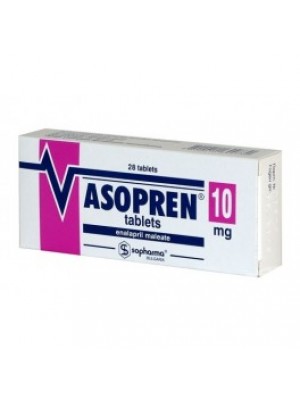
VAZOPREN 20 mg. 28 tablets
Product Code: VAZOPREN 20 mg. 28 tablets
Availability: In Stock

Product viewed: 1269


VAZOPREN 20 mg. 28 tablets
WHAT VAZOPREN AND WHAT IT IS USED?
Vazopren contains the active substance enalaprilov maleate, which refers to the antihypertensive (blood pressure lowering) of drugs called angiotensin converting enzyme (ACE) inhibitors. The drugs in this group inhibit the activity of this enzyme, resulting in decreased blood pressure, improves the overall activity of the cardiovascular system. Vazopren used to treat hypertension (high blood pressure), congestive heart failure (weakening of heart function) in dysfunction of the left ventricle of the heart.
2. BEFORE YOU TAKE VAZOPREN
Do not take Vazopren:
if you are allergic (hypersensitive) to the active substance or to any of the ingredients of the product;
if the previous treatment with an ACE ihibitori you got allergic reactions such as swelling of the face, lips, tongue and / or throat with difficulty in breathing and swallowing;
if you had such hypersensitivity reactions of unknown cause or if Bit been diagnosed with hereditary or idiopathic angioedema;
the last six months of pregnancy (use Vazopren not recommended in the first three months of pregnancy - see section "Pregnancy and lactation").
Take special care with Vazopren
Before starting treatment with Vazopren tell your doctor:
- If there is a risk of a strong decrease in blood pressure due to impaired water-salt balance, e. when treated with diuretics (water tablets), diet, limiting salt or due to vomiting or diarrhea;
- If you have narrowing of the aorta (aortic stenosis), renal artery or increased thickness of the heart muscle (hypertrophic myocardiopathy); if you have a heart problem, liver or kidney; If you have recently undergone kidney transplant;
- If you have previously had an allergic reaction with swelling of the face, lips and tongue with difficulty in swallowing or breathing;
- If you have diseases of the immune system, diabetes, an all-infectious inflammatory diseases (sore throat, fever, etc.);
- If you are being treated with allopurinol, procainamide or potassium-sparing diuretics, potassium supplements, potassium-containing salt and other drugs associated with increases in serum potassium in the blood;
- Before any surgery or anesthesia tell the doctor that you are taking enalapril, as you may have seen a sharp drop in blood pressure;
- If you are desensitisation therapy against insect venoms (bee or wasp). Desensitization treatment can sometimes increase the risk of anaphylactoid reactions when co-administered with ACE inhibitors;
- If you are being treated, called LDL-apheresis with dextran sulphate (purification of low-density lipoproteins from the blood for high cholesterol);
- If you have an hemodialysis with high flux membranes (polyacrylonitrile) if you think you are (or might be pregnant). The use of Vazopren not recommended during the first three months of pregnancy. The product should not be used after the third month of pregnancy, since intake during this period can cause serious harm to your baby (see section below on "Pregnancy and lactation").
If during treatment with Vazopren show some of the following symptoms, tell your doctor:
- Jaundice (yellowing of skin and whites of the eyes); persistent dry irritating cough. The application of this medicine requires regular monitoring by your doctor. Therefore you should follow the laboratory studies and surveys that your doctor is appointed.
children
There is limited experience on the use of Vazopren in children over 6 years of age with hypertension. No data for use in other indications. The drug is not recommended for infants and children with impaired renal function.
Taking other medicines
Please tell your doctor or pharmacist if you are taking or have recently taken any other medicines, including medicines obtained without a prescription such as diuretics (water resources) such as furosemide;
potassium-sparing diuretics such as spironolactone, amiloride or triamterene; potassium supplements and potassium containing salt substitutes;
medicines to treat cardiovascular diseases such as drugs that lower blood pressure, nitroglycerin and other nitrates or other drugs to dilate blood vessels (vasodilator), procainamide, digoxin;
anti-inflammatory drugs (indomethacin, diclofenac and others.); medicines for gout (allopurinol), probenecid;
drugs for the treatment of low blood pressure, shock, asthma, allergies such as noradretsalin, adrenaline, systemic corticosteroids; lithium salts;
medicines that suppress the immune system (immunosuppressants); antidiabetic agents; medicines for depression such as amitriptyline;
antacids (with increased acidity in the stomach);
aspirin (acetylsalicylic acid - in cardiological doses), thrombolytics (drugs for the destruction of blood clots) and beta-blockers (drugs for the treatment of certain heart conditions) may be applied simultaneously with Vazopren.
Taking Vazopren with food and drink
During treatment with Vazopren not recommended because alcohol can amplify the effect of the drug.
Pregnancy and lactation
Ask your doctor or pharmacist before taking any medicine.
pregnancy
The use of Vazopren not recommended during the first three months of pregnancy. If you are pregnant, planning to become pregnant or suspect that you are pregnant, please consult your doctor to change your treatment.
Vazopren should not be used during the last six months of pregnancy because it may cause serious harm to your baby.
breastfeeding
The use of Vazopren not recommended to mothers of premature infants, and the first few weeks after birth.
In older infants use Vazopren mother may be considered if necessary, to monitor the child for adverse reactions.
Driving and using machines
Vazopren can cause hypotension (low blood pressure) in some patients, especially early in treatment, which must be taken into account when driving or operating machinery.
3. HOW TO TAKE VAZOPREN?
Always take Vazopren just as you have been told by your doctor. If you're not sure, ask your doctor or pharmacist.
Vazopren taken orally 1 or 2 times a day before, during or after meals. Hypertension (high blood pressure): The recommended starting dose is 10 mg to 20 mg per day depending on the degree of hypertension. In mild hypertension the recommended starting dose is 10 mg 1 or 2 times a day. Some patients may need a lower starting dose. For other degrees of hypertension the initial dose is 20 mg daily. The usual maintenance dose is 20 mg 1 or 2 times per day.
Heart failure: Typically, the recommended starting dose is 2,5 mg once daily. The dose should be increased gradually depending on the individual response until the usual maintenance dose of 20 mg, taken once or in 2 divided doses.
Patients with impaired renal function
Your doctor will decide the dose depending on the degree of disability. Children with hypertension
There is limited clinical trial experience of the use of enalapril in hypertensive children. For children who can not swallow tablets, the dose should be determined individually. The recommended starting dose is 2,5 mg once daily in patients weighing 20 to 50 kg or 5 mg once daily in patients weighing more than 50 kg.
If you take more than the amount Vazopren
In cases of administration of very high doses may occur dizziness as a result of a sharp drop in blood pressure. Tell your doctor immediately or contact the nearest emergency room.
If you forget to take Vazopren
If you miss a dose, take it as soon as possible. If it is almost done time for your next dose, take it as normal. Do not take a double dose to make up for a missed dose. Continue to take the medicine as prescribed.
If you have any further questions on the use of this product, ask your doctor or pharmacist.
4. POSSIBLE SIDE EFFECTS
Like all medicines, Vazopren can cause side effects, although not everybody gets them. Vazopren generally well tolerated.
You may experience the following side effects:
It is vital to stop taking Vazopren and seek immediate medical attention if you experience any of the following symptoms:
- Allergic reactions - itching, difficulty breathing, hoarseness, swelling of the hands, mouth, throat, face.
Stop taking Vazopren and tell your doctor if you experience any of these side effects:
- Intense vertigo, dizziness, especially early in treatment, when increasing the dose or when standing, severe redness of the skin, blistering of the skin to peel off the skin.
Other possible side effects:
Very common (occurring in more than 1 in 10 people)
blurred vision, cough, nausea, asthenia (weakness). Common (affects less than 1 in 10 people)
headache, depression, low blood pressure, seizures; chest pain, changes in heart rate, pain behind the breastbone, rapid heartbeat, shortness of breath;
changes in taste, abdominal pain, diarrhea; swelling affecting other parts of the body; fatigue;
rash, hypersensitivity reactions hypersensitivity / angioneurotic edema: swelling of the face, extremities, lips, tongue, glottis and / or larynx;
increase of potassium and serum creatinine. Uncommon (affects less than 1 in 100 people)
anemia (reduction in red blood cells, which can lead to paleness, weakness, or shortness of breath), hypoglycemia (low blood sugar), confusion, drowsiness, insomnia, nervousness, tingling in the fingers of limbs, dizziness;
orthostatic hypotension (drop in blood pressure, especially when you stand up from a lying or sitting position, causing dizziness, light-headedness or fainting), feeling unusually quickly and correctly palpitations, myocardial infarction or cerebrovascular accident (in high-risk patients);
nasal discharge, sore throat and hoarseness, bronchospasm;
dry mouth, indigestion, loss of appetite, gastric irritation, vomiting, constipation, pancreatitis (inflammation of the pancreas), sudden severe stomach pain, ulcers, increased sweating, itching, hives, alopecia (loss of hair, usually on the head ), proteinuria (presence of protein in urine), impaired renal function, renal failure;
impotence, muscle cramps, flushing, tinnitus, malaise, increase in body temperature, myalgia (muscle pain); hyponatremia (low sodium), increased blood urea.
Rare (affects less than 1 in 1000 people) sleep disorder, abnormal dreams;
decreases in hemoglobin, hematocrit, leukopenia (reduction in white blood cells, which increases the likelihood of infection), neutropenia agranulocytosis (a strong decrease in white blood cells, which increases the likelihood of infection), thrombocytopenia (decrease in the number of platelets, which increases the risk of bleeding or bruising), pancytopenia (strong reduction of the number of blood cells, which can lead to weakness, bruising or increased likelihood of infection), bone marrow depression, lymphadenopathy (swollen lymph nodes), autoimmune diseases;
elevated serum bilirubin, elevated liver enzymes, hypoglycemia (very low blood sugar);
reduced blood flow in the limbs due to vasospasm (Raynaud's phenomenon), the effect on the lungs (pulmonary infiltrates), allergic inflammation of the lungs (allergic alveolitis / eosinophilic pneumonia);
inflammation of the oral mucosa with ulcers (stomatitis / aphthous ulcerations), inflammation of the tongue (glossitis), decreased urine output (oliguria);
liver failure, jaundice, inflammation of the liver (hepatitis); erythema multiforme, incl. Stevens-Johnson (serious illness accompanied by blistering of the skin, mouth, eyes and genitals), exfoliative dermatitis, toxic epidermal necrolysis (severe illness accompanied by blistering of the skin), purpura (multiple small hemorrhages skin and mucous membranes), cutaneous lupus, bullous pemphigus (a disease characterized by blistering of the skin and mucous membranes, which are easily cleaved to form a painful erosions), erythroderma (abnormal redness of the skin);
gynecomastia (enlarged breasts in men). Very rare (affects less than 1 in 10,000 people)
intestinal angioedema (swelling of the intestinal mucosa). Others (not known)
Syndrome of inappropriate antidiuretic hormone.
If any of the side effects gets serious, or you notice other effects not listed in this leaflet, please tell your doctor or pharmacist.
5. HOW TO STORE VAZOPREN?
Store in the original container, dry and protected from light, at
temperature below 25 ° C.
Keep out of reach of children.
Do not use Vazopren after the expiry date stated on the packaging. The expiry date refers to the last day of that month.
Medicines should not be disposed of in wastewater or household waste. Ask your pharmacist how to dispose of medicines no longer required. These measures will help to protect the environment.
6. FURTHER INFORMATION
What Vazopren?
The active substance is enalaprilov maleate 5 mg, 10 mg or 20 mg per tablet. The other ingredients are mannitol, microcrystalline cellulose, hydroxypropylcellulose, sodium bicarbonate, sodium starch glycolate; silica colloidal anhydrous;
magnesium stearate, red iron oxide (10 mg tablets and 20 mg), yellow iron oxide (tablet 20 mg), talc.
Vazopren looks like and contents of the pack?
Tablets 5 mg: round, flat tablets white, with bilateral facet and scored on one side and a diameter of 6 mm.
Tablets 10 mg: round, flat tablets with pink light mosaic with bilateral facet and scored on one side and a diameter of 7 mm.
Tablets 20 mg: round, flat tablets with beige color, with bilateral facet and scored on one side and a diameter of 8 mm.
Tablets 5 mg, 10 mg, 20 mg: at 7 tablets in a blister of a triple layer aluminum / aluminum foil; 4 blisters (28 tablets) in a cardboard box along with a leaflet.
Write a review
Your Name:Your Review: Note: HTML is not translated!
Rating: Bad Good
Enter the code in the box below:
Related Products

VAZOPREN table. 5 mg. 28 tablets VAZOPREN WHAT IS AND WHAT I..
25.00€