
Your shopping cart is empty!
Welcome visitor you can login or create an account.
UBISTESIN. 1.7 ml. 50 ampules
Product Code: UBISTESIN. 1.7 ml. 50 ampules
Availability: In Stock

Product viewed: 2917


UBISTESIN. 1.7 ml. 50 ampules

COMPOSITION
1 ml of solution for injection contains :
Active Ingredients:
Articaine hydrochloride - 40 mg;
Adrenaline hydrochloride (equivalent to 0.005 mg adrenaline) - 0.006 mg.
Other ingredients:
Anhydrous sodium sulphite , max. (equivalent to max . 0.31 mg SO2) - 0.6 mg;
Sodium chloride ;
Water for Injection ;
Hydrochloric acid and sodium hydroxide to adjust the pH .
PHARMACEUTICAL FORM AND CONTENTS
Solution for injection ; one tin contains 50 Kaprun in 1.7 ml.
Local anesthetic ( agent for topical sensation) of amide type with a vasoconstrictor ( vasoconstrictive ) composition for use in dentistry .
therapeutic indications
Local anesthesia (infiltration and transfer) for small manipulations in dentistry .
CONTRAINDICATIONS
Do not allow the use of Ubistesin in the following cases :
children under 4 years of age;
hypersensitivity ( allergy) to the drug or any of the excipients .
Due to the local anesthetic articaine , do not allow the use of Ubistesin in the following cases :
known allergy or hypersensitivity to amide local anesthetics ;
severe impairment of excitement - translation system of the heart (eg AV block II and III degree , severe bradycardia ( slow heart rate ) ) ;
acute decompensated heart failure (acute collapse of the heart) ;
severe hypotension (low blood pressure) ;
patients with a defect in the activity of plasma cholinesterase ( normally common chemical product in the organism ) ;
haemorrhagic diathesis ( predisposition to bleeding ) - especially in translation anesthesia ;
injection into an inflamed area .
Because of adrenaline as vazokonstdiktorna supplement, not allowing the use of Ubistesin in the following cases :
Heart diseases , such as:
unstable angina ( breakthrough pain behind the sternum ) ;
recent myocardial infarction ( necrosis of the heart muscle) ;
recently bypass surgery of the coronary arteries ( heart surgery ) ;
refractory arrhythmias ( disturbances of regular heart beat) and paroxysmal tachycardia (sudden shortness of the pulse ) or high , sustained arrhythmia ( very fast , irregular heartbeat ) ;
untreated or uncontrolled severe hypertension (high blood pressure ) ;
untreated or uncontrolled congestive heart failure ( failure of the heart) ;
Concomitant treatment with monoamine oxidase inhibitors (MAOIs ) or tricyclic antidepressants (medicines for depression) (see " Interactions " ) .
Due to the content of sulphite as excipient , not allowing the use of Ubistesin in the following cases :
allergy or hypersensitivity to sulfite;
severe bronchial asthma.
Ubistesin can cause severe allergic reactions with anaphylactic symptoms (eg bronchospasm ( constriction of the bronchi ) ) .
SPECIAL WARNINGS AND PRECAUTIONS FOR USE
Ubistesin should be used with great caution in the following cases :
severe renal impairment ;
angina (pain in the middle of the chest) (see " Dosage and method of administration " and " Contraindications " ) ;
arteriosclerosis ( stiffness of the arteries due to arteriosclerosis ) ;
significant bleeding disorders (see " Interactions " ) ;
thyrotoxicosis ( syndrome due to increased levels of thyroid hormones ) ;
narrow-angle glaucoma (a condition of vision loss due to abnormally high pressure in the eye ) ;
diabetes ( a disorder in which the sugars in the body does not burn because of the lack of pancreatic hormone , insulin) ;
lung diseases - particularly allergic asthma ;
pheochromocytoma ( tumor of the adrenal medulla , secreting adrenaline) .
Accidental injection may result in convulsions , followed by depression of the central nervous system or cardiorespiratory arrest . Should be available resuscitative equipment, oxygen and other resuscitative drugs for immediate use .
Since amide- type local anesthetics are metabolized by the liver , Ubistesin should be used with caution in patients with liver disease. Patients with severe liver disease are at higher risk of reaching a toxic concentration of the anesthetic in the blood plasma .
The product should be administered with caution in patients with cardiovascular disorders because they may have less ability to compensate for functional changes associated with the prolongation of AV conduction produced by these drugs .
The product should be administered with caution in patients with a history of epilepsy (a disorder of brain function characterized by recurrent seizures) .
Likelihood of positive results on doping tests athletes.
It should be borne in mind that during the treatment with inhibitors (drugs that prevent clotting of the blood , e. Heparin , acetylsalicylic acid) , an unintended effect on vessel at the introduction of local anesthetic can lead to serious bleeding and moreover , hemorrhagic tendency is generally increased (see " Interactions " ) .
Should avoid inadvertent intravascular application ( see section " Dosage and method of administration") .
When stuffing of the cavities or stump crowns must account of the reduced blood flow in the pulp tissue due to the presence of epinephrine and hence the risk of not observe the opening of the pulp.
Precautions for use :
Each time a local anesthetic should be available following drugs :
Anti-convulsant medicines (medicines to treat seizures , eg . Benzodiazepines or barbiturates ) , muscle relaxants ( drugs that reduce tension in voluntary muscles) , atropine and vasopressors (drugs for treating low blood pressure) or epinephrine for severe allergic or anaphylactic reaction.
Resuscitative equipment (especially oxygen) enabling artificial ventilation if necessary .
Careful and constant monitoring of cardiovascular and respiratory (adequacy of ventilation) vital signs . Must be ensured that the consciousness of the patient after each injection of a local anesthetic . Restlessness , anxiety, ringing in the ears , dizziness, blurred vision, tremor ( shaking), depression or drowsiness may be early signs of intoxication of the central nervous system (see " Treatment of overdose " ) .
Patients receiving phenothiazines (drugs to treat severe mental disorders)
Phenothiazines may reduce or reverse the pressor effect of adrenaline . Concurrent use of these agents should generally be avoided. In situations when concurrent therapy is necessary , the patient should be closely monitored .
Patients taking nonselective beta-blockers (medicines for high blood pressure)
Concomitant administration of cardioselective beta-blockers can cause increased blood pressure by the action of vasoconstrictors substances (adrenaline ) in Ubestesin ( see " Interactions " ) .
Pregnancy and lactation
Clinical experience of the use in pregnant and lactating women is limited. Safe use of local anesthetics during pregnancy has not been established with respect to adverse effects on fetal development . This medicine should not be used during pregnancy only if it considers that the benefits outweigh the risks.
The excretion of articaine and its metabolites in breast milk is unknown. Preclinical safety data suggest that the concentration of articaine in breast milk does not reach clinically relevant concentrations. Therefore, after anesthesia with articaine , nursing mothers should express and discard the first milk.
EFFECTS ON THE ABILITY TO DRIVE AND USE MACHINES
Although test patients have shown no impairment of normal reactions when driving , but the dentist must assess in each case the possible violation of the safety of motor vehicles or machinery. The patient should not leave the office until they have passed at least 30 minutes after injection.
INTERACTIONS
The sympathomimetic effect of epinephrine may be potentiated by concomitant intake of MAO inhibitors or tricyclic antidepressants (medicines for depression) (see " Contraindications " ) ;
Adrenaline can inhibit the secretion of insulin from the pancreas and reduce the effects of oral antidiabetic agents ;
Concomitant administration of cardioselective beta-blockers (medicines for high blood pressure) can lead to increased blood pressure by adrenalin in Ubistesin;
Some inhalation anesthetics ( means of sensation) , catalytic halothane , can sensitize the heart to catecholamines ( adrenaline ) and therefore induce arrhythmia after administration of Ubistesin;
During treatment with anticoagulants (drugs that prevent blood clotting ) increased bleeding tendency (see also section " Special warnings and precautions for use").
Dosage and method of administration
Dosage instructions :
Must use the smallest possible volume of solution which will result in effective anesthesia .
Upon extraction of the upper teeth , 1.7 ml Ubistesin in most cases it is sufficient for one tooth ; so can avoid painful palatal injections. Extractions of adjacent teeth , it is often possible to reduce the amount of the injected solution .
If a cut or suture of the palate is shown palatal injection of about 0.1 ml per puncture .
In extractions of mandibular molars usually sufficient infiltration anesthesia with 1.7 ml Ubistesin tooth ; in some cases a buccal re- injection of 1 - 1.7 ml. In rare cases, you may need injection into the mandibular foramen .
Vestibular injection of 0.5 -1.7 ml Ubistesin tooth allows taxidermy cavity and stump crowns .
Treatment of the lower molars should be translated using anesthesia .
In general, for children weighing 20 ~ 30 kg suffice 0.25 -1 ml; in children weighing 30-45 kg dose is 0.5 - 2 ml.
Ubistesin should not be used in children under 4 years of age.
In elderly patients may be observed to increase in plasma levels because of the delayed Ubistesin metabolic processes and lower volume of distribution. The risk of accumulation of Ubistesin is particularly increased after repeated administration (eg, re-injection ) . A similar effect can be obtained from the reduced general condition of the patient , as well as severely impaired liver and kidney (see also section " Special warnings and precautions for use").
Therefore, in all these cases it is recommended that a lower dose ( minimum quantity sufficient depth of anesthesia ) .
The dose should be reduced similarly in patients with some existing diseases ( angina ( pain in the center of the chest ) , arteriosclerosis (see also section " Special warnings and precautions for use").
Maximum recommended dose :
adults:
In healthy adults, the maximum dose articaine is 7 mg / kg body weight (500 mg for a 70 kg patient) , equivalent to 12.5 ml Ubistesin. The maximum dosage is a solution of 0.175 ml per kg .
children:
Level for injection should be determined by the age and weight of the child and the severity of the manipulation. Should not exceed the equivalent of 7 mg articaine / kg (0.175 ml Ubistesin / kg) body weight.
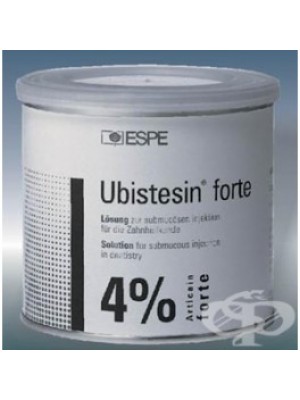
Also available Ubistesin forte, which would be more suitable for longer treatments when there is a risk of bleeding into the operative field.
Method of administration
Injectable / oral- mucosal administration
TO BE USED ONLY IN DENTAL ANAESTHESIA
To avoid injection into a blood vessel , should always be carefully held aspiration control in two planes ( rotation of the needle 180 °), even though the negative aspiration does not rule completely unnoticed and unintentional intravascular injection .
The injection rate should not exceed 0.5 ml for 15 sec. , Ie carpoule 1 minute.
Major systemic reactions as a result of accidental intravascular injection can be avoided in most cases by an injection technique : first aspiration , then slowly injecting 0.1 - 0.2 ml, wait at least 20-30 seconds and slowly introducing the rest .
Opened cartridges should not be used for other patients. Leftovers should be discarded.
Treatment of overdose
Adverse effects ( which show abnormally high concentration of anesthetic in the blood) may occur immediately - as a result of accidental intravascular injection or abnormal absorption conditions , e. in inflamed or intensive vascularised tissue - or later as a result of true overdose after injection of an excessive amount of anesthetic solution. They manifest themselves as symptoms of the central nervous system and / or the vascular system .
Symptoms caused by the local anesthetic articaine :
Milder central nervous symptoms include a metallic taste , ringing in the ears , dizziness, nausea , vomiting , restlessness, anxiety, initial shortness of breath .
More severe symptoms are drowsiness , confusion, tremor ( shaking), muscle spasms, tonic- clonic seizures ( convulsions ) , coma and respiratory paralysis ( severe respiratory disorders) .
Severe cardiovascular episodes are seen as a drop in blood pressure , impaired cardiac impulse conduction , bradycardia ( slow heart rate ) , cardiovascular arrest.
Symptoms caused by adrenaline as a vasoconstrictor ( vasoconstrictor ):
Cardiovascular symptoms, such as feeling hot , sweating , fast heartbeat, migraine headaches, high blood pressure, angina ( pain in the center of the chest ) , tachycardia (rapid heartbeat ) , tachyarrhythmia ( irregular and rapid heartbeat ), and acute heart vascular insufficiency.
Occurrence of various complications and side effects may mask the clinical picture.
therapy
If an adverse reaction , the use of local anesthetic should be discontinued .
General main measures:
Diagnosis ( respiration, circulation , consciousness) , maintenance / restoration of vital functions of respiration and circulation , oxygen , providing vein .
Special measures:
Hypotension : Raise your upper body ; if necessary - sublingual nifedipine ;
Convulsions : Protect patients from concomitant injuries ; if necessary, benzodiazepines (eg diazepam ) intravenously ;
Hypotension : Horizontal position ; if necessary - saline infusion , vasopressors (e.g. etilefrin intravenous ) ;
Bradycardia : Atropine intravenously ;
Anaphylactic shock : To call an ambulance , meanwhile the patient be placed in the shock position , generous infusion of saline , if necessary - adrenaline ( epinephrine ) intravenous cortisone intravenously ;
Acute cardiac failure : Immediate measures of cardiac and respiratory activity to call an ambulance.
SIDE EFFECTS
The local anesthetic articaine may cause the following side effects :
cardiovascular disorders
Rare (> 0.01%) :
Decrease in heart rate , hypotension (low blood pressure).
Drop in blood pressure disturbances in cardiac impulse conduction , bradycardia ( slow heart rate ) , asystole ( cardiac arrest ), acute cardiovascular failure.
Disorders of the nervous system
Rare (> 0.01% ):
Metallic taste , ringing in the ears, dizziness , nausea, vomiting , restlessness , yawning, shaking, nervousness, nystagmus ( oscillation of the eyes) , logoreya ( compulsive verbosity ), headache, shortness of breath . Paresthesia (loss of sensation , burning, tingling) of the lips, tongue , or both.
In appearance , these symptoms require prompt corrective measures to prevent worsening : dizziness , confusion, tremor ( shaking), muscle spasms, tonic- clonic seizures ( convulsions ) , coma and respiratory paralysis ( severe respiratory disorders) .
respiratory disorders
Rare (> 0.01%) :
Shortness of breath , followed by a delay , which may lead to respiratory arrest .
allergic reactions
Very rare (<0.01 %):
Can be observed hypersensitivity to articaine as rash, itching, swelling and redness , as well as vomiting , diarrhea , wheezing or anaphylaxis. Has a message for cross-reactivity to articaine in patients with delayed hypersensitivity to prilocaine .
Generally, patients with demonstrated hypersensitivity to articaine or other amides for subsequent procedures should be used ester local anesthetics .
Application of large doses of articaine may cause symptoms of methemoglobinemia ( chemical changes in hemoglobin ) in patients with asymptomatic methemoglobinemia .
The content of the vasoconstrictor epinephrine as an ingredient may cause the following side effects:
Cardiovascular disorders
Rare (> 0.01% ):
Can not exclude signs as feeling hot , sweating , fast heartbeat, migraine headaches , increased blood pressure , stenokadichni problems ( pain in the middle of the chest) , tachycardia ( rapid heartbeat ) , tachyarrhythmias (rapid irregular heartbeat ) and cardiovascular retention and acute edematous swelling of the thyroid gland.
The content of the sulfite as an adjuvant can lead to the following side effects:
allergic reactions
Very rare ( <0.01 %):
Allergic reactions or hypersensitivity occur , especially in patients with bronchial asthma, in the form of vomiting , diarrhea , wheezing , acute asthma attack , clouding of consciousness or shock.
The combination of articaine and adrenaline ( epinephrine ) may cause the following side effects:
Nervous System Disorders
Is described later facial paralysis , occurred two weeks after administration of articaine / adrenaline ( epinephrine ) and still occurs 6 months later . Occurrence of various complications and side effects may obscure the clinical picture.
STORAGE AND STABILITY
Keep out of reach and sight of children.
Do not store above 25 ° C.
Keep in the original container to protect from light.
Do not use after the expiry date stated on the bottom of the tin
box
Write a review
Your Name:Your Review: Note: HTML is not translated!
Rating: Bad Good
Enter the code in the box below:
Related Products
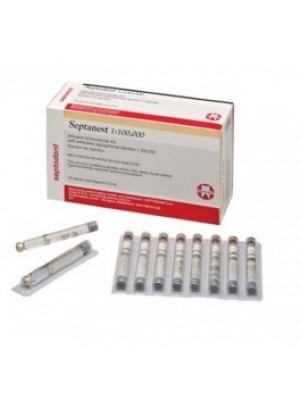
SEPTANEST adrenaline solution 68 mg. / 17 mcg. 50 pieces&n..
49.00€
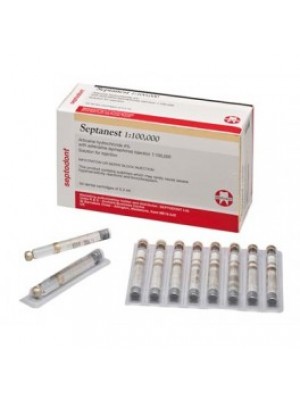
SEPTANEST . Adrenalin solution 68 mg. / 8.5 mcg.
..
49.00€