
Your shopping cart is empty!
Welcome visitor you can login or create an account.
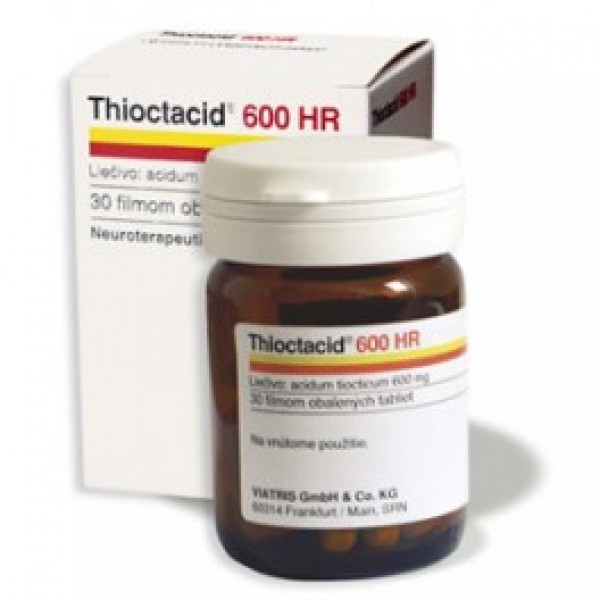
THIOCTACID 600 HR. 30 tablets
Product Code: THIOCTACID 600 HR. 30 tablets
Availability: In Stock
Product viewed: 4620


THIOCTACID 600 HR. 30 tablets
Qualitative and quantitative composition
1 tablet contains 600 mq tioctic acid as a drug.
3. Pharmaceutical Form
Film-coated tablet
4. Clinical data
4.1. Evidence
Treatment of the symptoms of peripheral (sensorimotor) diabetic polyneuropathy.
4.2. Dosage and method of administration
Take 1 tablet THIOCTACID 600HR (equivalent to 600 mg tioctic acid) daily in a single dose, approximately half an hour before the first meal. In highly symptomatic peripheral (sensorimotor) diabetic polyneuropathy recommended initiation parenteral therapy.
The film-coated tablets THIOCTACID 600HR should be swallowed whole with a sufficient amount of fluid on an empty stomach.
Co-administration with food may lead to reduced absorption of thioctic acid. It is therefore recommended total daily dose is administered once before breakfast, especially in patients with prolonged gastric passage.
4.3. Contraindications
Hypersensitivity to thioctic acid or to any of the excipients.
Note:
THIOCTACID 600HR has not been studied in children and adolescents, and in this respect there is no clinical experience because of the medicinal product must not be used in patients in these age groups. Use during pregnancy and lactation See section 4.6.
4.4. Special warnings and special precautions for use
Regular use of alcohol is an important risk factor for the occurrence and progression of neuropathic clinical picture and this can reduce the success of treatment with Tioktatsid. Therefore, patients with diabetic polyneuropathy must as far as possible, refrain from alcohol consumption. This also applies to free therapy intervals.
4.5. Interactions
With concomitant use with THIOCTACID 600HR can be weaken the effect of cisplatin. Tioktatsid is a metal chelator. Therefore, from the main reasons it should not be administered concurrently with metal compounds (e. Products of iron, manganese, dairy products because they contain calcium). If THIOCTACID 600HR taken 30 minutes before breakfast, products of iron and magnesium can be taken only at lunch or dinner.
As can be increased hypoglycaemic effect of insulin and oral antidiabetic agents is recommended regular blood glucose monitoring, especially at the beginning of therapy THIOCTACID 600HR. In isolated cases it may be necessary to reduce the dose of insulin or oral antidiabetic agents in order to avoid sugar deficit (hypoglycaemia).
4.6. Pregnancy and lactation
Under basic principles of medication medicinal product should be administered to pregnant and lactating women after a rigorous evaluation of the benefit / risk. Pregnant and lactating women should be treated with alpha-lipoic acid in urgent indications and only on prescription. From previously published results for reproductive toxicity no data to influence fertility or on early embryonic development. No evidence of embryotoxic effects.
Currently no data on the passage of drug in breast milk.
4.7. Effects on ability to drive and use machines
No
4.8. Adverse reactions
In isolated cases reported occurrence of gastrointestinal symptoms such as. nausea, vomiting, abdominal pain and diarrhea.
In separate reports of allergic reactions, resulting in skin rash, urticaria and pruritus.
Based on improvements glucose tolerance in some cases may be observed drop in blood sugar levels. In those cases described symptoms similar to those of hypoglycemia, such as dizziness, sweating, headache and visual disturbances.
4.9. Overdose
After unintentional oral intake or suicidal doses of 10 to 40 g of alpha-lipoic acid in combination with alcohol are described cases of severe intoxication sometimes fatal. Clinical symptoms of intoxication occur initially in psychomotor agitation or clouding of consciousness as the further course accompanied by typical manifestations such as generalized seizures and lactic acidosis. As a consequence of intoxication with high doses of alpha-lipoic acid are described and hypoglycemia, shock, rhabdomyolysis, hemolysis, disseminated intravascular coagulation (DIC), bone marrow suppression and multiple organ failure.
Therapeutic measures for intoxication:
Even at the slightest suspicion of intoxication Tioktatsid (eg.> 10 tablets of 600mg in adults and> 50 mg / kg body weight in children) require immediate hospitalization and taking general therapeutic measures in case of intoxication (eg. Induction emesis, gastric lavage, administration of activated charcoal and the like.). -Treatment of generalized seizures, lactic acidosis and other life-threatening consequences of intoxication must be in accordance with the principles of modern intensive therapy and symptomatic. The need to implement hemodialysis and hemoperfusion techniques and filtering at the forced elimination of thioctic acid is not yet confirmed.
5. Pharmacological
5.1. Pharmacodynamic properties
By chal a jug of diabetes hyperglycaemia leading to accumulation of glucose in the matrix proteins of the blood vessels and the formation of so-called "Advanced Glycosylation End Products". This process leads to a reduction in endoneurial blood flow and endoneurial hypoxia / ischemia, which is associated with increased production of oxygen free radicals which damage the peripheral nerve. Furthermore, in the peripheral nerves is established depletion of antioxidants, such as. glutathione.
In clinical trials in rats it was found that the thioctic acid is involved in these biochemical processes which increase in endoneurial blood flow in streptozotocin-induced diabetes, which leads to an increase in the physiological levels of the antioxidant glutathione, and also as an antioxidant, reduces the free oxygen radicals in nerve vessels in diabetics. These effects observed in experimental situations, have shown that the function of peripheral nerves can be greatly enhanced by the thioctic acid. This refers to the sensory disorders in diabetic polyneuropathy, which can occur as dysesthesia, paresthesia, eg. burning, pain, feeling of deafness, numbness.
In the experimental situation thioctic acid activated nerve and muscle and fat cells, similar to insulin, glucose uptake by phosphatidylinositol-H kinase.
5.2. Pharmacokinetic properties
After perorapen intake in humans thioctic acid is rapidly absorbed. Due to rapid distribution into tissues during the plasma half-life of the thioctic acid in humans is around 25 minutes. The maximum plasma level of about 4mg / ml was measured after about half an hour after oral administration of 600 mg of alpha-lipoic acid. By radioactive labeling, in animal experiments (rats, dogs) has been demonstrated mainly through the kidneys and release (80-90%) in the form of metabolites. Also in human urine were found negligible amounts eliminated intact substance. The biotransformation is carried out mainly by oxidative (p-oxidation) shortening of the side chains and / or by S-methylation of the corresponding thiols.
Bioavailability
Following a pronounced first-pass-effect absolute bioavailability (compared to iv application) thioctic acid (defined as basic substance) in Tioktatsid HR 600 film-coated tablets is around 20%. Like oral solution, which is a standard for maximum absorption, THIOCTACID 600HR shows the absorption profile with a rapid penetration of the active substance, combined with a reduced interindividual variability. The relative bioavailability of THIOCTACID 600HR (compared to the oral solution) is> 60%.
5.3. Preclinical safety data
Acute and chronic toxicity
Toxicity profile is characterized by symptoms that affect equally the autonomic and the central nervous system (see section 4.9. "Overdose"). After repeated application is found to target organs were the liver and kidneys.
Mutagenic and tumorigenic potential
Surveys conducted for mutagenic potential revealed no evidence of genetic and chromosomal mutations.
Clinical trials with rats oral carcinogenicity did not show any evidence of a tumorigenic potential of thioctic acid. Clinical Study tumor provoking effect of thioctic acid in relation to the carcinogenic agent N-nitrozodimetilamin (NDEA) has given negative results.
Reproductive toxicity on Co-
At maximum oral doses up to 68,1 mg / kg thioctic acid does not affect fertility or on early embryonic development in rats.
Intravenous administration of doses up to maternally toxic to rabbits did not occur malformations.
6. Pharmaceutical Particulars
6.1. List of ingredients and their quantities
Low-substituted hydroxypropy! cellulose (L-HPC LH-22) 157,00 mg
Hydroxypropylcellulose (Klucel EF) 20,00 mg
Magnesium stearate 24,00 mg
Hydromelose (Hydroxypropylmethylcellulose) 15,80 mg
Methylhydroxypropylcellulose 14,58 mg
Macrogol 6000 4,70 mg
Titanium dioxide (E 171) 4,00 mg
Talc 2,02 mg
Aluminium hydroxide lacquero of Quinoline yellow (E 104) 1,32 mg
Aluminium hydroxide lacquero of Indigo carmine (E 132) 0,16 mg
6.2.Fiziko Incompatibilities
Currently there is no known.
6.3. Expiry date
3 years
6.4. Special storage conditions
Store below + 30 ° C (86 ° F)! Keep out of reach of children!
Write a review
Your Name:Your Review: Note: HTML is not translated!
Rating: Bad Good
Enter the code in the box below:
Related Products
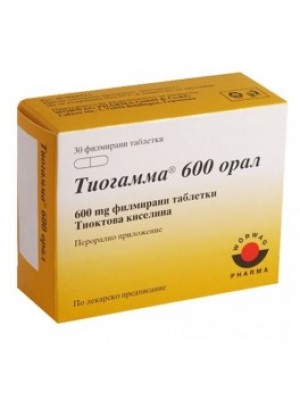
TIOGAMA table. 600 mg. 30 table WHAT TIOGAMMA 600 ORAL AND W..
32.00€
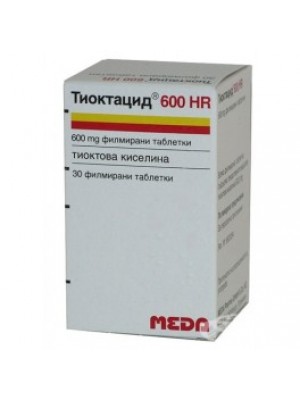
HR 600 TIOKTATSID table. 30 table Qualitative and quantitati..
45.00€

THIOGAMMA TURBOSET 600 mg. / 50 ml. 5 ampules
WHAT THIO..
48.00€