
Your shopping cart is empty!
Welcome visitor you can login or create an account.
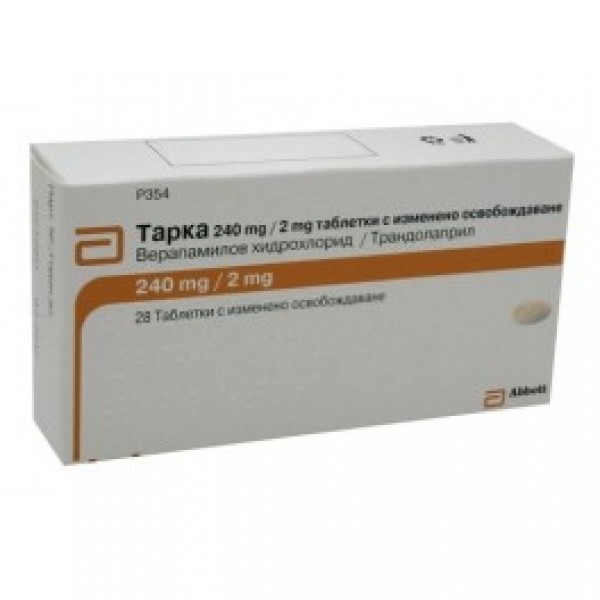
Tarka retard caps. 240 mg. / 2 mg. 28 caps
Product Code: Tarka retard caps. 240 mg. / 2 mg. 28 caps
Availability: In Stock
Product viewed: 1064


Tarka retard caps. 240 mg. / 2 mg. 28 caps
WHAT IS Tarka AND WHAT IT IS USED FOR?
Tarka is a drug containing a combination of two active substances in different ways lower blood pressure. Tarka is used for essential hypertension in patients whose blood pressure was normalized with the individual active substances in the same dosage.
WHAT YOU SHOULD KNOW BEFORE YOU TAKE Tarka
You should not take Tarka:
-In case of hypersensitivity (allergy) to trandolapril or any other ACE inhibitor and / or verapamil or any of the excipients
If you have swelling of the skin, and subcutaneous tissue (angioedema), prior treatment with an ACE inhibitor;
Hereditary angioneurotic edema or such without known cause;
Cardiovascular shock;
A recent heart attack with complications;
Severe cardiac conduction abnormalities (Y. AV-blokII. or level) and not wearing a pacemaker;
If you have a breach in the conductivity of the left atrium (SA-block);
If you have a failure in the event of cardiac impulse into the left atrium (syndrome sick sinus) and not wearing a pacemaker;
Congestive heart failure;
Atrial flutter / fibrillation in association with additional wire (eg, WPW-syndrome) - severe renal impairment (creatinine clearance <10 ml / min);
If you are on dialysis;
Severe hepatic impairment (liver cirrhosis) the collection of fluid in the abdomen (ascites);
Narrowing of certain heart valves (aortic or mitral-);
Thickening of the muscle sadechniya with difficulty pushing blood (hypertrophic obstructive cardiomyopathy);
Overproduction of the hormone aldosterone by the adrenal cortex (primary aldosteronism);
Pregnancy, lactation;
Use in children and adolescents (<18 years) Take special care with Tarka
When stimulated renin-angiotensin-aldosterone system (eg water or salt-depleted by the use of diuretics, low sodium diet, dialysis, diarrhea or vomiting, left ventricular failure, renovascular hypertension);
In renal function or congestive heart failure, as it can cause severe deterioration of renal function with increased levels of potassium in your blood;
Increased elimination of normal urine protein excretion (proteinuria);
Severe impairment of liver function, as there is not enough experience;
If you experience swelling of the face, tongue, throat or limbs (angioneurotic edema), you should stop using the product and seek medical attention, when treated with ACE inhibitors was observed higher incidence of angioedema in colored patients than in Caucasian subjects;
Degree of renal impairment, particularly when it is associated with connective tissue disease, eg. systemic lupus erythematosus, scleroderma and simunosupresivni treatment products;
During treatment with an ACE inhibitor may occur dry or nonproductive cough, which resolved after withdrawal of the drug;
For surgery requiring general anesthesia, because ACE inhibitors can cause hypotension;
For minor infringements of conduction of the heart;
In slow heartbeat (less than 50 beats / min);
Diseases in which abnormal neuromuscular conduction (myasthenia gravis, Lambert-Eaton, advanced muscular dystrophy Duchenne);
Hemodialysis patients;
LDL-apheresis when co-administered with ACE inhibitors because of the likelihood of life-threatening reactions;
Children and adolescents
Children and adolescents (<18 years) should not take Tarka.
Elderly
Tagka been studied only in a limited number of elderly patients with hypertension. Available data indicate that plasma concentrations of Tagka are higher in elderly patients compared to younger patients. Some elderly fall in blood pressure may be more pronounced than others. It is recommended that assessment of renal function after initiation of treatment.
Pregnancy and lactation
Tagka should not be taken during pregnancy and lactation.
Effects on ability to drive and use machines
Although no effect on ability to drive and use machines can ever be ruled deterioration of attention as Tarka can cause dizziness and fatigue. This is particularly true during concomitant use with alcohol.
Special attention
Tarka contains lactose, therefore you must tell your doctor if you have an zahar.Edna Tarka tablet contains 1.12 mmol (25.76 mg) of sodium. If Wall sodium diet, you should keep in min
Interactions with other medicinal products
Please tell your doctor or pharmacist if you are taking other medicines or have recently taken any, although they were not prescription. During concomitant use of these drugs Tarka may affect their action:
Potassium-sparing diuretics or potassium supplements: should be avoided because concomitant administration may increase the potassium level in the blood, especially in patients with renal impairment.
Dantrolene: not recommended.
Medicines to lower blood: the efforts of the hypotensive action Tagka. Diuretics: may experience an excessive drop in blood pressure, particularly in patients with salt and / or water deficit;
Lithium: amplification and weakening of lithium, may decrease excretion of lithium.
Anesthetics: may increase the blood pressure lowering effect of some anesthetics. Narcotic drugs / antisihotitsi: possible occurrence of hypotension upon standing (orthostatic hypertension).
Allopurinol (for gout), cytotoxic (cancer), immunosuppressive (suppress the immune system), certain hormones (systemic corticosteroids), procainamide (anti arrhythmias): can lead to a decrease in white blood cells.
Heart medicines (eg, beta-blockers, antiarrhythmics, inhalation anesthetics): can be side effects further.
Quinidine (antiarrhythmics): in a few cases in patients with thickening of the heart muscle (hypertrophic cardiomyopathy) with concomitant use of verapamil (a component of Tarka) is hypotension.
Digoxin: possible 50-75% increase in plasma digoxin concentrations, which requires a reduction of dose of digoxin.
Mgyurelaksanti: the effect of muscle relaxants may be potentiated. Sedatives / antidepressants: when combining products containing imipramine increased risk of hypotension upon standing.
NSAIDs: Can reduce the antihypertensive effects of Tarka, increase potassium balance in the blood and impair kidney function.
Antacids: decreased bioavailability of trandolapril (an ingredient of Tarka). Sympathomimetics: it is possible to reduce the antihypertensive effect of Tarka.
Carbamazepine (for epilepsy), cyclosporine (to suppress the immune system) and theophylline (for asthma): may increase levels of these drugs.
Rifampicin (for tuberculosis), phenytoin and phenobarbital (epilepsy): effect of lowering Tarka.
Cimetidine (a medicine to reduce stomach acidity): increases the effect of Tarka.
Antidiabetic: enhanced low blood sugar.
Concomitant use of Tarka with food and drink
During the use of Tarka should not drink alcohol because of increased hypotensive effect of Tarka.
Tarka should not be taken with grapefruit juice, because verapamil (one of the active ingredients in Tarka) may increase its effect under the influence of geypfrut.
Food intake leads to delayed absorption of verapamil (one of the active ingredients in Tarka), Tarka therefore should be taken half an hour before breakfast.
HOW TO TAKE Tarka?
Tarka Always take as directed by your doctor. Please ask your doctor or pharmacist if you are unsure.
Tarka tablets with modified release should be swallowed whole with sufficient liquid (preferably with a glass of water).
Unless otherwise prescribed the usual dose is:
1 tablet Tarka modified-release, once daily, in the morning, half an hour before breakfast. Tarka tablets should be swallowed tseli.Molya tell your doctor or pharmacist if you think that the effect of Tarka is too strong or too weak.
If you take too much Tarka:
The highest tested in clinical trials of trandolapril dose is 16 mg. This dose does not cause symptoms of intolerance. Generally, overdosage should lead to lower blood pressure.
Signs of overdosage with verapamil are depending on its effect on the cardiovascular system. These are low blood pressure, heart failure and cardiac arrhythmias. If overdose is suspected, seek medical attention
If you forget to take Tarka:
Do not take a double dose if you have forgotten the last.
Interruption of the use of Tarka:
With the exception of emergencies such as angioneurotic edema, Tarka should not be interrupted arbitrarily. Please talk beforehand with your doctor.
WHAT ARE POSSIBLE SIDE EFFECTS?
As with all medicines, Tarka can cause side effects.
In the assessment of adverse effects, the following definitions apply:
Very common: More than 1 in 10 treated
Common: less than 1 in 10 and more than 1 in 100
Not often: less than 1 in 100 or 1 in 1,000
Rare: less than 1 in 1000 and more than 1 in 10,000 treated
Very rare: less than 1 in 10,000, including single cases
The following side effects have been observed during treatment with Tarka:
Common: headache, constipation, flushing, cough, dizziness, vertigo;
Uncommon: allergic reactions, increased blood lipids, somnolence, tremor, extend the time for submission of the cardiac impulse (AV-block level I.), palpitations, stomach pain, diarrhea, gastrointestinal complaints, nausea, swelling of the face, pruritus, urticaria, sweating, frequent urination, pain in the chest, changes in liver function tests;
Rare: anorexia, seizures, hair loss caused by flammable herpes viruses manifestation of skin disease, increased bilirubin;
Very rare: decreased number of white blood cells, reduced numbers of all blood cells, low blood platelets, aggressive behavior, anxiety, depression, nevrnost, abnormal weight gain, insomnia, hypersensitivity, numbness, tingling, cold extremities, loss of consciousness or acute circulatory shock with loss of consciousness, abnormal taste, weakness, poor / blurred vision, angina pectoris, atrial fibrillation, severe conduction abnormalities (AV-block II., and III. extent), slow heartbeat, heart failure, stroke bleeding, swelling around the ankles, flushing, heart failure, sudden drop in blood pressure upon standing, increased heart rate, asthma, bronchitis, shortness of breath, sinus congestion, dry mouth, inflammation of the pancreas, vomiting, obstruction of bile tract, liver inflammation, increase in certain enzymes (lipase, gamma-GT, LDH), jaundice, angioneurotic edema, acute skin disease with severe generalized reactions (erythema multiforme), dermatitis, psoriasis, urticaria, joint pain, muscle weakness, muscle hurts, acute renal failure, mammary glands in men, impotence, increased potassium levels in the blood, increase of certain enzymes in the blood (transaminases, alkaline phosphatase);
HOW TO KEEP Tarka?
Store in a place out of sight and reach of children.
Do not use after the markings on the package shelf.
Store in original container.
Store at temperatures below 25 ° C.
Active substances in verapamil hydrochloride Tarka are prolonged-release and trandolapril. 1 tablet Tarka prolonged release contains verapamil hydrochlorid SR and trandolapril-angiotensin converting enzyme (ACE inhibitor).
Other ingredients: corn starch, lactose monohydrate, povidone, hypromellose, sodium stearyl fumarate, microcrystalline cellulose, sodium alginate, magnesium stearate, hyprolose, macrogol, talc, silica visokodispergiran, docusate sodium, titanium dioxide (E171), iron oxide and hydroxide (E172).
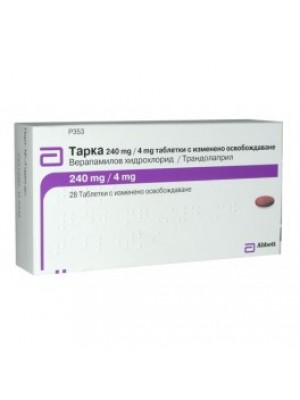
Modified-release tablets consist of a layer containing verapamil hydrochloride extended release and a second layer containing trandolapril with fast osvbozhdavane.Tarka comes in packs of 28 modified-release tablets. Pink, oval tablets, engraved with the logo of "Knoll" and "182" on one side
Write a review
Your Name:Your Review: Note: HTML is not translated!
Rating: Bad Good
Enter the code in the box below:
Related Products
Tarka retard caps. 240 mg. / 4 mg Active substances in verap..
42.00€
Tarka retard 240 mg. / 4 mg. 28 capsulesTarka active substan..
32.00€
Tarka 240 mg. / 2 mg. 28 capsulesTarka WHAT IS AND WHAT IS U..
29.00€
Tarka 240 mg. / 4 mg. 28 capsulesTarka WHAT IS AND WHAT IS U..
38.00€