Your shopping cart is empty!
Welcome visitor you can login or create an account.
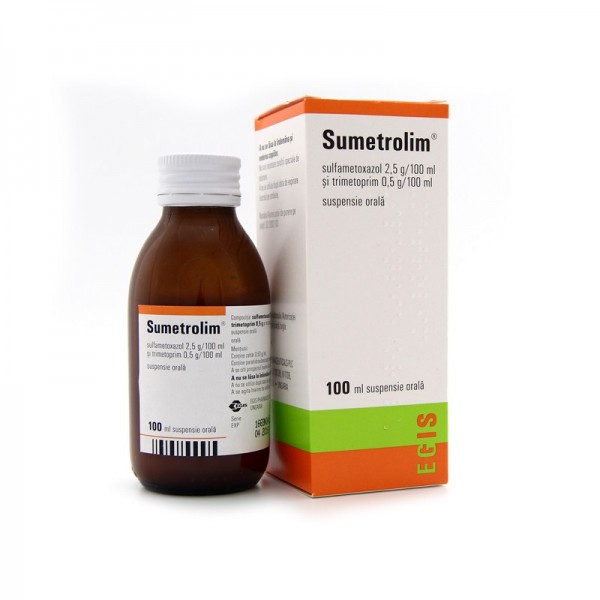
SUMETROLIM 100ml.
Product viewed: 2508


What is Sumetrolim Syrup and what it is used for
Sumetrolim is a combination of sulphonamide and trimethoprim, which has an antimicrobial effect.
The medicament is used to treat a variety of infections susceptible to the combination such as:
Infections of the respiratory tract: bronchitis, sinusitis, inflammation of the middle ear, some types of pneumonia;
Infections of the digestive system: inflammatory bowel disease, "travel diarrhea", typhus typhus;
Urinary and kidney infections: acute cystitis;
Infections of the sexual system: inflammatory diseases of the small pelvis in women, certain types of urethra inflammation;
Skin and soft tissue infections: boils (inflamed hair follicles containing pus), abscesses, infected wounds;
Other bacterial infections: acute brucellosis (in combination), cat scratch disease, prophylaxis and treatment of toxoplasmosis, etc.
Bladder syrup is used in children and adolescents aged 6 weeks to 18 years and in adults.
2. What you need to know before using Sumatrolim Syrup
Do not take Sumerolimus syrup:
If you or your child are allergic to sulfamethoxazole or trimethoprim or any of the other ingredients of this medicine (listed in section 6);
If you or your child have had allergic reactions to a chlorophonamide derivative or substance of similar chemical structure (eg some infections medicines, sulfonylureas, antidiabetics or thiazide diuretics);
If you or your child suffer from acute hepatitis, severe hepatic failure or a metabolic disease (porphyria);
If you or your child have a blood disorder, anemia associated with lack of folic acid, deficiency of a known protein (glucose-6-phosphate dehydrogenase enzyme deficiency);
If you or your child have severe kidney failure (unless you are on hemodialysis);
If you are pregnant or breast-feeding;
During the course of chemotherapy;
Bladder syrup should not be given to infants during the first 6 weeks after birth or to premature babies under 1 year of age. In newborns under 3 months of age, this medicine can only be used in exceptional cases if prescribed with strict individual need.
Warnings and precautions
Talk to your doctor or pharmacist before using Sumatrolim.
Potentially life-threatening skin rashes (Stevens-Johnson syndrome, toxic epidermal necrolysis) that originally appeared as reddish-like spots or round spots, often blistering, have been reported with the use of Sumemerim.
Additional symptoms to be monitored include ulcers in the mouth, throat, nose, genitals and conjunctivitis (redness and swelling of the eyes).
These potentially life-threatening skin rashes are often accompanied by symptoms resembling influenza. The rash may progress to widespread peeling or flaking of the skin.
The risk of serious skin reactions is highest during the first weeks of treatment. If you have developed Stevens-Johnson syndrome or toxic epidermal necrolysis during treatment with Sumatrolim, you should not be treated with Sumetrolim again.
If you get rash or similar skin symptoms, stop using Sumitromycin immediately, seek medical advice and tell your doctor if you are taking this medicine.
If any of the following applies to you, you should tell your doctor before using this medicine:
If you are being treated for a severe allergic reaction or asthma;
If you suffer from any of the following conditions: immune deficiency, hemodialysis, chronic alcoholism, acquired immune deficiency syndrome (AIDS), chronic liver disease, malabsorption syndrome or malnutrition, because the side effects are more common;
If you suffer from kidney disease because you may need lower doses and frequent monitoring of blood potassium levels;
If you have thyroid disease or if you or your close relative suffers from porphyria (a rare metabolic disorder) because both drugs may cause symptoms to get worse;
Elderly people are more prone to side effects during treatment with Sumatrolimus, especially if they have concomitant illnesses (liver and kidney problems) and if you are using other medicines at the same time;
In patients with X-linked chromosome-related mental illness, this drug may exacerbate symptoms;
If you have the so-called phenylketonuria because the metabolism of phenylalanine (amino acid) can be aggravated by one drug substance (trimethoprim) (mainly when the diet is not followed);
Because of the risk of hypoglycaemia and crystalluria, it is important to take a large amount of fluids in the first few days (see section 3 "How to use Sumerolimus").
Other medicines and Sumerolimus syrup
Tell your doctor or pharmacist if you are taking, have recently taken or might take any other medicines.
In particular, tell your doctor or pharmacist if you are taking any of the following medicines:
diuretics (drainage tablets, such as acetazolamide, thiazides) that help increase the amount of urine output;
spironolactone (the so-called potassium-sparing diuretic). Co-administration of Sumatrolim with diuretics containing spironolactone may result in severe hyperkalaemia (increased blood potassium levels). Symptoms of severe hyperkalemia include muscle spasms, irregular heartbeat, diarrhea, nausea, dizziness or headache;
pyrimethamine used for the treatment and prevention of malaria, as well as for the treatment of diarrhea;
ciclosporin used after transplantation or for your immune system;
medicines used to thin the blood like warfarin;
phenytoin used to treat epilepsy (seizures);
certain diabetes medicines such as glibenclamide, glipizide (sulfonylureas);
medicines to treat heart rhythm problems such as digoxin or procainamide;
amantadine used to treat Parkinson's disease, influenza or herpes zoster;
certain medicines for the treatment of HIV (human immunodeficiency virus) called zidovudine or lamivudine;
medicines that can increase the amount of potassium in your blood;
methotrexate, a medicine used to treat cancer, rheumatoid arthritis or psoriasis;
medicines called non-steroidal anti-inflammatory drugs (NSAIDs), including indomethacin, used to relieve pain;
certain medicines to treat depression (tricyclic antidepressants).
More frequent blood clotting, blood glucose levels or, in some cases, the levels of medicines that are taken together with Sumerolimus should be investigated.
During treatment with Sumatrolim, do not take any other medicines, with or without a prescription, without consulting your doctor.
Pregnancy and breastfeeding
If you are pregnant or are breast-feeding, think you may be pregnant or plan to become pregnant, ask your doctor or pharmacist for advice before taking this medicine.
Both drug substances of this drug affect the metabolism of folic acid, which is extremely important for the development of the fetus, so Sumerolimus should not be taken by pregnant women unless the doctor's decision and instruction is such.
It is excreted into the breast milk so it should not be used during breast-feeding. If administration of the medicinal product is necessary, breast-feeding should be discontinued for the duration of treatment and for the next 3 days as the infant should be breast-feeding from another mother or artificial feeding.
Driving and using machines
There is no data indicating that the medicine affects the ability to drive and use machines.
Supercharged syrup contains sucrose, Ariavit ponso 4R (E124), methyl parahydroxybenzoate and aniseed-flavored spirit.
1 ml of syrup contains 0.53 g of sugar to be considered for diabetes mellitus. If your doctor has told you that you have an intolerance to some sugars, talk to your doctor before using this medicine. If the treatment lasts for more than two weeks, the syrup can damage the teeth;
"Ariavit plus 4R" (E124) and methyl parahydroxybenzoate, which may cause allergic reactions (may be postponed);
This syrup contains a small amount of alcohol - less than 100 mg per dose (1 ml of syrup contains 1,175 mg of alcohol).
3. How to use Sumatrolim Syrup
Always use this medicine exactly as your doctor has told you. If you are not sure, ask your doctor or pharmacist.
The syrup should be taken with enough liquid twice a day (morning and evening), preferably after a meal. A polypropylene measuring cup with a 1 ml syringe spacing is placed on the bottle cap. 4 ml of syrup contains 20 mg of trimethoprim and 100 mg of sulfamethoxazole.
Make sure you take enough fluids - at least 1.5 liters per day - during treatment. If you are taking this medicine to your child, be sure to take frequent fluids.
For long-term treatment, your doctor will require regular blood counts and liver function tests and renal function tests. Folic acid may also be prescribed, which would not jeopardize the antimicrobial efficacy of the treatment, but can still counteract the haematological side effects of long-term drug administration.
Since Sumacrolim can cause photosensitivity, you should avoid exposure to direct sunlight or should be protected with protective clothing and / or photo-protective preparations during treatment.
Unless otherwise prescribed by your doctor, the recommended doses are:
Adults and children over 12 years: 32 ml of syrup administered twice a day (morning and evening) and 2 x 16 ml of syrup in long-term maintenance treatment. The maximum daily dose is 2 x 48 ml syrup.
Use in children (from 6 weeks to 12 years)
The recommended dose in children is equivalent to approximately 6 mg of trimethoprim and 30 mg of sulfamethoxazole per kg bodyweight per day administered in two intakes.
The child administration schedules are tailored to the age and body weight of the child and are given in the table below:
Age Recommended dose
6 weeks to 6 months 2-4 ml syrup twice a day
6 months to 2 years 4-8 ml syrup twice a day
2 to 6 years 8-12 ml syrup twice a day
6 to 12 years 12-16 ml syrup twice a day
Special patient groups
In renal impairment, the dose should be changed by the physician based on renal function and the type of infection.
In the elderly the dosage is determined by the physician according to the severity of the infection and by taking into account concomitant diseases and concomitant use of other drugs. In patients with reduced renal function, the dose should be changed accordingly.
If you take more Sumerolimus than you should
Contact your doctor immediately. Possible symptoms of overdose: dizziness, nausea, vomiting, diarrhea, headache, jaundice (on the skin or whites of the eye), decreased urination, dark colored urine, coma.
If you forget to take Sumatromil
Take the missed dose as soon as possible but only if there is enough time until the next dose. However, if it is time for the next dose, do not take a double dose to make up for the missed dose. This will not compensate for it, and you risk overdosing.
If you stop taking Sumerolim
For complete recovery, it is important to take your syrup for as long as prescribed, even if your symptoms improve before the end of the treatment.
If you have any further questions on the use of this medicine, ask your doctor or pharmacist.
4. Possible side effects
Like all medicines, this medicine can cause side effects, although not everyone gets them.
If taken at recommended doses, this drug is usually well tolerated. The most common side effects are diarrheal and skin allergic reactions.
In very rare cases, serious and sometimes fatal side effects and acute hypersensitivity reactions affecting both the entire body and specific organs (eg skin, liver, lungs, haematopoietic organs) may occur. Severe consequences can be avoided if the instructions are strictly observed and the symptoms are recognized early.
Potentially life-threatening skin rashes (Stevens-Johnson syndrome, toxic epidermal necrolysis) have been reported very rarely (see section 2).
Stop using Sumerolim,
Stop taking Sumerolim syrup and contact your doctor if you experience any of the following symptoms:
new coughing and difficulty in breathing;
fever, sore throat and joints that can not be explained for other reasons;
spot-like skin bleeds all over the body;
yellowing of the eyes and skin, dark urine;
skin rashes similar to burning.
Like other antimicrobial medicines, Sumerolim can also cause so-called diarrhea associated with antibiotic therapy. Talk to your doctor if you have persistent and severe diarrhea during treatment with Sumatrolimus.
Very common (may affect more than 1 in 10 people):
high levels of potassium in the blood (which can lead to severe cases of muscle spasms and abnormal heart rhythm).
Common (may affect up to 1 in 10 people):
an infection called a thrush or candida that can affect the mouth or vagina. It is caused by fungi;
headache;
nausea (vomiting);
diarrhea;
allergic skin rashes.
Uncommon (may affect up to 1 in 100 people):
malaise (nausea).
Rare (may affect up to 1 in 1,000 people):
inflammation of the tongue;
inflammation of the mouth.
Very rare (may affect up to 1 in 10,000 people):
reducing the number of white blood cells, making infections more likely;
reducing the number of blood platelets, which increases the risk of bleeding and bruising;
feeling weak, fatigue or apathy, pale skin (anemia);
methaemoglobinaemia (a disorder characterized by the presence of a higher level of methaemoglobin in the blood, resulting in a total reduction in the ability of red blood cells to release oxygen to the tissues);
increased number of eosinophils in the blood (certain types of white blood cells);
allergic reactions with rash, pruritus and hives, fever symptoms, joint swelling and joint pain, muscle aches, swollen lymph nodes and / or flu-like symptoms (signs of serum sickness;
inflammation of the heart;
severe allergic reactions that cause swelling of the face or throat;
fever;
violet skin rash, abdominal pain, joint inflammation, blood in stools, blood in the urine (purple of Henoch-Schonlein);
inflammation of the blood vessels (periarthritis nodosa);
systemic lupus erythematosus (a disease affecting your natural defense system);
low blood sugar;
low levels of sodium in the blood (which can lead to severe cases of fatigue and confusion, muscle twitching, convulsions and coma);
Lack of appetite;
view of strange and unusual images (hallucinations);
depression;
sudden headache or numbness of your neck accompanied by fever (meningitis);
seizures (convulsions or convulsions);
peripheral neuritis (weakness, tingling or numbness of the hands and feet);
difficulty controlling muscle movements;
feeling dizzy or dizzy;
ringing or other unusual sounds in your ears;
eye inflammation;
coughing;
dyspnoea;
inflammation of the pancreas, which causes severe pain in the abdomen and back;
increased levels of bilirubin in the blood and some liver and kidney function parameters;
hepatic inflammation;
photosensitivity;
skin irritation with scaling, rash, erythema;
severe skin reactions: Stevens-Johnson syndrome and toxic epidermal necrolysis;
pain in the muscles or joints;
impaired kidney function (sometimes renal insufficiency has been reported);
increased levels of liver enzymes.
Not known (can not be estimated from the available data):
weakness;
fatigue;
insomnia;
apathy.
In addition to the above-mentioned side effects urinary crystals can be observed.
How to Store Sumatrol Syrup
Store below 25 ° C.
Keep out of the reach and sight of children.
Do not use this medicine after the expiry date which is stated on the package. The expiry date refers to the last day of that month.
Do not dispose of medicines in the sewage system or in the household waste container. Ask your pharmacist how to dispose of medicines you no longer use. These measures will help to protect the miserable environment.
6. Package Contents and Additional Information
What Sweetrolim Syrup Contains
The active substances are: 25 mg of sulfamethoxazole and 5 mg of trimethoprim in each ml of syrup.
The other ingredients are: Ariavitus ponso 4R (E 124), methyl parahydroxybenzoate, aniseed alcohol, ketrol (xanthan gum), sucrose sodium, purified water.
What it looks like and what the pack contains
Violet-pink syrup, with a sweet taste, thick and free of granules, aniseed-flavored with a bitter bitter aftertaste.
100 ml syrup in a dark glass bottle with a drain cap and a 5 ml polypropylene measuring cup are placed in a folded carton together with the patient leaflet.
Write a review
Your Name:Your Review: Note: HTML is not translated!
Rating: Bad Good
Enter the code in the box below:
Related Products