Your shopping cart is empty!
Welcome visitor you can login or create an account.
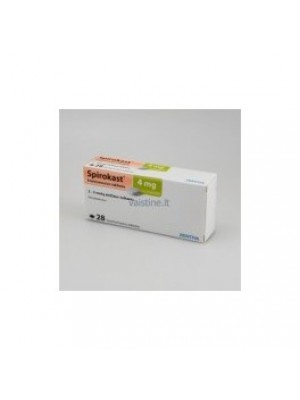
SPIROKAST 5 mg. 28 tablets
Product Code: SPIROKAST 5 mg. 28 tablets
Availability: In Stock

Product viewed: 1127


SPIROKAST 5 mg. 28 tablets
What is Spirokast and what it is used
The active ingredient is montelukast Spirokast which is a leukotriene receptor antagonist that blocks substances called leukotrienes. Leukotrienes cause narrowing and swelling of airways in the lungs. By blocking leukotrienes Spirokast improves the symptoms of asthma and contributes to controlling its.
Your doctor has prescribed Spirokast to treat your child's asthma, preventing daytime and nighttime symptoms of asthma:
Spirokast be used to treat patients who do not respond adequately to treatment or in need of further treatment;
Spirokast can be used as an alternative treatment of inhaled corticosteroids in patients who have not used shortly oral corticosteroids for treatment of their asthma and have shown that they can not use inhaled corticosteroids;
Spirokast also helps to protect the airways from narrowing in the effort.
Spirokast 5 mg chewable tablet is suitable for patients 6 to 14 years of age.
Your doctor will determine how to take Spirokast depending on the symptoms and severity of asthma in your child.
What is asthma?
Asthma is a chronic disease, which includes:
Difficulty breathing because of narrowed airways. This narrowing worsens or improves in response to various conditions;
Sensitive airways that react to many things such as cigarette smoke, pollen, cold air or effort;
Swelling (inflammation) of the mucosa of the respiratory tract.
Symptoms of asthma include coughing, wheezing and tightness of the chest.
2. What you need to know before taking Spirokast
Tell your doctor about any medical problems or allergies your child has or has had.
Do not give your child Spirokast:
if allergic to montelukast (the active ingredient) or any of the other ingredients of this medicine (listed in section 6).
Warnings and Precautions
If your asthma or breathing your child gets worse, tell your doctor immediately.
Spirokast is not for treatment of acute asthma attacks. If an attack occurs, follow the instructions given by your doctor for you or your child. Always wear inhaled rescue medicine for asthma in your child with you. It is important that your child take all asthma medications that your doctor prescribed. Spirokast should not be used instead of other asthma medications your doctor has prescribed for your child.
Each patient receiving anti-asthma medicines, be aware that if you develop a combination of symptoms such as flu-like illness, numbness and tingling in the arms or legs, worsening of pulmonary symptoms and / or rash, you should consult with your doctor.
Your child should not take acetyl-salicylic acid (aspirin) or anti-inflammatory drugs (also known as non-steroidal anti-inflammatory drugs or NSAIDs) if they worsen his asthma.
children
For children 6 to 14 years is available Spirokast 5 mg chewable tablet.
Other medicines and Spirokast
Some medicines may affect the action of Spirokast or Spirokast may affect the way other medicines taken by your child.
Tell your doctor or pharmacist if your child is taking, has recently taken or might take any other medicines.
Tell your doctor if your child has any of the following medicines before starting taking Spirokast:
Phenobarbital (used for the treatment of epilepsy);
Phenytoin (used for the treatment of epilepsy);
Rifampicin (used for the treatment of tuberculosis and other infections).
Spirokast food, beverages and alcohol
Spirokast chewable tablets should be taken 1 hour before or 2 hours after eating.
Pregnancy, lactation and fertility
If you are pregnant, think you may be pregnant or planning to become pregnant, ask your doctor or pharmacist before taking this medicine. Your doctor will decide whether you can take montelukast during this period.
It is not known whether monteluksat passes into breast milk. If you are breastfeeding or plan to breastfeed, you should consult with your doctor or pharmacist before taking this medicine.
Driving and using machines
This section does not apply to Spirokast chewable tablets since they are intended for children, however, the following information relates to the active ingredient, montelukast.
Spirokast not expected to affect the ability to drive a car or operate machinery. However, individual responses to medication may vary. Some side effects (such as dizziness and drowsiness) that have been reported very rarely Spirokast may affect some patients' ability to drive or operate machinery.
Spirokast chewable tablets contain aspartame, a source of phenylalanine.
May be harmful for people with phenylketonuria.
3. How to take Spirokast
Always take this medicine exactly as prescribed by your doctor. If you are not sure, ask your doctor or pharmacist.
The recommended dose is:
Children between 6 and 14 years: one chewable tablet Spirokast 5 mg once daily. The tablet should be taken at night, at least 1 hour before or 2 hours after a meal.
If your child has taken more than the amount Spirokast
If your child accidentally take more dose Spirokast, or if someone else has taken your medicine by mistake, contact your doctor immediately.
There were no side effects in the majority of cases of overdose.
The most commonly observed adverse reactions in overdose in adults and children included abdominal pain, insomnia, thirst, headache, vomiting and hyperactivity.
If you forget to give your child Spirokast
Try to give Spirokast as prescribed. However, if your child forgets to take a dose, continue your regular schedule of taking a tablet once a day.
Do not give a double dose to make up the missed dose.
If your child stops taking Spirokast
Spirokast can treat your child's asthma only if he continues taking it.
It is very important for your child to continue taking Spirokast as long as your doctor prescribes. This will help control your child's asthma.
It should be taken even when your child has no symptoms or has an acute asthma attack.
If you have any further questions on the use of this medicine, ask your doctor or pharmacist.
4. Possible side effects
Like all medicines, this medicine can cause side effects, although not everybody gets them.
In clinical trials with chewable tablets containing 4 mg of montelukast, the most commonly reported side effects (affecting up to 1 in 10 pediatric patients treated) were abdominal pain and thirst.
In clinical trials with chewable tablets containing 5 mg of montelukast, the most commonly reported side effect (affecting up to 1 in 10 pediatric patients treated), was headache.
Furthermore, after the release of the product have been reported following reactions:
Very common (may affect more than 1 in 10 patients):
Infection of the upper respiratory tract.
Common (may affect up to 1 in 10 patients):
Diarrhea, nausea, vomiting, elevated liver enzymes, itching, fever.
Uncommon (may affect up to 1 in 100 patients):
Allergic reactions (including rash, swelling of the face, lips, tongue and / or throat that may cause difficulty in breathing or swallowing), sleep disorders (eg. Nightmares), insomnia, sleep walking, irritability, hostility, anxiety, restlessness , agitation including aggressive behavior, depression, dizziness, somnolence, paresthesia (numbness and tingling), convulsions, bleeding from the nose, dry mouth, indigestion, bruising, hives, itching, pain in muscles and joints, muscle cramps, fatigue , tiredness, swelling (edema).
Rare (may affect up to 1 in 1000 patients):
Increased bleeding tendency, not volitional movements (tremor), increased heartbeat, rapid swelling of the skin (angioedema).
Very rare (may affect up to 1 in 10,000 patients):
Liver problems (hepatic eosinophilic infiltration), hallucinations, suicidal thoughts, influenza like illness, increased shortness of breath, numbness and tingling of the extremities, and / or rash (syndrome Churg-Strauss), inflammation of the liver (hepatitis), sensitive red nodes under skin, most commonly in the tibia (erythema nodosum).
In asthmatic patients treated with montelukast, have been reported very rarely cases of combined symptoms such as flu-like illness, numbness and tingling in the arms and legs, worsening of pulmonary symptoms and / or rash (syndrome Churg-Strauss). You should inform your doctor immediately if one or more of these symptoms occur in your child.
If your child experiences any side effects, please tell your doctor or pharmacist. This includes any possible effects not listed in this leaflet.
5. How to store Spirokast
Keep out of the reach and sight of children.
Store in the original package in order to protect from light.
Spirokast not use after the expiry date stated on the blister and carton after "EXP". The expiry date refers to the last day of that month.
Do not use this medicine if you notice any visual signs of deterioration (discoloration, etc.).
Do not dispose of medications in wastewater or household waste. Ask your pharmacist how to dispose of medicines no longer required. These measures will help to protect the environment.
6. Contents of the pack and other information
What Spirokast
The active ingredient is montelukast (montelukast sodium).
One chewable tablet contains montelukast sodium (montelukast sodium), equivalent to 5 mg of montelukast.
The other ingredients are: microcrystalline cellulose, mannitol, crospovidone type B, red iron oxide (E 172), hydroxypropyl cellulose, edetate disodium, cherry flavor, aspartame (E951), talc, magnesium stearate.
Spirokast looks like and contents of the pack
Spirokast 5 mg chewable tablets are pink, round, biconvex tablets, engraved with "M5" on one side.
Write a review
Your Name:Your Review: Note: HTML is not translated!
Rating: Bad Good
Enter the code in the box below:
Related Products