Your shopping cart is empty!
Welcome visitor you can login or create an account.
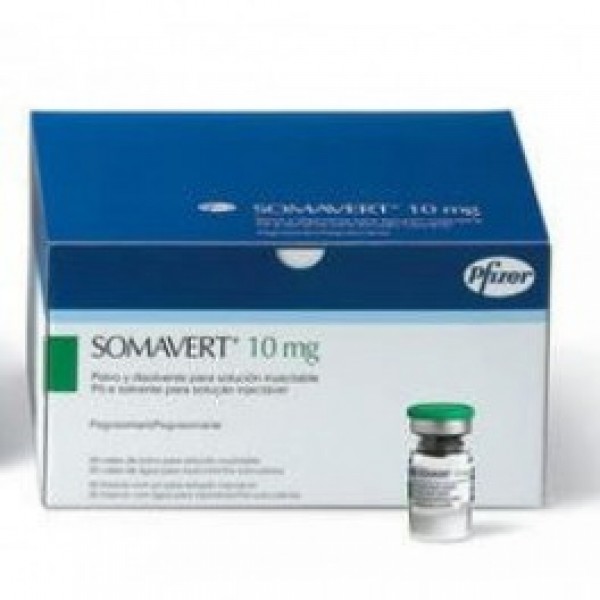
SOMAVERT 10 mg
Product Code: SOMAVERT 10 mg
Availability: In Stock
Product viewed: 1603


SOMAVERT 10 mg
WHAT SOMAVERT IS AND WHAT IT IS USED FOR?
SOMAVERT is used to treat acromegaly, a hormonal disorder resulting from increased secretion of growth hormone (GH) and IGF-I (Insulin-like growth factors), which is characterized by expansion of the bone, soft tissue swelling, heart disease and related this disorder.
SOMAVERT is a product of biotechnology. The active substance in SOMAVERT, pegvisomant is known as a receptor antagonist of growth hormone. These substances reduce the effects of GH and levels of IGF-I, circulating in the blood.
2. BEFORE YOU USE SOMAVERT
Do not use SOMAVERT:
• If you are allergic (hypersensitive) to pegvisomant or any of the other ingredients of SOMAVERT.
Take special care with SOMAVERT
- If while using SOMAVERT, experience disturbed vision or headaches, you should contact your doctor immediately.
- Your doctor or nurse will monitor the levels of IGF-I (insulin-like growth factors) circulating in the blood and, if necessary, adjust the dose of SOMAVERT.
- Your doctor should also monitor your adenoma (benign tumor).
- Your doctor or nurse will monitor the level of liver enzymes in the blood every 4-6 weeks for the first six months of treatment with SOMAVERT.
Administration of SOMAVERT should be discontinued if signs of liver disease.
- If you have diabetes, you may need your doctor to adjust the amount of insulin or other medicines you are taking.
- Female patients should use adequate contraception as fertility may be increased.
Taking other medicines:
You should tell your doctor if you have previously taken other medicines for the treatment of acromegaly or medicines for the treatment of diabetes.
Please tell your doctor or pharmacist if you are taking or have recently taken any other medicines, including medicines obtained without a prescription.
As part of the treatment may be given other medicines. It is important to continue to take all medicines as well as SOMAVERT, unless your doctor or pharmacist tells you otherwise.
Pregnancy and lactation:
The effects of SOMAVERT in pregnant women are not known and so the use of SOMAVERT in pregnant women is not recommended. You are advised to not become pregnant while being treated with SOMAVERT. If you become pregnant, you should consult your doctor. Ask your doctor or pharmacist before taking any medicine.
It is not known if SOMAVERT passes into breast milk. You should not breast-feed while taking SOMAVERT, unless your doctor has discussed this with you.
Driving and using machines:
No studies on the effects on driving and operating machinery. Important information about some of the ingredients of SOMAVERT
This product contains less than 1 mmol sodium (23mg) dose of 10 mg, less than 1 mmol sodium (23 mg) per 15 mg dose, or less than 1 mmol sodium (23 mg) per 20 mg dose ie contains virtually no sodium.
3. HOW TO USE SOMAVERT?
Always inject SOMAVERT exactly as your doctor tells you. If you are not sure, ask your doctor or pharmacist.
Your doctor will administer an initial dose of 80 mg SOMAVERT subcutaneously (just under the skin). Then, the usual daily dose of SOMAVERT is 10 mg, which is given by subcutaneous injection (just under the skin).
Every four to six weeks on the basis of so-called serum IGF-I, your doctor will make appropriate dose adjustments in increments of 5 mg pegvisomant / day to maintain an optimal therapeutic response.
Method and route of administration:
SOMAVERT is injected under the skin. The injection can be made by yourself or another person, for example your doctor or his assistant. Must follow the detailed instructions on injection procedure provided at the end of this leaflet. You should continue to inject SOMAVERT for as long as instructed by your doctor.
Before use SOMAVERT should be dissolved. The injection should not be mixed in the same syringe or vial as any other medicine.
Injection site may accumulate fat from the skin. To avoid this, each time, a different place for your injection as described in Step 2 of the "Guidelines for the preparation and injection Somavert" of this leaflet. This gives your skin and subcutaneous your area time to recover one injection before it receives another one in the same place.
If you have the impression that the effect of SOMAVERT is too strong or too weak, talk to your doctor or pharmacist.
If you use more than the amount of SOMAVERT
If you accidentally inject more SOMAVERT than told to by your doctor, it is unlikely to be serious, but you should immediately contact your doctor or pharmacist.
If you forget to use SOMAVERT
If you forget to give yourself an injection you should inject the next dose as soon as you remember and then continue to inject SOMAVERT as prescribed by your doctor. Do not inject a double dose to make up for forgotten individual doses.
If you have any further questions on the use of this product, ask your doctor or pharmacist.
4. POSSIBLE SIDE EFFECTS
Like all medicines, SOMAVERT can cause side effects, although not everybody gets them.
Common side effects (likely to occur in less than 1 in 10 patients) include:
• Headache, dizziness, sleepiness, uncontrolled trembling.
• Diarrhoea, constipation, nausea, vomiting, bloating, indigestion, gas.
• Sweating, itching, rash.
• Joint pain, muscle pain.
• Increased blood cholesterol, weight gain, increased blood glucose, increased appetite.
• Increased blood pressure.
• Bruising, bleeding or tenderness at the injection site, accumulation of fat under the skin at the injection site, swelling of extremities, weakness.
• Flu-like illness, fatigue.
• Increased levels of substances that measure the function of the liver. These can be seen in the results of blood tests.
• Abnormal dreams, problems sleeping.
Uncommon side effects (likely to occur in less than 1 in 100 patients) include:
• Decreased platelets in the blood, increased or decreased white cells in the blood, tendency to bleed.
• Decreased sense of touch, taste, migraine
• eyestrain, eye pain, inner ear problems
• Shortness of breath
• Dry mouth, increased saliva, tooth problems, hemorrhoids.
• Blood in the urine, protein in the urine, increased urine, kidney problems.
• Swelling of the face, dry skin, tendency to bruise, night sweats.
• induced arthritis.
• Increased fatty substances in the blood, low blood sugar.
• Fever, feeling abnormal, impaired healing.
• Anger, lack of interest, feeling confused, increased sex drive, panic attack, loss of memory.
If any of the side effects gets serious, or you notice other effects not listed in this leaflet, please tell your doctor or pharmacist.
About 17% of patients develop antibodies to growth hormone during treatment. The antibodies do not seem to interfere with the operation of SOMAVERT.
In some patients taking SOMAVERT, reported mild to severe allergic (anaphylactic) reactions. The symptoms of a serious allergic reaction may include one or more of the following: swelling of the face, tongue, lips or throat; wheezing or difficulty breathing (spasm of the larynx); skin rash all over the body, nettle rash (urticaria) or itching; or dizziness. If you experience any of these symptoms, immediately contact your doctor.
5. HOW TO STORE SOMAVERT?
Keep out of reach of children.
Do not use SOMAVERT after the expiry date stated on the carton and vial after "EXP". The expiry date refers to the last day of that month.
Store in a refrigerator (2 ° C - 8 ° C). Do not freeze. Keep the vials in the outer carton to protect from light.
After reconstitution SOMAVERT, it must be used immediately. Carefully dispose of any SOMAVERT solution that has not been injected.
Do not use SOMAVERT, if you notice that the solution is cloudy or contains particles.
Medicines should not be disposed of via wastewater or household waste. Ask your pharmacist how to dispose of medicines no longer required. These measures will help to protect the environment
6. FURTHER INFORMATION
What SOMAVERT?
- The active substance is pegvisomant.
- One vial contains 10 mg, 15 mg or 20 mg pegvisomant. After reconstitution with 1 ml of solvent, 1 ml of solution contains 10 mg, 15 mg or 20 mg pegvisomant
- The other ingredients are glycine, mannitol (E421), sodium phosphate dibasic anhydrous, sodium phosphate monobasic monohydrate.
- The solvent is water for injections. One vial of solvent contains 8 ml of water for injections.
SOMAVERT looks like and contents of the pack?
SOMAVERT is presented as a powder and solvent for solution for injection in a vial. Powder in vial (10 mg, 15 mg or 20 mg pegvisomant) and solvent in a vial (8 ml). Pack size of 1 and 30. Not all pack sizes may be marketed. The powder is white and the solvent is clear and colorless.
Marketing Authorisation Holder
Pfizer
producer
Pfizer
Write a review
Your Name:Your Review: Note: HTML is not translated!
Rating: Bad Good
Enter the code in the box below:
Related Products