Your shopping cart is empty!
Welcome visitor you can login or create an account.
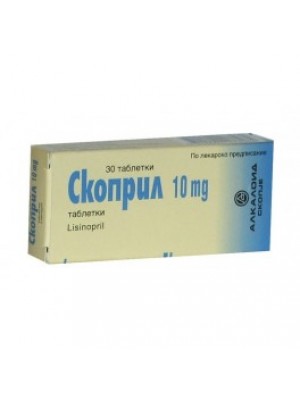
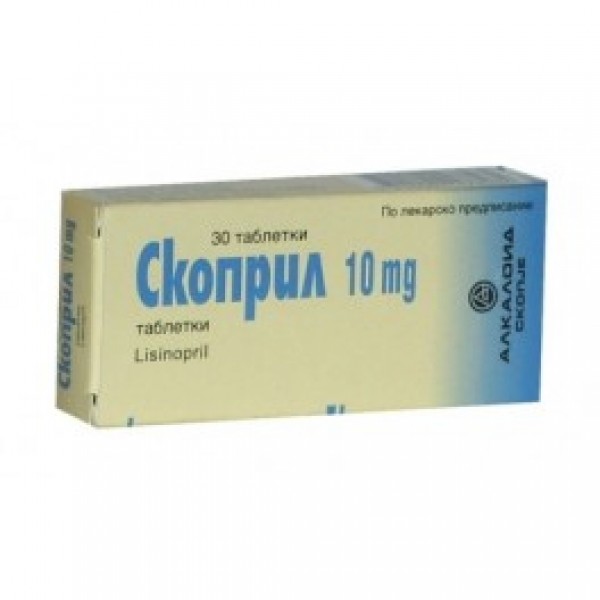
Skopryl 10 mg. 30 tablets
Product Code: Skopryl 10 mg. 30 tablets
Availability: In Stock
Product viewed: 2163


Skopryl 10 mg. 30 tablets
Active substance:
Each tablet contains 10 mg lisinopril (as dihydrate): Excipients; dibasic calcium phosphate, magnesium stearate, corn starch, mannitol, polyvidone, pregelatinized starch, coloring agent (iron oxide yellow 10, CI77 492, E172).
Pharmacotherapeutic group
Skopryl (Lisinopril) is an inhibitor of angiotensin converting enzyme (ACE). It belongs to the group of antihypertensive lekarstva.Mozhe be administered alone or be used in complex therapy with other drugs. Lisinopril is a medicine that reduces blood pressure and gives good effects in patients with heart failure, primarily through inhibition of the narenin-angiotensin-aldosterone.
INDICATIONS
Essential hypertension and kidney - alone as initial therapy or with other classes of antihypertensive funds from degrees of heart failure - as adjunctive therapy in patients who do not respond adequately to standard therapy with diuretics and digitalis drugs produkti.Ostar myocardial infarction in patients with stable hemodynamics in the first 24 hours of a heart attack - to prevent dysfunction of the left kamera.PROTIVOPOKAZANIYaSvrahchuvstvitelnost to lisinopril or other inhibitors of converting enzyme inhibitors, as well as to any of the excipients produkt.Anamneza of angioedema (swelling of the face, tongue ) associated with a previous treatment with an inhibitor of the converting enzyme.
SPECIAL PRECAUTIONS FOR USE
Special care is needed in the application of lisinopril in patients with renal vascular disease and aortic stenosis or other obstructive diseases where there is an obstacle in pushing blood from the left ventricle.
pregnancy and lactation
If you are pregnant or breast-feeding, tell your doctor before you start treatment with lisinopril. Pregnancy is relatively contraindication to the use of lisinopril, since it has been found that inhibitors of angiotensin converting enzyme may cause harm to the fetus. If you become pregnant during treatment, tell your doctor immediately since the adoption of lisinopril in this case should be discontinued. There is a possibility the medicinal product is excreted in milk and therefore administration of lisinopril during breastfeeding is not recommended.
As a consequence of inhibiting the renin-angiotensin-aldosterone system in certain subjects, particularly those with impaired renal function may be anticipated changes in renal function. Particular attention is needed in the first 2-5 weeks of treatment and if necessary, reduce the dose or treatment with lisinopril is interrupted. Caution should be exercised when co-administering lisinopril and diuretics for further reducing blood pressure effect. Such considerations have in patients with ischemic heart disease or cerebrovascular disease or in patients with acute myocardial infarction, in which significant drop in blood pressure can lead to heart attack or cerebrovascular intsident.Pri patients with a history of hereditary or idiopathic angioedema ( edema) treatment with lisinopril and other angiotensin-converting enzyme inhibitors should be avoided because of the increased risk of angioedem.Ne established safety and effectiveness in pediatric patients. Special attention is needed at the start of treatment with lisinopril in patients receiving diuretics, patients with restricted intake of salt in dialysis patients, dehydrated (dehydrated) or congestive (congestive) heart failure, as can occur hypotension maximum reduction in blood pressure of 6 to 8 hours after administration of dozata.Patsienti with severe congestive heart failure are most prone to renal damage and in them the treatment with inhibitors of the converting enzyme may lead to oliguria (decreased urine output) and / or progressive azotemia (increase of nitrogen bodies in the blood) and rare acute renal nedostatachnost.Pri patients with unilateral or bilateral stenosis (narrowing) of the renal artery can be seen an increase in blood urea nitrogen and serum creatinine, which is usually reversible after discontinuation lisinopril. In such patients during the first weeks of therapy renal functions; should be kontrolira.Spetsialno attention is nobhodimo in patients with peripheral vascular disease or generalized arteriosclerosis receiving lisinopril, the possible presence of asymptomatic renal disease.
In patients with acute myocardial infarction, treatment with lisinopril should not be initiated in data for renal dysfunction, defined by a serum creatinine above 177 mmol / l and / or proteinuria (presence of protein in urine) 500 mg / 24 h and at patients with low blood pressure below 100 mrnHg should not start treatment with lisinopril. Patients who are undergoing surgery under general anesthetic should inform the doctor that they accept lizinopril.Po during treatment with ACE inhibitors may develop persistent nonproductive cough. This cough was reversible after discontinuation of therapy, and should be borne in mind in the differential diagnosis plan.Pri patients receiving an ACE inhibitor during purification of the blood of low density lipoproteins in patients with high cholesterol at specific desensitization against poisons insects and hemodialysis patients with high flux membranes (AN 69) possible development of life-threatening anaphylactoid (allergic) reactions. In the treatment with inhibitors of angiotensin converting enzyme may occur various allergic reactions including angioedema, swelling of the face, lips, tongue, in severe cases, cover and upper respiratory tract. In the event of such a swelling taking lisinopril should be discontinued and notify lekar.Pri treating patients with renal impairment due to connective tissue disease (eg, systemic lupus, scleroderma) requires periodic monitoring of blood counts, especially levkotsitite.Ryadko intake of angiotensin - converting enzyme might cause damage chernodrbno. If signs of yellowing of the skin and / or whites patient should inform your doctor.
DRUG AND OTHER FORMS OF INTERACTION
Concomitant use of lisinopril and hydrochlorothiazide or other thiazide diuretics lead to additive hypotensive (blood pressure lowering) effect. The dosage of lisinopril should be reduced when it is coadministered with diuretik.Upotrebata lisinopril simultaneously with potassium-sparing diuretics (spironolactone, triamterene or amiloride), potassium-substituent medicines or potassium-sadarzhashtisoli can lead to a significant increase in serum kaliy.Saobshtavano for lithium toxicity in patients receiving lithium concomitantly with lizinopril.Preporachva frequent monitoring of serum lithium with concomitant therapy slizinopril.Nesteroidni inflammatory drugs may reduce the antihypertensive effect of ACE inhibitors, including on lizinopril.Uvedomete doctor about all the medicines you are taking, including those obtained without a prescription.
EFFECTS ON THE ABILITY TO DRIVE AND USE MACHINES
The drug did not affect psychomotor abilities of the patient.
DRUG AND OTHER FORMS OF INTERACTION
Concomitant use of lisinopril and hydrochlorothiazide or other thiazide diuretics lead to additive hypotensive (blood pressure lowering) effect. The dosage of lisinopril should be reduced when it is coadministered with diuretik.Upotrebata lisinopril simultaneously with potassium-sparing diuretics (spironolactone, triamterene or amiloride), potassium-substituent medicines or potassium-sadarzhashtisoli can lead to a significant increase in serum kaliy.Saobshtavano for lithium toxicity in patients receiving lithium concomitantly with lizinopril.Preporachva frequent monitoring of serum lithium with concomitant therapy slizinopril.Nesteroidni inflammatory drugs may reduce the antihypertensive effect of ACE inhibitors, including on lizinopril.Uvedomete doctor about all the medicines you are taking, including those obtained without a prescription.
DOSAGE AND METHOD OF USE
The dosage and duration of treatment with Skopryl be determined by the attending physician tablets may be administered before, during or after meals. The dosage is individual and can be changed depending on the condition of the patient.
hypertension
In patients with mild essential hypertension the recommended starting dose is 10 mg once daily. The dose should be adjusted according to the response in terms of blood pressure. The usual dose is 20 to 40 mg daily in a single dose. The daily dose is increased at weekly intervals up to 80 mg. If blood pressure is not normal for 1-3 months, your doctor may add to treatment in low-dose diuretic, a calcium antagonist or beta blocker. 12,5 mg HCT once daily was the most favorable combination. In patients with renal hypertension, especially those with bilateral renal artery stenosis or stenosis of the artery to a solitary kidney, which react very rapidly to the first dose of ACE inhibitor, the initial dose of Skopryl must be lower. The recommended dose is 2,5-5 mg. The dose is determined by the doctor and the usual maintenance dose is 20 mg once daily.
Heart failure
In patients with congestive (congestive) heart failure initial dose should be lower for. The recommended starting dose is 2,5-5 mg once daily. The dose is increased gradually in all patients for about 2-4 weeks until the normal effective dose, which varies between 5 to 20 mg once daily.
Acute myocardial infarction
In patients with stable hemodynamics in the first 24 hours of acute myocardial Skopryl apply as follows:
• For patients with systolic pressure higher than 120 mmHg initial dose of lisinopril is 5 mg in the first 24 hours after onset of symptoms, followed by a subsequent dose of 5 mg in 24 hours, then 10 mg after 24 hours and continuing to 10 mg once daily for six weeks.
• For patients with a low systolic pressure (100-120 mmHg) is applied at the lower daily doses of 2,5 mg lisinopril in the first two days after infarction followed by 5 mg daily for 6 weeks. If it comes to hypotension (systolic blood pressure <100 mmHg) a daily maintenance dose of 5 mg reduced to 2,5 mg. If hypotension persists (systolic blood pressure <90 mmHg for more than one hour) treatment with lisinopril should be abandoned.
In patients with acute myocardial infarction treatment with lisinopril lasts six weeks.
Dosage in renal impairment
In patients with impaired renal function dosing comply with creatinine clearance. In patients with creatinine clearance 10-30 ml / min initial dose is 5 mg once daily in patients with creatinine clearance <10 ml / min, the recommended initial dose is 2,5 mg. The dose may be increased to the normalization of blood pressure, a maximum of 40 mg per day. In acute myocardial infarction treatment with Skopryl should be dosed with caution in patients with underlying impaired renal function.
Dosing in both treatment with a diuretic
When concomitant treatment with Skopryl and diuretic, the diuretic should be stopped 2-3 days before starting treatment with Skopryl. In patients with hypertension, as the diuretic can not be stopped, the treatment with Skopryl should begin with a dose of 5 mg, and then adjusted by the doctor depending on the blood pressure values. If necessary, at the discretion of the treating physician diuretic therapy may be resumed.
Dosage in elderly patients
In elderly patients are typically administered at lower doses.
OVERDOSE
The most prominent symptom of overdose with lisinopril is prolonged hypotension. May occur hyperkalemia (increased levels of potassium in the blood), hyponatremia (reduction of sodium in the blood) and kidney dysfunction, even acute renal failure. In case of overdose should contact lekar.Terapiyata is symptomatic and supportive. Treatment consists of gastric lavage, charcoal and correction of dehydration, electrolyte imbalance and hypotension by standard procedures. There is no specific antidote.
SKIP THE DOSE
In the event that a dose is missed, the next dose should be taken as soon as possible. If the timing of your next dose has come, then you should skip the missed dose and continue with the implementation of the product in accordance with specifications regime. Do not take two doses at once.
SIDE EFFECTS
Lisinopril is welcomed. Treatment with lisinopril rarely leads to side effects that require interruption of therapy in patients with high blood pressure and a little more often appear as a reason for discontinuation of therapy in patients with acute myocardial infarction or congestive heart failure.
The most common adverse reactions were hypotension (low blood pressure), worsening of renal function, angioedema, skin rash, hives, itching, dry cough and other symptoms of upper respiratory tract infections such as rhinitis (runny nose), sinusitis and sore throat, and the part of the gastrointestinal tract are monitored dry mouth, nausea, vomiting, abdominal pain, dyspepsia (heartburn), anorexia, diarrhea and constipation. Patients taking lisinopril, can occur: angina, vasculitis, chest pain, orthostatic effects, palpitations, peripheral edema, tachycardia (increased heart rate), and arrhythmias including ventricular and atrial tachycardia, atrial fibrillation, premature ventricular contractions and bradycardia. Cerebrovascular accident, pulmonary embolism and stroke, transient ischemic attacks, nocturnal dyspnea (shortness of breath) occur very rarely. It is possible worsening of renal function, including increased plasma levels of urea and creatinine, which is reversible after discontinuation of lisinopril. Reported and proteinuria (presence of protein in urine) that some patients have progressed to nephrotic syndrome. Can occur hyperkalemia (increased potassium in the blood) particularly in patients with severe renal insufficiency and / or diabetes mellitus. Rarely can arise changes in liver function tests, resulting in elevated liver enzymes and alkaline phosphatase, cholestatic (congestive), jaundice, hepatitis, pankreatit.Promeni haematological including thrombocytopenia (decrease in trombotsitnte), neutropenia (decrease in white blood cells) and haemolytic anemia can rarely occur. Other side effects: headache, dizziness, fatigue, insomnia, taste changes, paresthesia (numbness and tingling in the extremities), pain in muscles and joints, arthritis, bronchospasm, mental confusion, mood changes, asthenia, impotence and alopecia (hair loss hair) .If you experience any of these side effects or other effects not listed in this leaflet, you should tell your doctor.
SPECIAL STORAGE
Do not store above 25 ° C.
KEEP OUT OF PLACES reach of children!
EXPIRY DATE
Three (3) godini.Da not used after the expiry date stated on the packaging.
Write a review
Your Name:Your Review: Note: HTML is not translated!
Rating: Bad Good
Enter the code in the box below:
Related Products
Vitopril. table. 20 mg. 30 tablets Indications:o High blood ..
16.00€