Your shopping cart is empty!
Welcome visitor you can login or create an account.
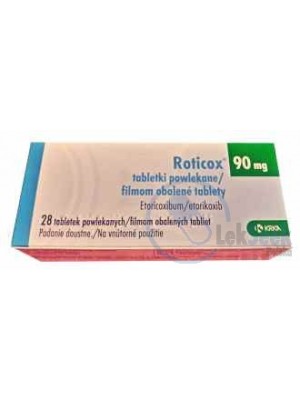
Roticox 90 mg. 28 tablets

Product viewed: 2940


What Roticox is and what it is used for
What is Roticox used for?
• Roticox contains the active substance etoricoxib. Rotikox belongs to a group of medicines called COX-2 inhibitors. They belong to a family of medicines called non-steroidal anti-inflammatory drugs (NSAIDs).
What is Roticox used for?
• Roticox helps reduce the pain and swelling in the joints and muscles of people 16 years of age and older with osteoarthritis, rheumatoid arthritis, ankylosing spondylitis and gout.
• Roticox is also used for short-term treatment of moderate pain after dental surgery in people 16 years of age and older.
What is osteoarthritis?
Osteoarthritis is a disease of the joints. It develops as a result of the gradual degradation of the cartilage that binds the end of the bones. This causes swelling (inflammation), pain, tenderness, stiffness and immobilization.
What is rheumatoid arthritis?
Rheumatoid arthritis is a prolonged inflammatory disease of the joints. It causes pain, stiffness, swelling and increasing loss of movement in the affected joints. It can also cause inflammation in other parts of the body.
What is gout?
Gout is a disease with sudden and recurrent seizures of very painful inflammation and redness of the joints. It is caused by the deposition of mineral crystals in the joints.
What is ankylosing spondylitis?
Ankylosing spondylitis is an inflammatory disease of the vertebrae and large joints.
2. What do you need to know before taking Rotikox?
Do not take Roticox:
if you are allergic (hypersensitive) to etoricoxib or any of the other ingredients of this medicine (listed in section 6);
if you are allergic to NSAIDs, including acetylsalicylic acid and COX-2 inhibitors (see Possible side effects, section 4);
if you have an active stomach ulcer or bleeding from the stomach and intestines;
if you have severe liver disease;
if you have severe kidney disease;
if you are pregnant or you may become pregnant or breast-feeding (see "Pregnancy, breast-feeding and fertility");
if you are under 16;
if you have an inflammatory bowel disease such as Crohn's disease, ulcerative colitis or colitis;
if you have high blood pressure that is not controlled by treatment (check with your doctor or nurse if you are not sure if your blood pressure is adequately controlled);
if your doctor has diagnosed heart problems, including heart failure (moderate or severe), angina (chest pain);
if you have suffered a heart attack, bypass surgery, peripheral arterial disease (poor blood supply to the legs or feet due to narrowing or blockage of the arteries);
if you have ever had a stroke (including a mini stroke, a transient ischemic attack, or a PIA). Etoricoxib may slightly increase the risk of heart attack and stroke and therefore should not be used by those who have already had heart or stroke problems.
If you think that any of these conditions fit your condition, do not take the tablets before consulting a doctor.
Warnings and precautions
Talk to your doctor or pharmacist before taking Rotikox if:
have a history of stomach bleeding or an ulcer;
you are dehydrated, for example due to prolonged vomiting or diarrhea;
you have edema due to fluid retention;
have a history of heart failure or any other form of heart disease;
have a history of high blood pressure. Rotikox may increase blood pressure in some people, especially in high doses, and your doctor will periodically ask for your blood pressure to be checked;
have a history of liver or kidney disease;
you are treating an infection. Rotikox may mask or mask the temperature that is a sign of infection;
you have diabetes, raised cholesterol, or are a smoker. They may increase your risk of heart disease;
You are a woman trying to get pregnant;
You are over 65 years of age.
If you are not sure if any of the above applies to you, talk to your doctor before taking Rotix to see if this medicine is right for you.
Rotikox works equally well in older and younger adult patients. If you are over 65 years old, your doctor will want to see you regularly. No dose adjustment is required for patients over 65 years of age.
Children and adolescents
Do not give this medicine to children and adolescents under 16 years of age.
Other Drugs and Rotikox
Tell your doctor or pharmacist if you are taking, have recently taken or might take any other medicines.
Especially if you are taking any of the following medicines, your doctor may want to check your condition to make sure the medicine works well once you start taking Rotix:
anti-blood clotting (anticoagulants),
Fertility
Roticox is not recommended for women trying to get pregnant.
Driving and using machines
Drowsiness and drowsiness have been reported in some patients taking Rotix.
Do not drive if you get dizzy or sleepy.
Do not work with appliances or machines if you get dizzy or sleepy.
3. How to take Roticox?
Always take this medicine exactly as your doctor has told you. If you are not sure, ask your doctor or pharmacist.
Do not take more than the recommended dose for your condition. Periodically, your doctor will discuss your treatment with you. It is important to use the lowest dose to control your pain, and you should not take Rotikox for longer than necessary. This is due to the risk of a heart attack or stroke that can increase after prolonged treatment, especially at high doses.
This tablet contains tablets with varying amounts of the active substance and depending on your illness. Your doctor will prescribe the appropriate dosage.
The recommended dose is:
Osteoarthritis
The recommended dose is 30 mg once daily, increased to a maximum of 60 mg once a day as needed.
Rheumatoid arthritis
The recommended dose is 60 mg etoricoxib once a day. The dose may be increased to a maximum of 90 mg.
Ankylosing spondylitis
The recommended dose is 60 mg etoricoxib once a day. If necessary, the dose may be increased to a maximum of 90 mg.
Treatment of acute pain
Etoricoxib should only be used during periods of pain.
Gone
The recommended dose is 120 mg once a day, which should only be given in periods of attack while treatment is limited to a maximum of 8 days.
Postoperative pain after dental surgery
The recommended dose is 90 mg once a day and treatment is limited to a maximum of 3 days.
People with liver problems
If you have a mild form of liver disease, you should not take more than 60 mg a day.
If you have moderate hepatic disease, you should not take more than 30 mg a day.
Use in children and adolescents
Roticox tablets should not be taken by children and adolescents under 16 years of age.
Elderly
No dose adjustment is required in elderly patients. Like other medicines, they should be used with caution in the elderly.
Application method
Rotikox is for oral use. Take the tablets once a day. Rotikox can be given with or without food.
If you take more Rotikox than you should
You should never take more tablets than prescribed by your doctor. If you take too many rotix tablets, you should immediately seek medical attention.
If you forget to take Rotikox
It is important to take Rotikox as your doctor prescribed. If you miss a dose, simply continue with the usual schedule the next day. Do not take a double dose to make up for the missed tablet.
If you have any further questions on the use of this medicine, ask your doctor or pharmacist.
4. Possible side effects
Like all medicines, this medicine can cause side effects, although not everyone gets them.
If you develop any of the following signs, you should stop taking Rotikox and tell your doctor immediately (See "What you need to know before taking Roticox", Item 2):
shortness of breath, chest pain or swelling of the ankle or if they get worse;
yellowing of the skin and eyes (jaundice) - this is a manifestation of liver;
problems with severe or prolonged stomach pain or if your stools become black;
an allergic reaction - may include skin problems such as ulcers or bubbles, or swelling of the face, lips, tongue or throat that may make breathing difficult.
Other side effects that may occur during treatment Rotikox:
Very common (may affect more than 1 in 10 people):
stomach ache.
Common (may affect up to 1 in 10 people):
dry alveolitis (inflammation and pain after tooth extraction);
swelling of the feet and / or feet due to fluid retention (swelling);
dizziness, headache;
palpitations (rapid or irregular heart rhythm), irregular heart rhythm (arrhythmia);
increased blood pressure;
wheezing or dyspnoea (bronchospasm);
constipation, gas, gastritis (inflammation of the stomach lining), heartburn, diarrhea, indigestion (dyspepsia) / stomach discomfort, nausea, malaise, inflammation of the esophagus, mouth ulcers;
changes in blood tests related to the liver;
bruising;
weakness and fatigue, a flu-like condition.
Uncommon (may affect up to 1 in 100 people):
gastroenteritis (inflammation of the gastrointestinal tract including stomach and small intestine / gastroenteritis), upper respiratory tract infection, urinary tract infection;
changes in laboratory performance (decreased red blood cell count, decreased white blood cell count decreased
5. How do you store Roticox?
Keep out of the reach and sight of children.
Do not use this medicine after the expiry date which is stated on the carton after EXP. The expiry date refers to the last day of that month.
This medicinal product does not require any special storage conditions.
Do not dispose of medicines in the sewage system or in the household waste container. Ask your pharmacist how to dispose of medicines you no longer use. These measures will help to protect the environment.
6. Package Contents and Additional Information
What does Roticox contain?
The active substance is etoricoxib (etoricoxib).
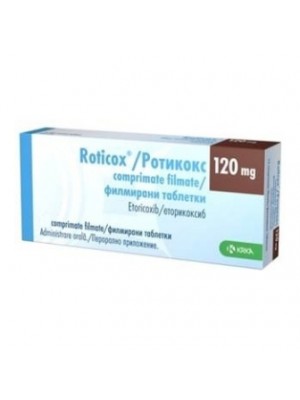
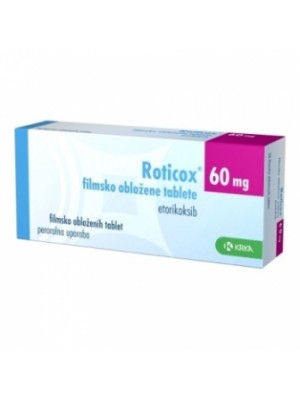
Each film-coated tablet contains 30 mg, 60 mg, 90 mg or 120 mg etoricoxib (etoricoxib).
The other ingredients are: microcrystalline cellulose, anhydrous calcium hydrogenphosphate, croscarmellose sodium, sodium stearin fumarate, colloidal anhydrous silica in the tablet core and polyvinyl alcohol, titanium dioxide (E171), macrogol 3000, talc, yellow iron oxide E172 ) and red iron oxide E172 (90 mg and 120 mg tablets) in the film coat.
What does Roticox look like and what does it contain?
Roticox film-coated tablets are available in four doses:
30 mg film-coated tablets: white to off-white, round (diameter: 6 mm), slightly biconvex, film-coated tablets with bevelled edges.
60 mg film-coated tablets: pale brownish-yellow, round (diameter: 8 mm), biconvex, film-coated tablets with bevelled edges, embossed "60" on one side of the tablet.
90 mg film-coated tablets: pink, round (diameter: 9 mm), biconvex, film-coated tablets with beveled edges, embossed "90" on one side of the tablet.
120 mg film-coated tablets: brown-red, round (diameter: 10 mm), slightly biconvex, film-coated tablets with bevelled edges, scored on one side of the tablet. The score line is not intended to break the tablet.
30 mg film-coated tablets
Packs of 7, 14, 28, 30, 56, 60, 84, 98 or 100 tablets in blisters are available.
60 mg film-coated tablets
Packs of 7, 14, 20, 28, 30, 50, 56, 60, 84, 98 or 100 tablets in blister packs are available.
90 mg film-coated tablets
Boxes containing 5, 7, 14, 20, 28, 30, 50, 56, 60, 84, 98 or 100 tablets in blisters are available.
120 mg film-coated tablets
Boxes containing 5, 7, 14, 20, 28, 30, 56, 60, 84, 98 or 100 tablets in blisters are available.
Not all pack sizes may be marketed.
Write a review
Your Name:Your Review: Note: HTML is not translated!
Rating: Bad Good
Enter the code in the box below:
Related Products
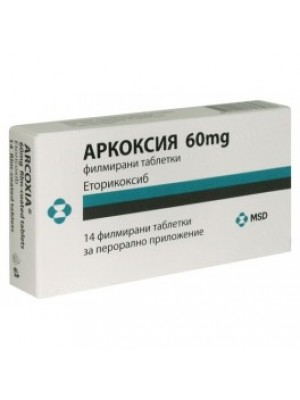
ARCOXIA table. 60 mg. 14 table ARCOXIA WHAT IS AND WHAT IT I..
25.00€
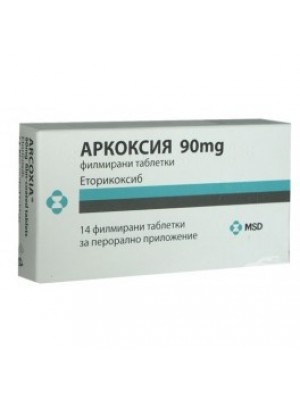
ARCOXIA table. 90 mg. 14 table ARCOXIA WHAT IS AND WHAT IT I..
26.00€