Your shopping cart is empty!
Welcome visitor you can login or create an account.
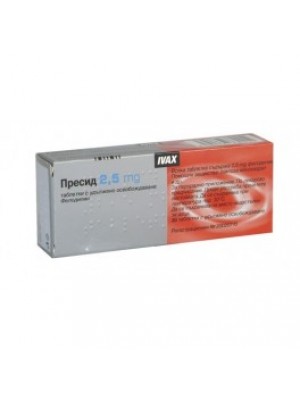
PRESID 5 mg. 30 tablets
Product Code: PRESID 5 mg. 30 tablets
Availability: In Stock

Product viewed: 1165


PRESID 5 mg. 30 tablets
Name of the medicinal product
PRESID 2,5 mg / 2.5 PRESID
2. Qualitative and quantitative composition
Felodipine 2,5 mg, 5 mg or 10 mg in 1 prolonged-release tablet
3. Formulation
PRESID 2,5 mg: Yellow, round, convex, coated tablets imprinted 2,5.PRESID 5 mg: Light pink, round, convex, coated tablets imprinted 5.PRESID 10 mg: Reddish-brown 'round biconvex, coated tablets imprinted with 10.
4. Clinical data
4.1. evidence
Treatment of essential hypertension. Prevention of stable and vasospastic form of stenokardiya.Lekarstveniyat product is intended for treatment of adult patients.
4.2. Dosage and administration
hypertension:
Adults (including the elderly): The dose of the product must always be determined individually. The treatment starts with a dose of 5 mg once daily. If necessary, the dose may be increased or added another antihypertensive agent. The usual maintenance dose is 5-10 mg once daily. In order to test the dosage is appropriate to use the tablet of 2,5 mg felodipine. In older patients a starting dose of 2,5 mg once daily may be sufficient.
angina:
Adults: The dose of the product must always be determined individually. The treatment starts with a dose of 5 mg once a day and if necessary, the dose may be increased to 10 mg once daily. The maximum dose is 20 mg daily.
Medicinal product Presid may be administered in combination with beta-blockers, ACE inhibitors or & diuretics / Combination therapy generally increased antihypertensive effect. Hypotension should be avoided. In patients with severely impaired hepatic function therapeutic dose should be reduced (we recommend a starting dose of 2,5 mg daily). The pharmacokinetics of the product is not significantly altered in patients with impaired renal function and therefore no dose adjustment is necessary for patients.
application:
The best way for acceptance of the product is in the morning before eating or after a snack. The coated tablets should be swallowed whole with a little water and must not be chewed, divided, or crushed.
4.3. Contraindications
The product is contraindicated in patients with unstable angina in patients with pre-existing allergic to felodipine or other dihydropyridine (cross-reactivity), known hypersensitivity to any of its ingredients and child. Medicinal product Presid should not be used in patients with symptomatic aortic stenosis, in decompensated heart failure for 1 month after the onset of myocardial infarction, where underlined hypotension, cardiogenic shock.
4.4. Special precautions
Only in rare cases, the product Presid like other vasodilators may cause severe hypotension, which in hypersensitive patients can manifest as myocardial ischemia. There is no any evidence that the product can be effective for secondary prevention of myocardial infarction.
The efficacy and safety of the product in the treatment of malignant hypertension has not yet been established.
The safety and efficacy of the product in children has not been established and therefore should not be administered to children.
4.5. drug interactions
Co-administration of substances that interact with cytochrome P-450 enzyme system may affect plasma concentrations of felodipine. Enzyme inhibitors (eg. Cimetidine, erythromycin, itraconazole, ketoconazole, ritonavir, saquinavir, quinidine) increased plasma concentration of felodipine and therefore administered doses of the product Presid must be reduced in case of concomitant administration of these drugs. The enzyme inducers (eg. Phenytoin, carbamazepine, rifampicin and barbiturates) may reduce plasma concentrations of felrdipina and therefore doses of the product Presid should be increased. There is no need to modify dosage for co-administration with digoxin. The high degree of binding of felodipine to plasma proteins does not affect other drugs highly bound to plasma proteins (eg. Warfarin).
The use of grapefruit juice containing flavonoids leads to an increase in peak plasma levels and bioavailability of felodipine, and therefore grapefruit juice should not be administered concurrently with Presid. Antihypertensive agents prolong the hypotensive effect of felodipine, while sympathomimetics reduce it.
4.6. Pregnancy and lactation
It is forbidden consequence of the use of the product Presid child. Felodipinat is found in breast milk but is not known to have adverse effects on the newborn. Nursing mothers should use the product only if the effect of therapy outweighs the risk to the newborn.
4.7. Effects on ability to drive and use machines
The product can Presid especially at the start of treatment or dose adjustment to affect the ability to drive a motor vehicle or operating machinery.
4.8. Adverse reactions
Like other calcium antagonists may be observed flushing, headache, palpitations, dizziness and fatigue. These effects are usually transient and occur most frequently during initiation of treatment or after an increase in dosage of the product. It can be observed more in relation to the dose ankle swelling as a result of precapillary vasodilation. Slight swelling of the gums can be observed in patients suffering from gingivitis or periodontitis. It may be avoided by careful oral hygiene. Like other dihydropyridines in rare cases may occur deterioration of the symptoms of angina pectoris especially at the beginning of treatment in patients with ischemic heart disease.
In clinical studies and monitoring of the product the following adverse reactions grouped as follows:
Common (greater than 1%), uncommon (0.1 - 1%), rare (0.01 - 0.1%), very rare (less than 0.01%).
common
Central and peripheral nervous system
KozhaSadova system (extra-cardiac)
Headache Flushing Peripheral edema
Uncommon
Cardiovascular
Central and peripheral nervous system
Gastrointestinal tract
leather
total:
Tachycardia, palpitations Dizziness, paraesthesia nausea, abdominal pain and rash sarbezhUmora
rare
Cardiovascular
Gastrointestinal tract
skeletal muscle
Psychiatric disorders
skin:
Syncope Vomiting Pain in joints and muscles impotence, sexual dysfunction
very rare
Digestive system:
Hives gingival hyperplasia, gingivitis
Liver:
Increased levels of liver enzymes
skin:
Photosensitivity reaction, leukocytoclastic vasculitis
Excretory system:
pollakiuria
total:
Hypersensitivity reactions eg. angioedema and fever
4.9. overdose
Symptoms: an overdose of the product occurs with significant peripheral vasodilatation and symptomatic hypotension which may sometimes be accompanied by bradikardiya.Lechenie: if observed severe hypotension should be symptomatic treatment. The patient is placed in supine position with legs raised. If there is a bradycardia and apply atropine 0.5 - 1 mg i.v. If these measures are not sufficient to apply fiziolgichen infusion solution or dextran. If the patient's clinical condition is normal apply a1-sympathomimetic.
5. Pharmacological
5.1. Pharmacodynamic properties
Pharmacotherapeutic group: vasodilator antihypertensives
Felodipine is a highly vazoselektiven calcium antagonist with a predominant vascular effect of the dihydropyridine type, which lowers blood pressure by reducing peripheral vascular resistance. At therapeutic doses it affects selective smooth muscle of the arterioles and does not directly affect myocardial contractility and conduct an impulse conduction system of the heart. "It does not affect smooth muscle veins or adrenergic vasomotor mechanisms and therefore the application of felodipine is not associated with symptoms orthostatic hypotension. felodipine has a slight natriuretic and diuretic effect, so no fluid retention in the body.
The product Presid can be used as monotherapy or in combination with other antihypertensive agents eg. beta-blockers, diuretics, ACE inhibitors or in order to achieve an increased antihypertensive effect. Felodipine reduces systolic and diastolic blood pressure and can be used in patients with isolated systolic hypertension. Felodipine antihipetenzivnata retains its effectiveness even when combined with nonsteroidal antiinflammatory drugs (NSAID).
Felodipine has antianginal and anti-ischemic effects due to its ability to improve the balance between consumption and supply of oxygen to the myocardium. Felodipinat reduce coronary vascular resistance. Blood flow through the coronary veins and the supply of oxygen to the myocardium is also increased as a result of the dilation of the arteries and arterioles of the epicardium. Felodipinat effectively prevents the emergence and development of spasm of the coronary vessels. The reduction in systemic blood pressure of Felodipine leads to a reduction of afterload of the left ventricle of the heart and a reduction of myocardial oxygen requirements.
Felodipine improves tolerability of the load and reduces angina attacks in patients with stable exertional angina caused. In patients with angina of vasospastic type it reduces the manifestations of coronary heart disease.
Felodipinat is effective and well tolerated in elderly patients and in patients suffering from underlying diseases eg. asthma and other obstructive pulmonary disease, renal dysfunction, diabetes, gout, hyperglycemia, Raynaud's phenomenon in patients after renal transplantation. Felodipinat does not affect the sugar lipid profil.Myasto and mechanism of action on their pharmacodynamic characteristics felodipine has a high selectivity with respect to blood "containers. The resistant smooth muscle of the arterioles is extremely sensitive to the effects of felodipine. Felodipinat inhibits electrical and contractile activity of vascular smooth muscularity through an effect on calcium channels in the cell membrane. hemodynamic effects; primary haemodynamic effect of felodipine is a reduction in total peripheral vascular resistance which leads to a decrease in blood pressure, the effect is dependent on dose. Typically, reductions in blood pressure were observed for 2 hours after a single administration and was continued for at least 24 hours. The ratio T / R is significantly higher than 50%. There is a positive correlation between plasma concentration of the drug, the degree of decrease in peripheral vascular resistance and the degree of decrease in blood pressure.
Electrophysiological and other cardiac effects: In tepapevtichni dozifelodipinat not affect myocardial contractility, AV conduction and refractory stage an AV vazel.Babrechni effects: Felodipinat has natriuretic and diuretic effect by reducing reabsorption of Na + in the renal tubules. After it apply to other vasodilators observed water retention, and sodium. Following administration of felodipine renal vascular resistance is reduced and the glomerular filtration rate does not change. In patients with impaired renal function glomerular filtration rate may increase during the implementation of felodipin.Patsientite after kidney transplant well tolerated felodipine.
5.2. Pharmacokinetic properties
Absorption and distribution:
After oral administration felodipine coated tablets prolonged-release is completely absorbed in the gastrointestinal tract. The systemic bioavailability of Felodipine is 15% in men and is independent of dose when used in a therapeutic dose range. Felodipine is bound to plasma proteins, especially albumin at about 99%. Felodipine in the form of coated tablets with prolonged release leads to an extension of the phase of absorption and plasma concentration for 24 hours.
Metabolism and Elimination:
Felodipine is metabolized primarily in the liver and all its metabolites are inactive. The half-life is 25 hours. During prolonged application of the active substance there was no accumulation. Older patients and patients with impaired babrechna.funktsiya have higher plasma concentrations of felodipine, than younger patients. The pharmacokinetics of felodipine are not changed in patients with renal impairment, including patients on hemodialysis; about 70% of the dose was excreted in urine and faeces as metabolites. Less than 0.5% of the administered dose is excreted unchanged in the urine. No significant accumulation of the product during continued treatment. Felodipine is metabolized primarily in the liver to inactive metabolites. About 70% of the dose is excreted as metabolites in the urine, and the remainder is excreted in faeces. Less than 0.5% of the dose is excreted unchanged in the urine.
5.3. Preclinical safety data
Reproductive toxicity:
In a study on fertility and reproductive behavior of rats treated with felodipine in the groups treated with higher doses of felodipine period of birth was longer and cases of mortality during childbirth and the postnatal period were higher. There were no violations of the fertility of rats in the use of felodipine in therapeutic doses. Reproduction studies on rabbits have shown reversible enlargement of the mammary glands of females and limb abnormalities of fetuses according to the doses used. Abnormalities in fetuses were found when felodipine was used in the early stages of fetal development. Mutagenesis: mutagenicity studies using four different test did not show any mutagenic properties of felodipine.
carcinogenicity:
Studies were conducted on mice and rats. They were observed tumors interstitial cells of the testis of rats. This particular effect is due to the effect of felodipine on the endocrine system of rats and was not seen in men.
b. pharmaceutical data
6.1. List of excipients (qualitative)
Lactose monohydrate, Cellulose microcrystalline, Hypromellose 2910/50, HypromeJIose 2910/6, Povidone 25, Propyl gallate, Silica colloidal anhydrous, Magnesium stearate. Ferric oxide yellow. Ferric oxide red (in Presid tablets 5 mg and 10 mg), Titanium dioxide, Talc, Propylene glycol.
6.2. incompatibilities
He known.
6.3. Expiry date
3 years.
6.4. storage
At temperatures below 30 ° C.
Write a review
Your Name:Your Review: Note: HTML is not translated!
Rating: Bad Good
Enter the code in the box below:
Related Products
PRESID table. 10 mg. 30 tablets Qualitative and quantitative..
15.00€