Your shopping cart is empty!
Welcome visitor you can login or create an account.
Ormus caps. 20 mg
Product Code: Ormus caps. 20 mg
Availability: In Stock

Product viewed: 1993


Ormus caps. 20 mg
QUALITATIVE AND QUANTITATIVE COMPOSITION
Each capsule contains 20 mg esomeprazole (as magnesium dihydrate).
Excipients: Each capsule contains 8.05 sucrose, 1.85 micrograms of methyl p-hydroxybenzoate (E218) and 0.56 micrograms of propyl p-hydroxybenzoate (E 216).
Each capsule contains 40 mg esomeprazole (as magnesium dihydrate).
Excipients: Each capsule contains 16.09 1tsht sucrose, 3.65 micrograms of methyl p-hydroxybenzoate (E218) and 1.1 microgram propyl p-hydroxybenzoate (E 216).
For a full list of excipients, see section 6.1.
PHARMACEUTICAL FORM
Gastro-resistant capsules, hard.
Each capsule has an opaque yellow cap and opaque white body, marked "20 mg" in black. Capsule contains a whitish-gray spherical microgranules.
Each capsule has an opaque yellow cap and yellow opaque body, marked "40 mg" in black. Capsule contains a whitish-gray spherical microgranules.
CLINICAL DATA
Indications
Gastro-resistant capsules are intended for Ormus:
Gastro-oesophageal reflux disease (GERD)
Treatment of erosive reflux esophagitis
Long-term treatment of patients with healed esophagitis to prevent relapse
Symptomatic treatment of gastroesophageal reflux disease (GERD)
Prolonged treatment after iv induced prevention of bleeding peptic ulcers.
Treatment of Zollinger Ellison Syndrome
Dosage and method of administration
The capsules should be swallowed whole with some liquid. It should not be chewed or crushed. For patients who have difficulty swallowing, the tablets can be dissolved in half a glass of plain water. You should not use other liquids as gastro-resistant coating can be dissolved.
For patients who can not swallow the tablets can be dissolved in water and can be applied using a naso-gastric tube is important to determine whether the selected syringe and tube are appropriate. For instructions on reconstitution of the medicinal product, see section 6.6
Adults and children over 12 years
Gastro-oesophageal reflux disease (GERD)
treatment of erosive reflux esophagitis 40 mg once daily for 4 weeks.
It is recommended that an additional 4 weeks of treatment in patients who have not healed ezofagityt or symptoms persist.
term treatment of patients with healed esophagitis to prevent relapse 20 mg once daily.
Symptomatic treatment of gastroesophageal reflux disease (GERD)
20 mg once daily in patients without esophagitis. If you do not achieve control of symptoms after four weeks, the patient should be further investigated. Once symptoms have resolved, subsequent symptom control can be achieved by taking 20 mg once daily. In elderly patients may need to take 20 mg once daily as needed. In patients treated with NSAIDs, where there is a risk of gastric ulcer and duodenal ulcer, it is recommended that further control of symptoms as under if needed
Adults
In combination with appropriate antibacterial therapeutic regimen for eradication of Helicobacter pylori and
Healing of duodenal ulcer associated with Helicobacter pylori and
Prevention of relapse of peptic ulcers in patients with ulcers associated with Helicobacter pylori
Ormus 20 mg with 1 g of amoxicillin and 500 mg clarithromycin - all twice daily for 7 days.
Patients requiring long-term therapy with NSAIDs
Healing of gastric ulcers associated with NSAIDs: The usual dose is 20mg once daily for 4-8 weeks.
Prevention of gastric and duodenal ulcers caused by NSAID therapy in patients at risk: 20mg once daily.
Maintenance of hemostasis and prevention of re-bleeding gastric or duodenal ulcer after treatment with infusion
40 mg once daily for 4 weeks after infusion prsfilaktika re-bleeding peptic ulcers.
Treatment of Zollinger Ellison Syndrome
The recommended initial dose is 40 mg Ormus twice daily. Subsequently, dosage should be tailored to individual needs and to continue treatment based on clinical indicators. Based on available clinical data the majority of patients can be controlled with doses of 80 to 160 mg of esomeprazole daily. At doses above 80 mg daily, the dose should be divided into two doses per day.
Children under 12 years of age
Ormus should not be used in children under 12 years of age, as there is no data available.
Impaired renal function
There is no need for dosage adjustment in patients with impaired renal function. Due to limited experience in patients with severe renal insufficiency, such patients should be treated with caution (see section 5.2).
Impaired liver function
No adjustment is necessary for patients with mild to moderate hepatic impairment. In patients with severe hepatic impairment should not exceed a maximum dose of 20 mg Ormus (see Section 5.2).
Elderly
There is no need for dosage adjustment in elderly patients.
Contraindications
Known hypersensitivity to esomeprazole or to any of the excipients. Esomeprazole should not be taken concomitantly with nelfinavir (see section 4.5).
Special warnings and precautions for use
With any troublesome symptoms (eg, significant weight loss, recurrent vomiting, dysphagia, haematemesis or melaena) and in cases with suspected or diagnosed gastric ulcer should be ruled out malignancy because by treatment with esomeprazole can obfuscated symptoms and delay diagnosis.
Patients on long-term treatment (particularly those receiving therapy for more than a year) should be monitored regularly. Patients treated with esomeprazole in need should be addressed to immediately contact their physician if their symptoms change in character. When prescribing esomeprazole for treatment need to be given to the possibility of interactions with other pharmaceuticals, due to fluctuating plasma concentrations of esomeprazole. See Section 4.5.
When prescribing esomeprazole for eradication of Helicobacter pylori, must be taken into account possible interactions of all the components of the triple therapy. Clarithromycin is a potent inhibitor of SURZA4 and this must be taken into account, as well as contraindications and interactions for clarithromycin as triple therapy is used in patients concurrently taking other drugs metabolized by SURZA4 (such as cisapride, etc.)..
This product contains sucrose. Patients with rare hereditary disorders characterized by intolerance to fructose malabsorption of glucose-galactose or sucrase-isomaltase insufficiency should not take this medicine.
Treatment with proton pump inhibitors may lead to an increased risk of gastrointestinal infections such as Salmonella and Campylobacter (see section 5.1).
Concomitant administration of esomeprazole and atazanavir (see section 4.5). If the combination of atazanavir with a proton pump inhibitor is considered inevitable, careful clinical monitoring in combination with increasing dose of atazanavir to 400 mg with 100 mg ritonavir, should not increase the dose of 20 mg esomeprazole.
4.5 Interaction with other medicinal products and other forms of interaction
Effects of esomeprazole on the pharmacokinetics of other drugs
Medicinal products with pH dependent absorption
Decreased intragastric acidity during treatment with esomeprazole may increase or decrease the absorption of drugs if it is influenced by gastric acidity. As with other inhibitors of acid secretion or antacids, the absorption of ketoconazole and itraconazole can decrease during treatment with esomeprazole.
For omeprazole has been reported to interact with some protease inhibitors. The clinical importance and the mechanisms behind these reported interactions are always vague. Increased gastric pH during omeprazole treatment may change the absorption of protease inhibitors. Other possible interaction mechanisms are via inhibition of CYP2C19. For atazanavir and nelfinavir, decreased serum levels have been reported when administered with omeprazole and so the combination is not recommended. Co-administration of omeprazole (40 mg once daily) with atazanavir 300 mg / ritonavir 100 mg to healthy volunteers resulted in a significant reduction in atazanavir exposure (approximately 75% reduction in AUC, Cmax and Cmin. Increase the dose of atazanavir to 400 mg did not compensate effects of exposure to omeprazole and atazanavir. adopting Co omeprazole (20 mg) with atazanavir 400 mg / ritonavir 100 mg to healthy volunteers resulted in a reduction in atazanavir exposure approximately 30% compared to the exposure observed with atazanavir 300 mg / ritonavir 100 mg, but omeprazole 20 mg. Concomitant administration of omeprazole (40 mg) and nelfinavir, decreased the mean AUC, Cmax and Cmin, nelfinavir by 36-39% and the mean AUC, Cmax and Cmin of pharmacologically active metabolite M8 were reduced by 75-92%. For saquinavir (with concomitant ritonavir) reported elevated serum levels (80-100%) during the combined administration of omeprazole (40 mg). treatment with omeprazole 20 mg had no effect on amprenavir exposure (with or without ritonavir intake enovremenno). treatment with 40 mg omeprazole does not affect exposure to lopinavir (with concomitant and ritonavir). Due similar pharmacodynamic effects and pharmacokinetic properties of omeprazole and esomeprazole, concomitant administration of esomeprazole and atazanavir, and the combination of esomeprazole and nelfinavir is contraindicated.
Drugs that are metabolized by CYP2C19
Esomeprazole inhibits CYP2C19, the major esomeprazole metabolising enzyme. Therefore, when esomeprazole is combined with drugs that are metabolized by CYP2C19, such as diazepam, citalopram, imipramine, clomipramine, phenytoin etc.., Plasma concentrations of these drugs may increase and require dose reduction. This should be considered especially when prescribing treatment if necessary. Concomitant administration of 30 mg esomeprazole resulted in a 45% decrease in clearance of the CYP2C19 substrate diazepam. Concomitant administration of 40 mg esomeprazole resulted in a 13% increase in trough plasma levels of phenytoin in epileptic patients. Monitoring of plasma phenytoin concentrations when initiating or discontinuing therapy with esomeprazole. Omeprazole (40 mg once daily) taken with voriconazole (a substrate of CYP2C19) increased its Cmax and AUC by 15% and 41%, respectively.
In a clinical study, coagulation time in patients on concomitant esomeprazole 40 mg and varafarin not exceed limits.
However, post-marketing experience are seen few isolated cases of clinical significance of elevated INR. Medical supervision is recommended for patients who start and terminate concomitant warfarin or other coumarin derivatives.
In healthy subjects, co-administration of 40 mg esomeprazole resulted in a 32% increase in area under the concentration-time curve (AUC) and a 31% prolongation of life (the first half), but no significant increase in peak plasma levels of cisapride. Slightly prolonged QTc interval observed after administration of cisapride alone, was not further prolonged when cisapride was given in combination with esomeprazole (see also Section 4.4.).
Co-administration of omeprazole (40 mg once daily) with atazanavir 300 mg / ritonavir 100 mg to healthy volunteers reduced atazanavir exposure (approximately 75% decrease in AUC, Cmax and Cmin.). The increase in the dose of atazanavir to 400 mg did not compensate for the impact of omeprazole on atazanavir exposure. Proton pump inhibitors, including esomeprazole should not be co-administered with atazanavir (see section 4.3).
It has been shown that esomeprazole no clinically relevant effects on the pharmacokinetics of amoxicillin or quinidine.
Reciprocal administration of esomeprazole and either naproxen or rofecoxib show no clinically significant interactions in the short-term studies evaluating the effect of co-administration.
Effects of other drugs on the pharmacokinetics of esomeprazole
Esomeprazole is metabolised by CYP2C19 and SURZA4. Concomitant administration of esomeprazole and a inhibitoryt SURZA4 clarithromycin (500 mg twice daily) resulted in a doubling of the exposure (AUC) to esomeprazole. Reciprocal administration of esomeprazole and a combined inhibitor of CYP2C19 and SURZA4 can lead to increased exposure of omeprazole more than twice. Inhibitor of CYP2C19 and SURZA4 as voriconazole increases the area under the curve (AUC) of omeprazole by approximately 280%. Dose adjustment of omeprazole is not normally required in these cases. However, dose adjustment, however, must be carefully considered in patients with severe hepatic impairment or prescribed treatment.
Pregnancy and lactation
No clinical data on exposure to esomeprazole during pregnancy. Epidemiological studies with omeprazole racemic mixture at high exposure during pregnancy showed no harmful or toxic effects to the fetus. Animal studies with esomeprazole do not indicate direct or indirect harmful effects with respect to embryonal / fetal development. Animal studies with the racemic mixture do not indicate direct or indirect harmful effects with respect to pregnancy, childbirth or posttdatalnoto development. Special attention should be paid when prescribing esomeprazole for pregnant women.
It is not known whether esomeprazole is excreted in human milk. No studies in lactating women. Therefore esomeprazole should not be used during breastfeeding.
4.7 Effects on ability to drive and use machines
There were no such effects.
Adverse reactions
The following adverse reactions have been identified or suspected in the clinical trials of esomeprazole and post-marketing use. None of them were related to dose. According to the frequency of reactions are divided into (common> 1/100, <1/10, uncommon> 1/1000, <1/100, rare> 1/10 000, <1/1000, very rare <1 / 10000).
Blood and lymphatic system
Rare: Leukopenia, thrombocytopenia
Very rare Agranulocytosis, pancytopenia
Immune System
Rare: Hypersensitivity reactions eg fever, angioedema and anaphylactic reaction / shock
Metabolism and nutrition
Uncommon Peripheral edema
Rare Hyponatremia
Psychiatric Disorders
Uncommon Insomnia
Rare, agitation, confusion, depression
Very rare, Aggression, hallucinations
Nervous System
Common-Headache
Uncommon: Dizziness, paresthesia, somnolence
Rare Taste disturbance
Eye Disorders
Rare Blurred vision
Ear and labyrinth disorders
Uncommon: Vertigo
Respiratory, thoracic and mediastinal disorders
Rare Bronchospasm
Gastrointestinal Disorders
Frequent abdominal pain, constipation, diarrhea, flatulence, nausea / vomiting
Uncommon Dry Mouth
Rare stomatitis, gastrointestinal candidiasis
Hepatobiliary disorders
Uncommon: Elevations of liver enzymes
Rare: Hepatitis with or without jaundice
Very rare, hepatic failure, encephalopathy in patients with history of liver disease
Skin and subcutaneous tissue disorders
Uncommon: dermatitis, pruritus, rash, urticaria
Rare: alopecia, photosensitivity
Very rare, Erythema multiforme syndrome, Stevens-Johnson, toxic epidermal necrolysis (TEN)
Musculo-skeletal and connective tissue disorders Rare: Arthralgia, myalgia
Very rare muscle weakness
Renal and urinary disorders
Very rare, interstitial nephritis
Reproductive system and breast disorders
Very rare-Gynecomastia
General disorders and administration site conditions
Rare malaise, increased sweating
Write a review
Your Name:Your Review: Note: HTML is not translated!
Rating: Bad Good
Enter the code in the box below:
Related Products
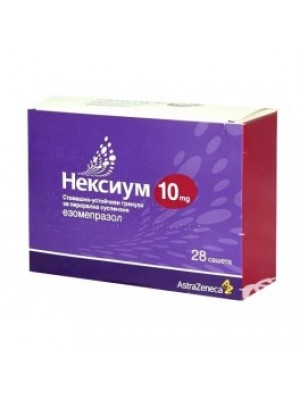
Nexium 10 mg sachet. 28 sachet NAME OF THE MEDICINAL PRODUCT..
65.00€
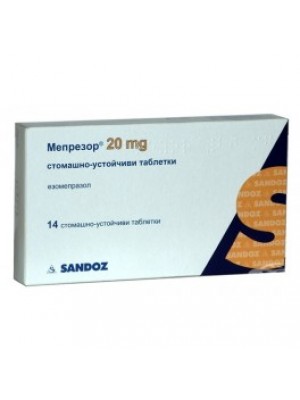
ESOMEPRAZOLE table. 20 mg. 14 tablets Esomeprazole is used t..
21.00€

ESOMEPRAZOLE table. 20 mg. 28 table Esomeprazole is used to ..
31.00€