Your shopping cart is empty!
Welcome visitor you can login or create an account.
Nivalin 10 mg. 20 tablets
Product Code: Nivalin 10 mg. 20 tablets
Availability: In Stock

Product viewed: 2479


Nivalin 20 tablets - 10 mg

Nivalin WHAT IS AND WHAT IT IS USED
Nivalin is a medicine that contains the active substance galanthamine, an alkaloid isolated from the tubers of marsh. Galantamine belongs to a group of medicines called atsetilho-linesterazni inhibitors. It raises the level of the chemical acetylcholine, which is involved in conducting nerve impulses in the brain and peripheral nerves. Improves the condition of patients with Alzheimer's disease and slow its development. Used to treat mild to moderate dementia of the Alzheimer type, diseases of peripheral nerves associated with movement disorders (poliradikulonevrit, radikulonevrit, neuritis, polyneuritis, polyneuropathy), muscle weakness (myasthenia gravis), Duchenne muscular dystrophy, polio, cerebral palsy.
BEFORE YOU TAKE Nivalin
Do not take Nivalin
if you are allergic (hypersensitive) to the active ingredient galantamine or any of the other ingredients of Nivalin.
If any of the following illnesses: severe renal and / or hepatic failure, asthma, heart disease, which is associated with a significant slowing of the heart rhythm disturbance or cardiac conduction (atrioventricular block); angina, severe heart failure ( weakness of the heart muscle), epilepsy hyperkinesia (involuntary movements).
Take special care with Nivalin
Tell your doctor if you have conditions such as:
irregular heart beat pulse late or taking medications that cause its delay;
ulcers of the stomach or duodenum;
chronic lung disease with bronchospasm;
retention (retention) of urine or recently had prostate surgery. Before performing surgery with general anesthesia should tell your doctor that treatment with Nivalin.
During treatment Nivalin is recommended to use more fluids. During treatment with Nivalin can be observed weight loss. Recommended weight control, especially in patients with dementia.
Taking other medicines
Tell your doctor if you take:
medicines to treat arrhythmias and high blood pressure (quinidine, digoxin, beta-blockers such as atenolol, propranolol, metoprolol);
antibiotics (gentamicin, amikacin, erythromycin);
cimetidine;
medicines used to treat depression such as paroxetine, fluoxetine;
ketoconazole (an antifungal medicine);
ritonavir (medicines to treat HIV).
These drugs may increase the side effect of changing Nivalin or therapeutic effect;
Nivalin may antagonize the therapeutic effects of drugs such as atropine, etc. benzoheksoniy. ganglioblokeri, tubocurarine.
Please tell your doctor if you are taking or have recently taken any other medicines, including medicines obtained without a prescription.
Pregnancy and lactation
Ask your doctor before taking Nivalin. Its safe use in pregnancy has not been established, so it is not recommended for use by pregnant women and breast-feeding.
Driving and operating machinery
During treatment with Nivalin, especially early in treatment may occur drowsiness and dizziness. In such cases, do not drive or perform activities requiring alertness until the symptoms have resolved.
Important information about some of the ingredients of Nivalin
This product contains an ingredient like wheat starch, which may contain gluten, but only in minor amounts. It is therefore considered that wheat starch is safe for people with gluten intolerance (celiac disease). Patients with wheat allergy (different from celiac disease) should not take this medicine. If you have an intolerance to some sugars, contact your doctor before starting treatment with Nivalin as in tablets present as an excipient lactose.
HOW TO TAKE Nivalin
Nivalin always take it exactly as prescribed by your doctor. If you're not sure, ask your doctor.
Nivalin tablets are taken orally with a meal. During treatment, it is necessary to take more fluids.
The dosage and length of treatment is determined by the doctor.
If you take more than the dose Nivalin
May occur nausea, vomiting, abdominal cramps Colicky, diarrhea, low blood pressure, slow heart beat, difficulty breathing, salivation, tears-stream, and in more severe cases - seizures and coma. When these symptoms occur, contact your doctor immediately or in the hospital.
If you forget to take Nivalin
If you miss a dose, take it as soon as possible. If almost happened next dose, take it as usual, skip the dose you forgot. Do not take a double dose to make up. Continue to take your medicine as prescribed by your doctor. If you have any further questions on the use of this product, ask your doctor.
POSSIBLE SIDE EFFECTS
Like all medicines, Nivalin can cause side effects, although not everybody gets them.
Nivalin can cause:
General disorders - chest pain, sweating, weakness, malaise.
Cardiac disorders - low blood pressure (hypotension), orthostatic hypotension, slow heart rate (bradycardia), irregular heartbeat, heart failure.
Nervous system - dizziness, involuntary muscle cuts, paresthesia (tingling, burning, tingling), impaired motor coordination (ataxia), speech disorders (aphasia), seizures, increased libido, delirium. Nivalin treatment may worsen the symptoms of Parkinson's disease.
Psychiatric disorders - confusion, depression, paranoia, paranoid reactions, hallucinations, aggression.
Gastrointestinal disorders - dry mouth or salivation, bloating, nausea, vomiting, abdominal pain, blood in stool, stomach inflammation (gastritis).
Metabolism and nutrition disorders - loss of appetite, weight loss, hyperglycemia (elevated blood glucose), blood levels of alkaline phosphatase, dehydration.
Blood and lymphatic system - thrombocytopenia (low blood platelets), pinpoint hemorrhages on skin and mucous membranes.
Renal and urinary disorders - retention of urine, blood in urine, frequent urination, cystitis.
If any of the side effects gets serious, or you notice other effects not listed in this leaflet, please tell your doctor.
STORAGE Nivalin
Store in the original package to protect from light and moisture.
Do not store above 25 ° C.
Keep out of reach of children!
Nivalin Do not use after the expiry date stated on the pack.
Medicines should not be disposed of via wastewater or household waste.
Ask your pharmacist how to dispose of medicines no longer required. These measures will help to protect the environment.
ADDITIONAL INFORMATION
What Nivalin
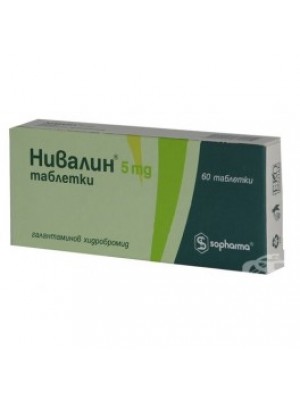
Tablets 5 mg
The active ingredient is galantaminov hydrobromide 5 mg.
The other ingredients are lactose monohydrate, wheat starch, talc, magnesium stearate, microcrystalline cellulose, calcium hydrogen phosphate dihydrate.
Tablets 10 mg
The active ingredient is galantaminov hydrobromide 10 mg.
The other ingredients are lactose monohydrate, wheat starch, talc, magnesium stearate, microcrystalline cellulose.
Nivalin looks like and contents of pack
Off-white, round, flat tablet with bevelled and scored on one side.
Tablets 5 mg
10 tablets in blister PVC / aluminum foil, in 1 blister with leaflet in carton box. 20 tablets in blister PVC / aluminum foil, 1 or 3 blister with leaflet in carton box.
Tablets 10 mg
10 tablets in blister PVC / aluminum foil, 1 or 2 blister with leaflet in carton box.
Marketing authorization holder and manufacturer Sopharma
The following information is intended for healthcare professionals only:
Dosage
Adults:
The usual dose is 10-40 mg, divided into 2-4 doses.
Alzheimer's Disease
The recommended starting dose is 5 mg two times daily, preferably with morning and evening meals. After receiving 4-week course of treatment, the dose can be increased until a maintenance dose of 20 mg daily in 2 divided doses (10 mg two times daily).
The dose is increased depending on the clinical picture and the individual patient.
Children:
The recommended daily dose for children is:
6 to 8 years - 5-10 mg daily;
9 to 11 years - 5-15 mg daily;
12 to 15 years - 5-25 mg.
Write a review
Your Name:Your Review: Note: HTML is not translated!
Rating: Bad Good
Enter the code in the box below:
Related Products