Your shopping cart is empty!
Welcome visitor you can login or create an account.
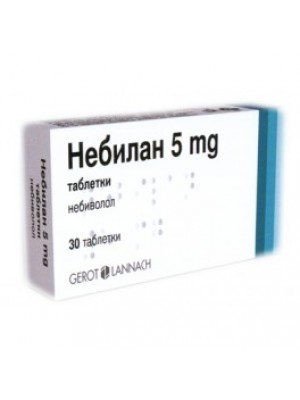
NEBILAN table. 5 mg
Product Code: NEBILAN table. 5 mg
Availability: In Stock

Product viewed: 1261


NEBILAN table. 5 mg

QUALITATIVE AND QUANTITATIVE COMPOSITION
Each tablet contains 5.45 mg of nebivolol hydrochloride equivalent to 5 mg of nebivolol.
Excipient: 143.48 mg lactose monohydrate / tablet.
INDICATION:
Treatment of essential hypertension.
Treatment of chronic heart failure in addition to the usual treatment regimens in elderly patients over 70 years of age.
DOSAGE AND ADMINISTRATION
Method of application:
The tablet should be swallowed with some liquid / glass of water as / with or without food.
Hypertension:
Adults:
The dose is one tablet daily, preferably taken at the same time of day. The tablets can be taken with food.
Pronounced effect on lowering blood pressure noted after treatment for 1-2 weeks.
Sometimes the optimal effect is achieved after 4 weeks.
Combination with other antihypertensive MEDICINAL PRODUCT
Beta-blockers can be used alone or concomitantly with other antihypertensive agents. So far, the additional effect is only found when combining Nebilan 5 mg hydrochlorothiazide 12.5 to 25 mg.
Patients with renal insufficiency
In patients with renal insufficiency is recommended that the initial dose of 2.5 mg daily. If necessary, the daily dose may be increased to 5 mg.
Patients with hepatic impairment
Data on drug use in patients with hepatic disease or hepatic impairment are limited. For this reason, the use of Nebilan 5 mg in these patients is contraindicated.
Elderly
Patients over the age of 65 is recommended starting dose of 2.5 mg daily. If necessary, the daily dose may be increased to 5 mg. However, the limited experience of using the drug in patients over 75 years of age, it should be used with caution and such patients should be carefully monitored.
Children and adolescents
not recommended for use Nebilan 5 mg in children and adolescents under 18 years.
Chronic heart failure
Treatment of stable chronic heart failure should start with dose escalation until the optimal individual maintenance dose.
Patients should have stable chronic heart failure without acute episodes of heart failure over the past six weeks. It is recommended that the physician has experience in the treatment of chronic heart failure. Patients taking drugs for the treatment of cardiovascular diseases, including diuretics and / or digoxin and / or ACE inhibitors and / or angiotensin II, recommended dosage of these products to be specified in the last two weeks before treatment with nebivolol.
The initial adaptation gradually increasing dose should be carried out as follows in 1-2 week intervals depending on patient tolerance:
A single daily dose of 1.25 mg nebivolol should be increased to 2.5 mg nebivolol once daily, then to 5 mg once daily, then 10 mg once daily.
Maximum recommended dose is 10 mg once daily nebivolol.
Initiation of therapy and any increase in dose should be done under the supervision of an experienced physician for at least 2 hours to be sure that the clinical condition remains stable.
Usually, treatment of chronic heart failure with nebivolol is long. Not recommended abrupt discontinuation of nebivolol, as this may cause a transient worsening of heart failure. If necessary, discontinuation of therapy, the dose should be gradually reduced by half every week.
The tablets can be taken with food.
Patients with renal insufficiency
In mild or moderate renal impairment is not necessary to change the dose, as the gradual increase in dose until the maximum tolerated dose is individually adjusted.
Patients with hepatic impairment
Data on drug use in patients with hepatic impairment is limited. For this reason, the use of nebivolol in these patients is contraindicated.
Elderly
No adjustment of the dose as the gradual increase in dose until the maximum tolerated dose is individually adjusted.
CONTRAINDICATIONS:
Hypersensitivity to the active substance or to any of the excipients
Liver failure or liver dysfunction
Acute heart failure, cardiogenic shock or episodes of decompensated heart failure requiring intravenous inotropic therapy.
Syndrome sick sinus
Heart block, second and third degree
A history of asthma or bronchospasm
Untreated phaeochromocytoma
Metabolic acidosis
Bradycardia
Hypotension
Severe peripheral circulatory disorders
Pregnancy and lactation
Use in pregnancy
Nebivolol has pharmacological effects that may cause harmful effects on pregnancy and / or the fetus / newborn. In general, beta-adrenoceptor blockers reduce placental perfusion, which is associated with delayed fetal growth, intrauterine death, abortion or stillbirth. In the fetus and neonate may be side effects. If necessary, carry out the treatment with beta-adrenoceptor blockers, preferably using selective beta-adrenoceptor blockers.
Nebivolol should not be used during pregnancy unless clearly necessary.
Use during lactation
Most beta-blockers, particularly lipophilic compounds like nebivolol and its active metabolites pass into breast milk, although in varying degrees. Therefore, it is recommended that treatment with nebivolol during lactation.
SIDE EFFECTS
Cardiac disorders:
Very common - bradycardia
Common - worsening heart failure, first degree atrioventricular block
Rare - bradycardia, heart failure, slow AV conduction / AV block
Nervous system disorders:
Common - headache, dizziness, paraesthesia
Eye disorders:
Rare - blurred vision, dry eyes
Respiratory, thoracic and mediastinal disorders:
Common - dyspnea
Rare - bronchospasm
Gastrointestinal:
Common - constipation, nausea, diarrhea
Rare - dyspepsia, flatulence, vomiting
Skin and subcutaneous tissue disorders:
Common - swelling
Rare - itching, rash erythematous
Vascular disorders:
Common - orthostatic hypotension
Rare - hypotension
Psychiatric disorders:
Rare - nightmares, depression
Write a review
Your Name:Your Review: Note: HTML is not translated!
Rating: Bad Good
Enter the code in the box below:
Related Products
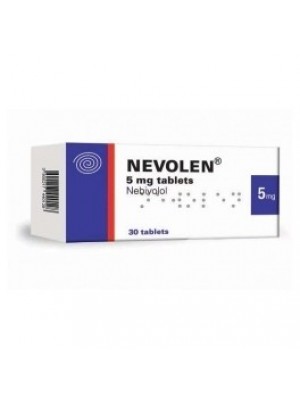
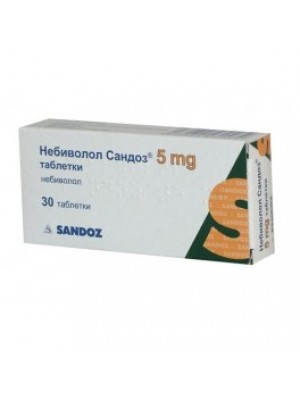
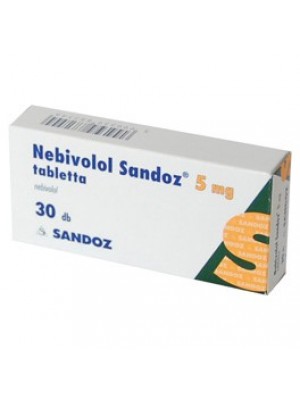
Nebivolol table. 5 mg. 30 tablets Nebivolol Sandoz WHAT IS A..
15.00€