Your shopping cart is empty!
Welcome visitor you can login or create an account.
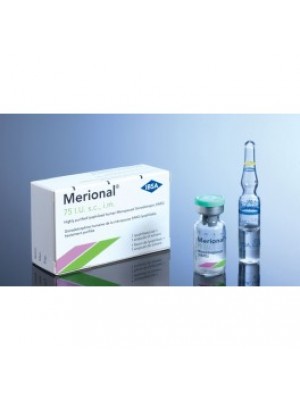
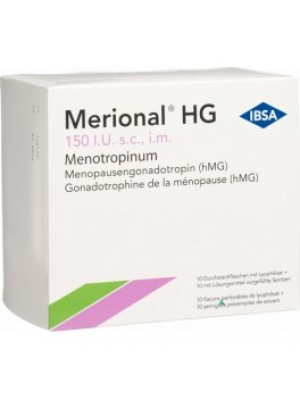
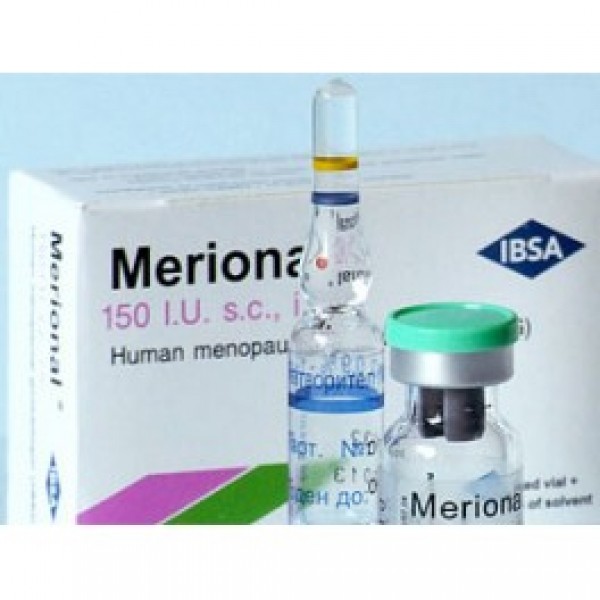
MERIONAL ampoule. 150 IU + solvent
Product Code: MERIONAL ampoule. 150 IU + solvent
Availability: In Stock
Product viewed: 1536


MERIONAL ampoule. 150 IU + solvent

Qualitative and quantitative composition
1 vial MERIONAL 150 IU contains: Active substance: Human menopausal gonadotropin (HMG) 150 IU, 150 IU providing follicle-stimulating hormone (FSH) and 75 IU luteinizing hormone (LH) - activity.
* 1 IU LH activity was determined by standardizing a human gonadotropin, to achieve the ratio of FSH and LH 1: 1.
3 PHARMACEUTICAL FORM
Powder for solution for injection
Of the powder: white lyophilised powder
Type of solvent: clear colorless solution
4 Clinical data
4.1. indications
1 Anovulation (including polycystic ovarian disease, PCOD) in women who do not respond to treatment with clomiphene citrate.
2 Stimulating multiple follicular development in patients who will undergo assisted reproductive technologies (APT) as fertilization in-vitro (IVF), gamete intra-fallopian transplant (GIFT) and zygote intra-fallopian transplant (ZIFT).
3 MERIONAL ® 150 IU is shown to stimulate spermatogenesis in men with congenital or acquired hypogonadotropic hypogonadism and concomitant therapy with human chorionic gonadotropin.
4.2 Posology and method of administration
Treatment with 150 IU MERIONAL be performed only under the supervision of a physician experienced in infertility problems.
To prevent painful injections and to reduce the likelihood of leakage of the composition from the injection site MERIONAL 150 IU should be administered slowly intramuscularly or subcutaneously. To avoid lipoatrophy, the site of subcutaneous injection needs to be changed.
The powder was dissolved in the solvent prior to application. In order to avoid administration of a large volume of liquid per 1 ml of solvent can be dissolved in 5 vials MERIONAL 150 IU.
men:
Sperm stimulated with human chorionic gonadotropin (hCG) - from 1000 to 2000 IU hCG 2-3 times weekly. It administered MERIONAL (75 lUj or 150 lU) 2-3 times a week. To achieve improvement in spermatogenesis, treatment should continue for at least three months. This clinical experience shows that it is necessary for at least 18 months of treatment to achieve adequate spermatogenesis.
Women with anovulation
The goal of therapy MERIONAL 150 IU is the development of a single mature Graafian follicle from which by administration of hCG will release the egg. MERIONAL 150 IU was administered once a day. In menstruating women treatment MERIONAL 150 IU began within the first seven days of the menstrual cycle.
Treatment is tailored to the individual patient's response. Follow by measuring follicle size by ultrasound and / or determination of estrogen secretion. The treatment generally begins with MERIONAL 75-150 IU per day and gradually increased as the patient's response. The maximum daily dose usually does not exceed 225 IU. In the absence of a satisfactory response after 4 weeks of treatment, it is suspended. Treatment is started again in the next cycle, higher than the previous dose.
When an optimal response, 24-48 hours after the last administration of 150 IU MERIONAL a single injection of 5000-10000 IU hCG. The patient is recommended to have coitus on the day of hCG administration or the next day. The alternative is intrauterine insemination.
If an excessive response, the treatment should be stopped and applies hCG. Treatment started again the next cycle at a lower dose, compared to the previous cycle.
Women undergoing controlled ovarian stimulation for a multiple follicular development prior to in-vitro fertilization or other assisted reproductive technologies:
The most common scheme for ovarian stimulation include the use of 75 -150 IU MERIONAL day, starting from 2-3 day cycle and continued until a satisfactory follicular development. The latter was assessed by monitoring serum concentrations of estrogen and / or ultrasound. The dose is adjusted according to individual patient response, but should not exceed 450 IU daily. Satisfactory development of the follicle is typically achieved at about 10 days of treatment (range 5-20 days).
To induce maturation of the follicle, 24-48 hours after the last dose of 150 IU MERIONAL a single injection of 5000-10000 IU hCG.
In order to suppress endogenous LH maximum and controlling its tonic levels, ie to achieve the item. called. down-regulation of pituitary apply a gonadotrophin releasing hormone (GnRH). In the most frequently used route of administration, the treatment with 150 IU MERIONAL starts after about 2 weeks of initiation of treatment with agonists of GnRH. Both medicinal products are used to achieve a satisfactory follicular development. For example, two weeks after the down-regulation of pituitary agonist, for 7 days is administered 150-225 IU MERIONAL. The dose is adjusted according to the individual response of the patient's ovaries.
Experience with assisted reproductive technologies shows that in general the probability of a successful outcome is the same during the first 4 times, and then gradually decreases.
Women with anovulation resulting from severe deficiency of luteinizing hormone (LH) and follicle-stimulating hormone (FSH)
The goal of treatment with 150 IU MERIONAL in women with hypogonadotropic hypogonadism regression of single mature Graafian follicle from which, by subsequent administration of hCG will release the oocyte. As these women have menstruation and have low endogenous estrogen secretion, treatment can commence at any time.
Treatment was assessed according to the individual patient's response, which was monitored by measuring ultrasound follicle size and / or estrogen secretion. Treatment usually begins with 75-150 IU MERIONAL and gradually increased according to individual patient response. For proper dose escalation MERIONAL®150 IU, dosage adjustment is made 7-14 days increased by 150 IU. It is permissible extend the duration of stimulation to 5 weeks per cycle.
Upon receipt of a satisfactory response within 24-48 hours after the last dose of 150 IU MERIONAL apply 5000-10000 IU hCG. The patient is recommended to have coitus on the day of hCG administration or the next day. The alternative is intrauterine insemination.
It should be borne in mind luteal phase because of the lack of substances with luteotrophic activity (LH / hCG) can lead to premature loss of the corpus luteum.
If an excessive response, treatment should be stopped and administered hCG (see. T. 4.4.). Treatment is started again in the next cycle at a dose lower than the preceding cycle.
4.3. Contraindications
MERIONAL 150 IU should not be used in the following patients:
• hypersensitivity to human menopausal gonadotropin or any of the excipients;
• tumors of the hypothalamus or pituitary. MERIONAL 150 IU must not be given to women of:
• ovarian enlargement or OVARIAN CYST without regard to polycystic ovarian disease;
• gynecological haemorrhages of unknown aetiology; ovarian, uterine or breast cancer.
MERIONAL 150 IU should not be used during pregnancy and lactation.
MERIONAL 150 IU must be used in cases where it can not be expected to effectively respond, e.g. .:
women:
• primary ovarian failure;
• malformations of sexual organs incompatible with pregnancy
• fibroid tumors of the uterus incompatible with pregnancy.
men:
• primary testicular failure.
4.4. Special warnings and special precautions for use
MERIONAL 150 IU highly gonadotrophic acting drug and can cause mild to severe adverse reactions. Therefore, it should only be administered by physicians experienced in infertility problems and their management. To minimize the risk of ovarian hyperstimulation syndrome and multiple pregnancy is recommended ultrasound and measurement of oestradiol levels.
Gonadotrophin therapy requires a certain time commitment of doctors, assisted by other health professionals, and the availability of appropriate monitoring equipment. The safety and efficiency of treatment with 150 IU MERIONAL women require monitoring the response of the ovaries by ultrasound alone or, preferably, regular determining serum levels of estradiol. Response to treatment with human menopausal gonadotropin (hMG) may vary in different patients, and some response is unsatisfactory. And in both men and women is to be administered as the lowest effective dose, which can achieve the expected result.
Treatment for Women:
Before starting treatment, you should consider whether the couple's infertility is suitable for this therapy and follow generally accepted contraindications for pregnancy. In particular, patients should be screened for HYPOTHYROIDISM, hyperprolactinemia, and tumors of the pituitary gland or hypothalamus and appropriate specific treatment.
Patients undergoing stimulation of follicular maturation or treatment of anovulatory infertility in assisted reproductive technologies may be an increase in the ovaries or manifestation of ovarian hyperstimulation syndrome. To reduce the incidence of these adverse effects is recommended strict adherence to dosage MERIONAL150 IU, route of administration and careful monitoring.
The precise interpretation of the data for follicular development and maturation requires an experienced doctor in this regard.
Ovarian hyperstimulation syndrome (OHSS)
OHSS is a condition different from uncomplicated ovarian enlargement. This is a syndrome that is manifested by a gradual worsening of symptoms. Manifested by a strong increase in the size of the ovaries, high serum concentrations of sex steroid hormones and increased vascular permeability, pleural and sometimes pericardial effusion.
The following symptoms may occur in severe cases of OHSS: abdominal pain, feeling of fullness in the abdomen, strongly enlarged ovaries, weight gain, dyspnoea, oliguria and gastrointestinal symptoms such as nausea, vomiting and diarrhea. Clinical studies indicate hypovolemia, hemoconcentration, electrolyte imbalances, ascites, hemoperitoneum, pleural effusions, hydrothorax, acute respiratory distress syndrome and thromboembolic events.
Excessive ovarian response to gonadotropin treatment rarely leads to the manifestation of OHSS unless ovulation induction is not administered hCG. Therefore, in the manifestation of OHSS does not apply hCG, and the patient is advised to abstain from sexual intercourse or to use barrier contraceptive methods for at least 4 days. OHSS may progress rapidly (within 24 hours to several days) and turn into a serious medical problem. Therefore, patients should be monitored for at least 2 weeks after administration of hCG.
recommend ultrasound or determining the levels of estradiol. In case of anovulation, the risk of OHSS or multiple pregnancy is increased in serum estradiol> 900 pg / ml (3300 pmol / i) and 3 follicles with diameters 14 mm or more. In ART increased risk of experiencing OHSS occurred in serum estradiol> 3000 pg / ml (11000 pmol / l) and 20 or more follicles with a diameter of 12 mm or more.
When serum estradiol> 5500 pg / ml (20200 pmol / l) and in the presence of a total of 40 or more follicles may hCG administration is not necessary.
Adherence to the prescribed dose MERIONAL 150 IU, treatment regimen and careful monitoring of therapy will reduce the risk of manifestation of OHSS and multiple pregnancy (see. Tons. 4.2. "Dosage and method of administration" and so on. 4.8. "Undesirable effects ").
In ART, aspiration of all follicles prior to ovulation may reduce the frequency of occurrence of OHSS.
OHSS may be more severe and more pronounced clinical picture in case of pregnancy. Most often, OHSS occurs after discontinuation of hormone treatment and peaked at 7-10 days after treatment. Usually, OHSS resolves spontaneously with onset of menstruation.
In event of severe OHSS, gonadotrophin treatment is discontinued (if it still applies), the patient is hospitalized and specific therapy for OHSS. This syndrome occurs more often in patients with PCOD.
multiple pregnancy
Multiple pregnancy, especially with a large number of fruits, high risk and maternal and perinatal complications.
In patients undergoing ovulation induction with MERIONAL 150 IU, the incidence of multiple pregnancy is increased compared with natural conception. In most cases it comes to twins. To minimize the risk of developing multiple pregnancy is recommended careful monitoring of ovarian response.
In patients undergoing assisted reproductive technologies, the risk of multiple pregnancy is related mainly to the number returned to the uterus embryos, quality and age of parents.
Before starting therapy, patients should be warned of the increased risk of multiple pregnancy.
Fetal loss
The incidence of fetal loss due to the inability to wear or abortion is higher in patients undergoing stimulation of follicular growth for ovulation induction or assisted reproductive technologies, compared to the normal population.
ectopic pregnancy
The risk of ectopic pregnancy in women with a history of diseases of the fallopian tubes is higher, whether the pregnancy is the result of natural conception or treatment of infertility. The cases of ectopic pregnancy after in-vitro fertilization is 2-5% compared to 1-1.5% in the general population.
Neoplasms of genital organs
There was evidence of benign and malignant tumkori ovarian and other reproductive organs in women treated with multiple drugs for the treatment of infertility. It is not yet known whether treatment with gonadotrophins increases the baseline risk of these tumors in patients suffering from infertility.
congenital anomalies
The incidence of congenital abnormalities after assisted reproductive originator may be slightly higher compared with natural conception. It is believed that this is due to differences in parental characteristics (eg. Maternal age, sperm characteristics) and multiple pregnancies.
thromboembolic events
In women with generally recognized risk factors for thromboembolic events, such as personal or family history, treatment with gonadotropins may further increase this risk. In these women should carefully assess the risk / benefit of the use of HCG. It should be noted that, in itself, pregnancy also carry an increased risk of a thrombotic event.
Treatment for men
Elevated levels of endogenous FSH are indicative of primary testicular failure. Such parents do not respond to therapy MERIONAL / hCG
Recommended semen analysis 4-6 months after initiation of treatment to assess the response.
4.5. Interactions
Co-administration of 150 IU MERIONAL other drugs to stimulate ovulation (eg. HCG, clomiphene citrate) may potentiate the follicular response. Co-administration of a GnRH agonist to suppress pituitary can lead to a need to increase the dose of 150 IU, MERIONAL to achieve a satisfactory response of the ovaries. Data on other kpinichno significant drug interactions.
MERIONAL 150 IU must not be mixed with other drugs in the same injection.
4.6. Pregnancy and lactation
Use in pregnancy
MERIONAL 150 IU must not be used in pregnancy. Data on teratogenic risk following controlled ovarian stimulation in clinical use with gonadotropins. There is insufficient clinical data to fully eliminate the risk of teratogenicity when administered in pregnant women.
Use in lactation
MERIONAL 150 IU is not indicated during lactation. Prolactin secretion during lactation can lead to scarce response to ovarian stimulation.
4.7. Effects on ability to drive and use machines
There are no studies on the effects on ability to drive and use machines.
4.8. Undesirable effects
With the use of urinary gonadotropins, occasional occurrence of allergic reactions. Most often, they manifest themselves as local reactions - pain, rash at the site of injection, or general effects of rash and fever.
Men have not been established. Women: nausea, vomiting.
Increased risk of hyperstimulation exists if estrogen levels in urine exceed 540 nmol (150 mcg) / 24 hours estrogen plasma levels exceeding 3000 pmol / l (800 picograms / ml) or at their sharp rise. In this case, treatment with 150 IU MERIONAL immediately stopped and administered hCG. Severe OHSS may be life-threatening. It is characterized by large ovarian cysts (with the risk of rupture), acute abdominal pain, ascites, often hydrothorax, sometimes thromboembolic event.
4.9. overdose
The results of overdose MERIONAL 150 IU are unknown, although it may be expected ovarian hyperstimulation syndrome described in paragraph 4.4.. "Special warnings and special precautions for use".
Write a review
Your Name:Your Review: Note: HTML is not translated!
Rating: Bad Good
Enter the code in the box below:
Related Products