Your shopping cart is empty!
Welcome visitor you can login or create an account.
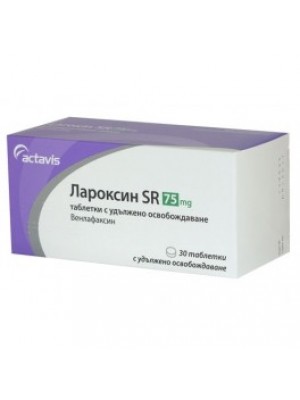
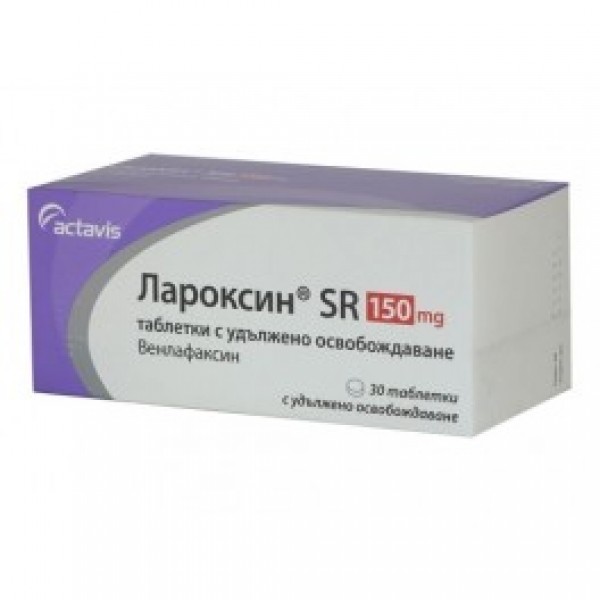
LAROXIN SR 150 mg. 30 tablets
Product Code: LAROXIN SR 150 mg. 30 tablets
Availability: In Stock
Product viewed: 1531


LAROXIN SR 150 mg. 30 tablets
WHAT LAROXIN SR AND WHAT IT IS USED
Laroxin SR belongs to the group of medicines called antidepressants that are used for alleviating depressive symptoms.
The drug also has anxiolytic properties and is used for the treatment of anxiety. Laroxin SR applies to:
• alleviating the symptoms of depression, including. depression associated with anxiety, as well as in patients of the hospital treatment and in ambulatory patients.
• to prevent worsening of depressive episode or occurrence of new depressive episodes.
• for the treatment of symptoms associated with specific anxiety disorders including. and with continued dosing.
• For the treatment of social anxiety disorder and generalized anxiety disorder.
2. WHAT YOU NEED TO KNOW BEFORE TREATMENT WITH LAROXIN SR
Laroxin SR does not apply to:
• Pregnancy (unless your doctor has told you so) and lactation;
• Known hypersensitivity to the active substance or to the excipients;
• Concomitant use of the product with other antidepressants known as MAO inhibitor or taking MAOI in the last two weeks before starting treatment with Laroksin SR;
• If you feel depressed and / or have an anxiety disorder is sometimes possible to think about harming or killing yourself. These may be increased when first starting antidepressants, since these medicines all take time to start running - usually about two weeks but sometimes longer.
You may be more likely to think like this:
-If You have previously had thoughts of suicide or self-harm;
- If you are a young person; Data from clinical studies suggest an increased risk of suicidal behavior in young people (under 25 years) with psychiatric conditions who were treated with an antidepressant.
If at any time there you have thoughts of harming or killing yourself, immediately contact your doctor or go to hospital!
You may find it helpful to tell a relative or close friend that you are depressed or have an anxiety disorder, and ask them to read this leaflet. You might ask them to tell you if they think your depression or anxiety is getting worse, or are worried about changes in your behavior.
• Age below 18 years.
You should consult with your doctor or pharmacist if:
• suffer from liver or kidney disease, as prescribed dose can be reduced;
• If you suffer from epilepsy. The doctor will closely monitor you throughout the course of treatment.
Application of Laroxin SR and intake of foods and beverages
The product should be taken with food.
Pregnancy and lactation
Before taking any medicine, consult your doctor or pharmacist
It is proven safety during pregnancy. SR Laroksin not be used during pregnancy unless absolutely necessary. Use of the product in the late stage of pregnancy or prenatal must be given to the possibility of developing withdrawal symptoms in the newborn. In neonates whose mothers received the product in the last three months of pregnancy were observed respiratory failure or prolonged hospital stay.
Data on the passage of the product in human milk. In such cases, you must decide whether to hold a treatment or to stop breastfeeding.
Driving and using machines
Although Laroksin SR showed no effect on psychomotor, cognitive or common behaviors in healthy volunteers, some psychoactive substances can impair judgment, thinking or motor reactions. Patients should be warned about this and be careful in the use of machines whose use carries some risk, incl. and cars.
Taking other medicines
Please tell your doctor or pharmacist if you or your child are taking or have recently taken any other medicines, even if they have not been prescribed by your doctor
3. HOW TO USE LAROXIN SR
Always take Laroxin SR according to the instructions of the doctor!
The usual dose of Laroksin SR for the treatment of depression is 75 mg per day taken once daily. In need of additional therapeutic effect after a two-week course of treatment, the dose may be increased to 150 mg daily, taken once daily. In the event that it is necessary to use a higher dose of the latter may be increased to 225 mg, taken once daily in patients with moderate to severe depression and 375 mg per day in patients with major depression. Changes in dosage should be made at intervals of about two weeks, but not less than four days.
At a dose of 75 mg antidepressant activity of the product was proyavyava_sled conducting around two weeks of treatment.
The usual dose of Laroksin SR for the treatment of specific anxiety disorders, including social anxiety disorder is 75 mg, taken once daily. If necessary for further clinical response after two weeks of treatment, the dose may be increased to 150 mg, administered once daily. In the event that it is necessary to use a higher dose of the latter may be increased to 225 mg per day mg in patients with major depression. Changes in dosage should be made at intervals of about two weeks or more, but not less than four days.
At a dose of 75 mg anxiolytic activity of the product occurs after approximately one week of treatment. In patients who do not respond to treatment with a dose of 75 mg once daily, the dose may be increased to a maximum of 225 mg a day. The dose may be increased by not more than 75 mg daily as changes need to be made at intervals of about two weeks or more, but not less than four days. Recommended intake of the product becomes a meal.
Laroksin SR should be taken once a day at approximately the same time of day, morning or evening. Patients with impaired renal function
In patients with renal impairment and glomerular filtration rate of 10 to 70 ml / min, the daily dose Laroksin SR should be reduced by 25-50%. In hemodialysis patients, the daily dose should be reduced by 50%. The medicinal product should not be administered during hemodialysis.
Patients with impaired hepatic function
In patients with moderate hepatic impairment, the dose should be reduced by 50%. Some patients may require a dose reduction by more than 50%.
Elderly
Usually no dose adjustment is required in elderly patients. However, caution is required in such cases (because renal impairment). It is necessary to apply the lowest effective dose and, if necessary by increasing the dose patients should be monitored.
Children and adolescents
Not been proven effective Laroksin SR in patients under 18 years of age. Maintenance and long-term treatment
It is assumed that in case of acute episodes of major depression require continuous treatment for several months or more. Patients with specific anxiety disorders including. social anxiety disorder often suffer for years and in this case it is necessary to conduct long term therapy.
The effectiveness of Laroksin SR in long-term treatment (up to 12 months in depression and b months under specific anxiety disorders, incl. SAD). Typically, when the drug is used to prevent deterioration of a depressive episode or occurrence of new depressive episodes, the dosage regimen is the same as that which is applied in the initial treatment.
The physician should periodically reassess each patient appropriateness of continued treatment with Laroksin SR. Discontinuation of treatment
Sudden discontinuation of treatment should be avoided. After a treatment period of more than six weeks is recommended gradual reduction of the administered dose over a period of at least two weeks. The period of gradually reducing the dosage can depend on a very dose, the duration of treatment and the individual patient.
If you have the impression that the effect of Laroksin is too strong or too weak, talk to your doctor or pharmacist!
If you take a large amount of the drug:
Accidental administration of higher doses than prescribed, immediately contact a doctor for help!
If you forget to use Laroksin SR
If you forget to take another dose within 12 hours of the last dose, then take it to the next day and continue normal treatment. If it has been more than 12 hours should skip the intake and the next day to continue normal treatment.
4. POSSIBLE SIDE EFFECTS
Like any other medicine, Laroxin SR can cause side effects
SR Laroksin usually well tolerated. If you experience side effects must be borne in mind that they usually are not serious and quickly resolved.
If any side effects worry you, note that they do not occur in any patient. Some of these reactions are very rare.
Provided that some of these symptoms are severe or begin to bother you, you should inform your doctor: insomnia, increased Does irregular heartbeat, flushing or redness of the face, reduced or altered appetite, constipation, nausea, vomiting, nervousness , nervous agitation, delirium, dizziness, fatigue, difficulty sleeping, abnormal dreams, impotence, drowsiness, muscle stiffness or tremor, unpleasant sensations in the skin such as "pins and needles" or burning, sweating (incl. at night), rash, tinnitus (ringing in the ears), bruxism (teeth grinding unconsciously), severe itching, hair loss, redness, dry mouth, altered taste sensation, sensitivity, lung damage known as pulmonary eosinophilia, elevated intraocular pressure, loss or weight gain, decreased libido, difficulty in urination, diarrhea, bruising, mucosal bleeding, apathy, hallucinations, severe and prolonged menstruation, hepatitis, seizures, mania, akathisia, neuroleptic malignant syndrome, serotonergic syndrome, pancreatitis, increased prolactin (a hormone produced in the brain) damage to muscle tissue, abnormal movements, or muscle tone, severe skin reactions such as Stevens Johnson syndrome and toxic epidermal necrolysis, rashes.
Should inform your doctor if you experience an allergic reaction such as skin rash or any other allergic reaction.
Some patients sometimes feel dizzy or unstable upright due to lower blood pressure. Others have seen an increase in blood pressure and slight changes in cholesterol and sodium in the blood, abnormal blood cells or changes in liver function. Sometimes blood pressure increases slowly and therefore it needs not to be monitored, especially in patients who are treated by the high blood pressure.
Very rarely observed rapid heart rate (tachycardia) and cardiac rhythm disorders. Use in children and adolescents below 18 years
Write a review
Your Name:Your Review: Note: HTML is not translated!
Rating: Bad Good
Enter the code in the box below:
Related Products
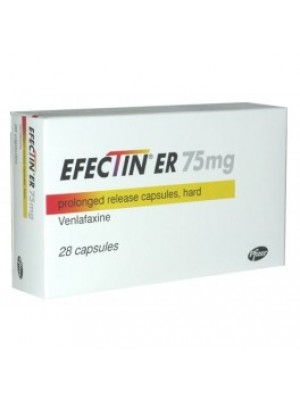
EFECTIN ER table. 75 mg.28 table EFECTIN ER WHAT IS AND WHAT..
33.00€