
Your shopping cart is empty!
Welcome visitor you can login or create an account.
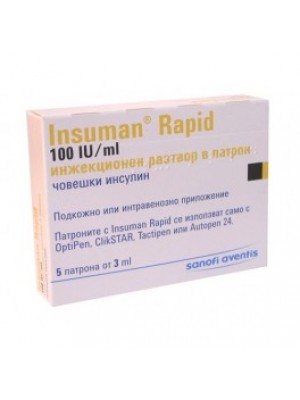
Insuman Rapid 100 IU / ml
Product Code: Insuman Rapid 100 IU / ml
Availability: In Stock

Product viewed: 1448


Insuman Rapid 100 IU / ml
What is Insuman Rapid and what it is used
Insuman Rapid contains the active substance of human insulin, which is produced by a biotechnological process, and it is identical to its own insulin in the body.
Insuman Rapid is an insulin product with rapid onset and short duration of action.
Insuman Rapid is used to reduce high blood sugar in patients with diabetes mellitus who require insulin therapy. Diabetes mellitus is a disease in which the body does not produce enough insulin to control blood sugar. Insuman Rapid may also be used for treatment of diabetic coma (coma caused by very high blood sugar) and ketoacidosis (accumulation of acid in the blood because the body breaks down fat instead of sugar), and also for controlling the blood sugar before, during and after surgery.
2. What you need to know before you use Insuman Rapid
Do not use Insuman Rapid:
If you are allergic to insulin or any of the other ingredients of this medicine (listed in section 6).
Warnings and Precautions
Talk to your doctor, pharmacist or nurse before using Insuman Rapid. Strictly follow the instructions for dosage, monitoring (blood and urine), diet and physical activity (physical work and exercise) as discussed with your doctor.
If you are allergic to this medicine or to animal insulins, talk to your doctor.
Special populations
If you have liver or kidney problems or are elderly, speak to your doctor as you may need lower doses of insulin.
travel
Before traveling consult your doctor. You may need to talk about:
the availability of your insulin in the country you are visiting;
enough insulin, syringes, etc .;
correct storage of your insulin while traveling;
timing of meals and insulin administration while traveling;
possible effects of changing to different time zones;
possible new health risks in the countries to be visited;
what to do in emergency situations when you feel unwell or become ill.
Illnesses and injuries
In these situations, the management of your diabetes may require a lot of care:
if you are ill or have a major injury, your blood sugar may increase (hyperglycaemia);
if you do not eat enough, your blood sugar may become too low (hypoglycaemia).
In most cases you will need a doctor. Contact a doctor early.
If you have diabetes type I (insulin-dependent diabetes mellitus), do not stop your insulin and continue to get enough carbohydrates. Always tell people who are caring for you or treating you that you require insulin.
Some patients with long-standing type 2 diabetes and heart disease, or stroke (stroke) treated with pioglitazone and insulin develop heart failure. Tell your doctor as soon as possible if you experience signs of heart failure such as unusual shortness of breath or rapid increase in weight or localized swelling (edema).
Other medicines and Insuman Rapid
Some medicines cause changes in the blood sugar level (decrease, increase or both depending on the situation). In any case, it may be necessary to adjust your insulin dosage to avoid too low or too high blood sugar levels. Be careful when you start or stop taking another medicine.
Tell your doctor or pharmacist if you are taking, have recently taken or might take any other medicines. Ask your doctor before taking any medicine whether it can affect your blood sugar and how to take action if necessary.
Medicines that may cause decrease your blood sugar (hypoglycaemia) include:
all other medicines to treat diabetes;
angiotensin converting enzyme (ACE) inhibitors (used in the treatment of certain heart disease or high blood pressure);
disopyramide (used to treat certain cardiac diseases);
fluoxetine (used to treat depression);
fibrates (used to lower the high levels of lipids in the blood);
monoamine oxidase inhibitors (MAOI) (used to treat depression);
pentoxifylline, propoxyphene, salicylates (such as aspirin, used to relieve pain and lower temperature);
sulfonamide antibiotics.
Medicines that may cause raising your blood sugar (hyperglycemia) include:
corticosteroids (such as cortisone, used to treat inflammation);
danazol (medicine acting on ovulation);
diazoxide (used to treat high blood pressure);
diuretics (used to treat high blood pressure or excessive fluid retention);
glucagon (pancreas hormone used to treat severe hypoglycaemia);
Isoniazid (used to treat tuberculosis);
oestrogens and progestogens (eg in the contraceptive pill used for birth control);
phenothiazine derivatives (used to treat psychiatric disorders);
somatropin (growth hormone);
sympathomimetic drugs (such as epinephrine [adrenaline], salbutamol, terbutaline used to treat asthma);
thyroid hormones (used to treat disorders of the thyroid gland);
protease inhibitors (used to treat AIDS);
atypical antipsychotic medications (such as olanzapine and clozapine).
Your blood sugar may either fall or rise if you take:
beta-blockers (used to treat high blood pressure);
clonidine (used to treat high blood pressure);
lithium salts (used to treat psychiatric disorders).
Pentamidine (used to treat certain infections caused by parasites) may cause hypoglycaemia, which may sometimes be followed by hyperglycaemia.
Beta-blockers like other sympatholytic medicines (such as clonidine, guanethidine, and reserpine) may weaken or suppress entirely the first warning symptoms which help you to recognize hypoglycaemia.
If you are not sure whether you are taking any of these medicines, ask your doctor or pharmacist.
Insuman Rapid and alcohol
Your blood sugar may rise or fall if you drink alcohol.
Pregnancy and lactation
If you are pregnant or breast-feeding, think you may be pregnant or planning to become pregnant, ask your doctor or pharmacist before taking this medicine.
Inform your doctor if you become pregnant or if you are already pregnant. During pregnancy and after birth may need your dose of insulin to be changed. Careful control of your diabetes, and prevention of hypoglycaemia, is especially important for the health of your baby. However, there is no experience with the use of Insuman Rapid in pregnant women.
If you are breastfeeding, talk to your doctor as you may require adjustments in your insulin doses and your diet.
Driving and using machines
Your ability to concentrate or react may be reduced if:
you have hypoglycaemia (low blood sugar);
you have hyperglycaemia (high blood sugar);
vision problems.
Keep this possible problem in all situations where you might put to risk yourself and others (such as driving a car or operating machinery). You should consult with your doctor whether on driving if:
you have frequent episodes of hypoglycemia;
the first warning symptoms which help you to recognize hypoglycaemia are reduced or absent.
Important information about some of the ingredients of Insuman Rapid
This medicine contains less than 1 mmol (2.3 mg) of sodium per dose, ie contains virtually no sodium.
3. How to use Insuman Rapid
dose
Always use this medicine exactly as prescribed by your doctor or pharmacist. If you are not sure, ask your doctor or pharmacist.
Based on your life-style and the results of your blood sugar (glucose), your doctor will:
determine how much Insuman Rapid you need a day;
Tell you when to explore your blood sugar and if necessary, urine tests;
Tell you when you may need to inject a higher or lower dose of Insuman Rapid.
Many factors can affect your blood sugar. You should be aware of these factors, so that you can react correctly to changes in your blood sugar and prevent too high or too low. See the box at the end of this leaflet for more information.
Frequency of administration
Insuman Rapid is injected under the skin 15 to 20 minutes before eating.
Method of administration
Insuman Rapid is a solution for injection under the skin, or in exceptional circumstances, into a vein (blood vessel).
Your doctor will show you in which area of the skin you should inject your insulin. With each injection, change the injection site within the defined area of the skin you are using.
Insulin administration into a vein for example to treat severe hyperglycaemia and ketoacidosis, requires experience and special safety precautions. Therefore, this should be done in a clinic or facility.
Do not use Insuman Rapid in insulin pumps - for use with these devices special insulin products. Do not use it and peristaltic pumps with silicone tubing.
How to handle the cartridges
Use bullets to Insuman Rapid with OptiPen, ClikSTAR, Tactipen or Autopen 24 to make sure you get the correct dose. Not all of these pens may be marketed in your country.
The pen should be used, as recommended from the manufacturer of the device in the patient information. The manufacturer's instructions for using the pen must be followed carefully for loading the cartridge, attaching the injection needle and administering the insulin injection.
Keep the cartridge at room temperature for 1 or 2 hours before inserting it in the pen.
Look at the cartridge before you use it. Only be used if the solution is clear, colorless with no particles visible, and has a water-like consistency.
Special care before injection
Before injection remove any air bubbles (see instructions for using the pen). You should make sure that insulin is not dirty neither alcohol nor other disinfectants or other substances.
Problems with the pen?
Refer to the manufacturer's instructions for using the pen.
If the insulin pen is damaged or not working properly (due to mechanical defects) it has to be discarded, and to use a new pen.
If the pen does not work well, you can draw the insulin from the cartridge into a syringe for injection. Therefore, you must also have needles and syringes. However, use only injection syringes which are intended for an insulin concentration of 100 IU (International Units) per ml.
If you use more than the amount of Insuman Rapid
If you have injected too much Insuman Rapid, your blood sugar may become too low (hypoglycaemia). Explore your blood sugar frequently. In general, to prevent hypoglycaemia you must eat more food and monitor your blood sugar. For information on the treatment of hypoglycaemia, see box at the end of this leaflet.
If you forget to use Insuman Rapid
If you miss a dose of Insuman Rapid or if you have not injected enough insulin, your blood sugar can significantly increase (hyperglycaemia). Explore your blood sugar frequently. For information on the treatment of hyperglycaemia, see box at the end of this leaflet;
Do not take a double dose to make up the missed dose.
If you stop using Insuman Rapid
This can lead to severe hyperglycaemia (very high blood sugar) and ketoacidosis (build-up of acid in the blood because the body is breaking down fat instead of sugar). Do not stop treatment with Insuman Rapid without consulting a doctor who will tell you what needs to be done.
If you have any further questions on the use of this product, ask your doctor, pharmacist or nurse.
Confusion insulin
You should always check the insulin label before each injection to avoid confusion between Insuman Rapid and other insulins.
4. Possible side effects
Like all medicines, this medicine can cause side effects, although not everybody gets them.
Like any insulin therapy, the most common adverse reaction was hypoglycaemia (low blood sugar). The specific frequency can not be estimated from available data (not known). Serious hypoglycaemia may cause a heart attack or brain damage and may be life-threatening. For further information on the side effects of low blood sugar or high blood sugar, see the box at the end of this leaflet.
May lead to serious allergic reactions to insulin, which can be life threatening. Such reactions to insulin or to the excipients can cause large-scale skin reactions (rash and itching all over the body), severe swelling of skin or mucosa (angioedema), shortness of breath, low blood pressure with rapid heart beat and sweating. The frequency of these reactions can not be estimated from available data.
Common reported side effects (may affect up to 1 in 10 people):
Edema - Insulin treatment may also cause temporary build-up of water in the body with swelling in the calves and ankles;
Reactions at the injection site.
Uncommon reported side effects (may affect up to 1 in 100 people):
Severe allergic reaction with low blood pressure (shock);
Injection site urticaria (itchy rash).
Other side effects include (from the available data can not be estimated):
Sodium retention;
Systemic allergic reactions - Associated symptoms may include large-scale skin reactions (rash or itching), severe swelling of skin or mucosa (angioedema), shortness of breath, low blood pressure with rapid heart beat and sweating;
Eye reactions - marked change (improvement or worsening) in control of your blood sugar can disturb your vision temporarily. If you have proliferative retinopathy (an eye disease related to diabetes) severe hypoglycaemic attacks may cause temporary loss of vision;
Skin changes at the injection site (lipodystrophy) - If you often inject insulin at the same place, subcutaneous adipose tissue at this site may shrink or thicken. Insulin injected in such a place may not work very well. Changing the site with each injection may help to prevent such skin changes;
Skin and allergic reactions - may occur other mild reactions at the injection site (such as reddening, unusually intense pain at the injection site, itching, swelling or inflammation at the injection site). They can also spread around the injection site. Most minor reactions to insulins usually resolve in a few days or a few weeks.
Insulin treatment can cause the body to produce antibodies to insulin (substances that act against insulin). Very often, however, this may require a change in insulin dose.
If you get any side effects, tell your doctor, pharmacist or nurse. This includes any possible effects not listed in this leaflet.
5. How to store Insuman Rapid
Keep out of the reach and sight of children.
Do not use Insuman Rapid after the expiry date stated on the carton after "EXP" and vial label after "EXP". The expiry date refers to the last day of that month.
Unopened cartridges
Store in a refrigerator (2 ° C - 8 ° C). Do not freeze. Do not put Insuman Rapid near the freezer compartment or freezer bag. Keep the vial in the outer carton to protect from light.
In use cartridges
Cartridges in use (in the insulin pen) or carried as a spare may be stored for a maximum of 4 weeks below 25 ° C, away from direct heat (eg next to a heating unit) or direct light (direct sunlight or near lamp). The cartridge in use must not be stored in the refrigerator. Do not use the cartridge after this period.
Do not dispose of medications in wastewater or household waste. Ask your pharmacist how to dispose of medicines no longer required. These measures will help to protect the environment.
6. Contents of the pack and other information
What Insuman Rapid
The active substance is human insulin. One ml of Insuman Rapid contains 100 IU (International Units) of the active substance human insulin.
The other ingredients are: metacresol, sodium dihydrogen phosphate dihydrate, glycerol, sodium hydroxide (see section 2, "Important information about some of the ingredients of Insuman Rapid"), hydrochloric acid (for pH adjustment) and water for injections.
Insuman Rapid looks like and contents of the pack
Insuman Rapid is a clear, colorless solution, free of visible particles and a water-like consistency.
Insuman Rapid is supplied in cartridges containing 3 ml solution (300 IU). Packs of 3, 4, 5, 6, 9 and 10 cartridges of 3 ml.
Not all pack sizes may be marketed.
Write a review
Your Name:Your Review: Note: HTML is not translated!
Rating: Bad Good
Enter the code in the box below:
Related Products
Insuman combo OPTIPEN 25 300IU WHAT INSUMAN COMB 25 AND WHAT..
57.00€
Insuman Basal OPTIPEN 300 IU 3 ml Insuman Basal WHAT IS AND ..
57.00€
What ABASAGLAR is and what it is used for
ABASAGLAR is a so..
198.00€