
Your shopping cart is empty!
Welcome visitor you can login or create an account.
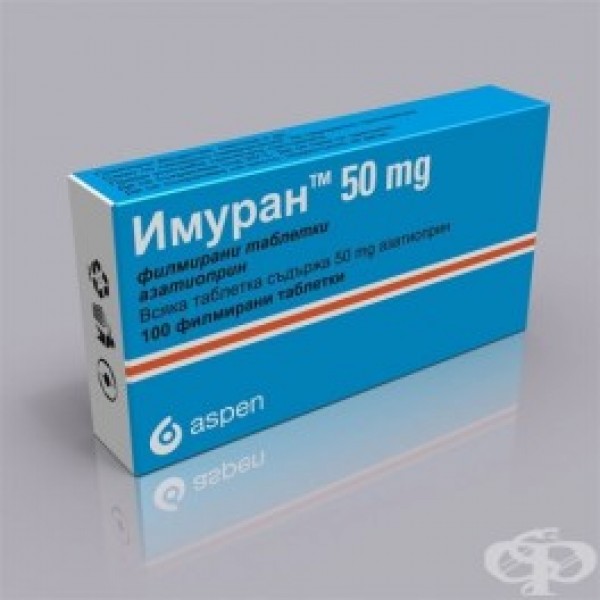
IMURAN. 50 mg. 100 table
Product Code: IMURAN. 50 mg. 100 table
Availability: In Stock
Product viewed: 2073


IMURAN. 50 mg. 100 table

Your medicine is called Imuran and is in the form of tablets. The tablets contain 50 mg of the active ingredient azathioprine (Imuran).
Contain the following inactive ingredients: lactose, maize starch, hydrolyzed starch, stearic acid, magnesium stearate, purified water, metilhidroksipropil cellulose and polyethylene glycol 400.
Under what conditions apply Imuran?
Imuran is a group of medicines called immunosuppressants. It is used to suppress the immune system functions. Immunosuppressants are drugs whose use is sometimes necessary to support the body when taking transplanted organs, eg. kidney, heart or liver. Used to treat these diseases in which the immune system attacks the body's own cells (autoimmune disease): severe rheumatoid arthritis, systemic lupus erythematosus, dermatomyositis and polymyositis, autoimmune chronic active hepatitis, pemphigus vulgaris, polyarteriitis nodosa, autoimmune hemolytic anemia and Chronic recurrent idiopathic thrombocytopenic purpura. Imuran can be used to treat multiple sclerosis, Crohn's disease and chronic ulcers, hemorrhagic colitis. Your doctor has determined that this medicine is suitable for you and your condition. Imuran can be used alone, but in most cases it is used in combination with other medicines.
BEFORE YOU TAKE
You should not take Imuran:
If you are allergic to azathioprine or any of the other ingredients of Imuran
If you are allergic to Puri-nethol (mercaptopurine), medicine similar to Imuran.
Before taking this medicine, tell your doctor if:
Are pregnant or breastfeeding
You plan to have a child. Discuss with your doctor whether you are male or female
You suffer from liver or kidney disease
Have a condition in which the body produces a very small amount of a substance (enzyme) thiopurine methyltransferase;
You have a condition known as Syndrome Lesch-Nyhan
If you have had chickenpox or herpes zoster.
If you decide to be vaccinated, tell your doctor before administering the vaccine. Imuran may affect the mechanism by which the vaccine or lead to a poor response from the body to the vaccine. Do not break the tablets before taking. If you handled the broken tablet, immediately wash your hands.
If you are pregnant or breast-feeding
Imuran should not be used in women who are pregnant or likely to become pregnant in the near future without careful consideration by the physician of the potential hazard to the fetus against the potential benefit to the mother. As with other cytotoxic intake is recommended to apply appropriate contraceptive measures if either partner is receiving Imuran. The active ingredient of Imuran passes into the breast milk of mothers who took the drug. Breastfeeding is not recommended in women who are treated with Imuran.
Effects on ability to drive and use machines
No data on the effect of azathioprine on the ability to drive or operate machinery. Before driving or operating machinery should make sure that the medication will not affect these activities.
Interaction with other drugs
e sure to tell your doctor about all other medicines you are taking or have recently taken, even those you bought yourself without a prescription. Imuran treatment can lead to abnormal blood from your picture. Therefore, your doctor will arrange regular blood tests during treatment with Imuran. Frequency of these tests usually decreases after prolonged treatment with Imuran. Some other drugs also affect blood and this effect can be increased if you are taking these medicines together with Imuran.
Tell your doctor immediately if you are taking any of the following:
penicillamine (used primarily in the treatment of rheumatoid arthritis)
captopril (used primarily in the treatment of high blood pressure and heart failure)
cimetidine (used to treat stomach ulcers and digestive disorders)
indomethacine (used as an analgesic and anti-inflammatory drug) and
co-trimoxazole (used to treat infections)
Other drugs that may interact with Imuran and assumed that must tell your doctor include:
allopurinol, oxipurinol and thiopurinol (used mainly in the treatment of gout)
tubocurarine, succinylcholine (used in anesthesia)
furosemide (used to reduce swelling in the accumulation of fluids)
warfarin (used to prevent blood clots) and
mesalazine, olsalazine, sulphasalazine (used mainly in the treatment of chronic ulcers, hemorrhagic colitis).
HOW TO TAKE IMURAN TABLETS?
It is important to take your medicine at the right of the doctor's time. The physician determines the dosage and duration of treatment depending on the condition and change of blood counts. At regular intervals the doctor will appoint a blood test. They are made to determine the number of blood cells and if that is necessary to adjust the dose of the drug.
Dosage after transplantation in adults and children: The usual starting dose is 5 mg / kg body weight (bw) orally on the first day. Apply a maintenance dose of 1 to 4 mg / kg bw daily.
In elderly patients usually the lowest therapeutic dose. Dosage in adults with multiple sclerosis: The recommended dosage for treatment of multiple sclerosis is 2-3 mg / kg bw daily.
Dosage for adults and children for the treatment of autoimmune diseases, Crohn's disease and chronic ulcers, hemorrhagic colitis: The initial dosage is between 1 and 3 mg / kg bw daily, the dose in this range may vary depending on the change of state (may occur after weeks or months) and haematological tolerance. The usual maintenance dose is in the range of 1 mg / kg bw to 3 mg / kg bw daily.
In elderly patients usually the lowest therapeutic dose. The tablets should be swallowed whole with some water. A small number of patients may have nausea after the first administration of the drug. This can be reduced when taking the tablets after meals.
What to do in case you take more than prescribed
If you take too high a dose of medicine or any other of your environment (especially children) ingested the drug accidentally, tell your doctor or call an ambulance.
What to do in case you miss a dose
If you forget to take a dose, do not double the dose to "make up" missed. Wait and take your next dose at the regular time. Tell your doctor about missed doses.
POSSIBLE SIDE EFFECTS
Imuran, like any medication, can cause side effects. Some people are allergic to medicines.
STOP taking the medicine and tell your doctor immediately if soon after taking Imuran notice any of the following signs:
Pain in the muscles or bones
Kidney problems
Dizziness, especially when standing
Severe diarrhea and / or abdominal pain
Jaundice (yellow skin and eyes eclairs)
Patients treated with immunosuppressants have a greater risk of developing tumors, incl. skin cancer. During treatment with Imuran should avoid excessive exposure to sunlight. It is necessary to use protective clothing and cosmetics with a high SPF. Disease chickenpox and shingles may be serious in patients receiving immunosuppressants. Therefore, you should avoid contact with chicken pox or herpes zoster.
Tell your doctor immediately if during treatment with Imuran notice any of the following signs:
Fever or other signs of infection
unexpected bleeding or bruising
Cough or difficult breathing, as with lung infection
Nausea and vomiting
Tiredness, dizziness, weakness
If you have been in contact with chicken pox or herpes zoster.
During treatment with Imuran may find that your thinning hair. In many cases, it grew again, although the drug continues. If thinning hair bother you, talk to your doctor. Inform your doctor if you notice any side effects not listed in this leaflet, or if there is something troubling you, interfere with or understand it.
STORE THIS MEDICINE
Keep Imuran tablets below 25 ° C, and protected from direct light. Keep out of reach of children. Do not use after the expiry date shown on the packaging. It is recommended that after stop taking the drug to return unused tablets to your doctor or pharmacist to be stored or disposed of safely.
REMEMBER!
This medicine is only for you. Never give it to someone else. It may harm them, even if their symptoms are like yours.
Write a review
Your Name:Your Review: Note: HTML is not translated!
Rating: Bad Good
Enter the code in the box below:
Related Products

Azathioprine table. 50 mg. 100 tab WHAT azathioprine - TEVA ..
49.00€

Azathioprine . 50 mg. 100.tablets WHAT azathioprine - TEVA A..
49.00€

Dexamethason 4 mg. 25 ampoulesWhat is Dexamethason KRKA and ..
39.00€