
Your shopping cart is empty!
Welcome visitor you can login or create an account.
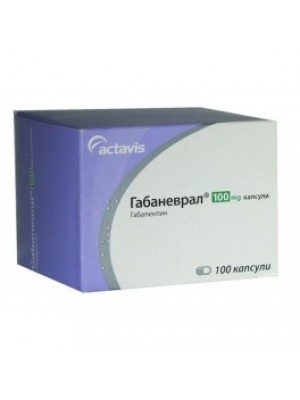
GABANEVRAL 400 mg. 100 capsules
Product Code: GABANEVRAL 400 mg. 100 capsules
Availability: In Stock

Product viewed: 1805


GABANEVRAL caps. 400 mg
What Gabanevral and what it is used?
Gabanevral a structure analogous to gamaaminomaslenata acid, but the mechanism of action is different from that of many other drugs that interact with its synapses. Owns anticonvulsant action.
Gabanevral is used to treat:
Epilepsy:
Monotherapy in adults and children over 12 years with partial seizures with or without secondary generalization.
Adjunctive therapy in adults and children over 3 years with partial seizures with or without secondary generalization.
Neuropathic pain:
The treatment of neuropathic pain in patients over 18 years.
What you need to know before you start treatment with Gabanevral
Gabanevral not be used in patients with hypersensitivity to the active substance or to any of the excipients.
In this medicinal product, please note the following:
Treatment product is a proven phenomenon of increased symptoms after stopping treatment. However, treatment discontinuation should be gradual due to risk of unlock status epilepticus. The same goes for dose reduction, discontinuation or replacement with another anticonvulsant. This should be done gradually over a period of one week. This product is not effective in absence seizures.
Patients taking Gabanevral may show changes in mood and behavior.
The product is used with caution in patients with a history of mental illness because of the risk of psychotic episodes. They resolved with dose reduction or discontinuation.
Small number of people, epileptics such as gabanevral have had thoughts of harming or killing yourself. If you have these, contact your doctor.
Application Gabanevral and intake of food and beverages:
No evidence of need for special treatment or restrictions on certain foods and beverages while taking this product.
Pregnancy
Before taking any medicines, check with your doctor or pharmacist.
There are no adequate studies in pregnant women. It is therefore recommended Gabanevral be used in those cases when the potential benefit to the mother is greater than the potential risk to the fetus.
Lactation
Gabanevral passes into breast milk. Therefore, you should carefully consider whether the benefits of treatment clearly outweigh the risks of it.
Driving and using machines:
Patients should be advised not to drive or perform activities requiring a high degree of concentration until you are sure that the product does not change their reactivity.
Taking other medicines:
No evidence of interactions between Gabanevral and phenytoin, phenobarbital, valproic acid and karabamazepin.
Combined use of the product with an oral contraceptive containing norethindrone and / or ethinyl estradiol, does not affect the pharmacokinetics.
The bioavailability of the product decreased by about 20% when administered with antacids containing aluminum and magnesium. It is desirable that the product should be administered at least 2 hours after taking antacids.
Probenecid does not affect renal excretion of Gabanevral. In determining the protein in urine tests Ames N-Multitrix SG can be observed false positive results. Preferably in this case is to use a more specific test with sulfosalicylic acid.
In patients receiving concomitant morphine Gabanevral may increase the concentration of product in the plasma. These patients should be monitored for signs of CNS depression such languor and doses of morphine Gabanevral must be reduced.
How is Gabanevral?
Epilepsy:
Adults and children over 12 years - starting dose 300 ml three times daily on day 1.
The daily dose divided into three equal intake can be increased to a maximum dose of 3600 mg.
The maximum time between doses in the triple regimen should not exceed 12 hours to prevent seizures.
Dose: 900 mg - Day 1 to 300 mg once daily
- Day 2 to 300 mg once daily
- Day 3 to 300 mg once daily
For children 3 to 12 years - the product effective dose is 25-35 mg / kg / day, taken in three equal doses.
Originally titration to achieve therapeutically effective dose is made in the first three days as they apply 10 mg / kg / day on day 1, 20 mg / kg / day on day 2 and 30 mg / kg / day for 3 days.
The daily dose in three divided doses may be increased to a maximum dose of 35 mg / kg / day.
Dosage in children 3 to 12 years:
Body weight / 17 to 25 kg / - daily dose - 600 mg
Body weight / 26 to 36 kg / - daily dose - 900 mg
Body weight / 37 to 50 kg / - daily - 1200 mg
Body weight / 51 to 72 kg / - daily - 1800 mg
Dosage in children - starting doses:
Body weight: Dose: Day 1 Day 2 Day 3
17-25600 mg 200 mg 200 mg once once 200 mg once
day day day
more than 26 kg 900 mg 300 mg 300 mg once twice three 300 mg
times daily daily daily
Neuropathic pain in adults:
The starting dose is 900 mg / day, taken in three equal doses. This dose can be increased as necessary until the clinical response to a maximum dose of 3600 mg / day.
Patients with renal insufficiency:
Creatinine clearance in mg / min Total daily dose in mg / day
more than 80 900-3600
50-79 600-1800
30-49 300-900
15-29 150-600
less than 15,150 to 300
The total daily dose should be administered in three doses.
In patients undergoing hemodialysis is recommended loading dose of 300 to 400 mg after each 4 hours of hemodialysis take 200 to 300 mg Gabanevral.
Possible side effects:
Epilepsy in adults:
Since Gabanevral was used more frequently in combination with other antiepileptic drugs, it is not possible to determine which product caused the corresponding reaction.
The most common side effects - stuporous and confused
Common - ataxia, fatigue, visual disturbances, tremors, blurred vision, myopia, impaired speech, forgetfulness, weight loss, numbness, joint pain, heartburn, anxiety, weight gain
Uncommon - low white blood cell count, nervousness, fever, impotence.
Rarely loss of urine, inflammation of the pancreas, liver enzymes, severe skin reactions, depression, emotional lability, hostility, changes in thinking.
Epilepsy in children:
In children aged 3-12 years the most common adverse reactions are emotional lability, nervousness, changes in thinking.
In children aged 3-12 years in clinical trials, adverse reactions with an incidence of 2% or more compared with placebo: languor, fatigue, weight gain, emotional lability, confusion, movement disorders, nausea, bronchitis, respiratory infections, fever.
Neuropathic pain:
The most common side effects are confusion and languor.
Common - diarrhea, dry mouth, peripheral edema, weight gain, abnormal gait, forgetfulness, movement disorder, thinking abnormal, rash and short-sightedness.
Uncommon - injuries, weight loss, back pain, flatulence, nausea, hyperesthesia, dizziness, dyspnea, pharyngitis.
Adverse reactions in postmarketing surveillance:
Other adverse reactions observed in the treatment of epilepsy and neuropathic pain is acute renal failure, allergic reactions, incl. urticaria, alopecia, chest pain, hepatitis, jaundice, hallucinations, movement disorders, tinnitus, palpitations.
Of adverse events following discontinuation of treatment most frequently reported anxiety, insomnia, nausea, pain and sweating.
Write a review
Your Name:Your Review: Note: HTML is not translated!
Rating: Bad Good
Enter the code in the box below:
Related Products


GABANEURAL 300 mg. 100 capsulesWHAT GABANEURAL AND WHAT IT I..
59.00€

GABANEURAL 400 mg. 100 capsulesWHAT GABANEURAL AND WHAT IT I..
69.00€