Your shopping cart is empty!
Welcome visitor you can login or create an account.
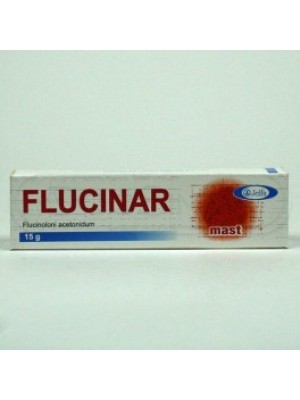
Flucinar N cream 15g.
Product Code: Flucinar N cream 15g.
Availability: In Stock

Product viewed: 3059


Composition
Medicines
Fluocinolone acetonide 0.25 mg / g Neomycin sulfate 5.00 mg / g
Excipients
Propylene glycol, liquid paraffin, cetostearyl alcohol, sorbitan stearate, polysorbate, methyl parahydroxybenzoate, propyl parahydroxybenzoate, purified water.
Properties and action
The components of Flucinar N cream have a combined effect in the treatment of inflammatory skin lesions of allergic origin and hyperkeratosis complicated by bacterial infection. Fluocinolone acetonide is a potent glucocorticosteroid intended for topical application to the skin. It has a powerful anti-inflammatory, anti-inflammatory, anti-allergic and vasoconstrictive effect. Because of its local vasoconstrictor effect it suppresses exudative reactions. It easily penetrates the skin and has a long lasting effect. Metabolized predominantly in the liver. It is mainly excreted in the form of glucoconjugates with urine and to a lesser extent with bile. Absorption of fluocinolone acetonide through the skin is intensified after application to soft skin, skin folds, facial skin, damaged skin or skin damaged by an inflammatory process. Absorption increases in very frequent use or when applied on a large skin surface. Absorption through the skin is more intense in younger than in adult patients.
Neomycin sulfate is a broad-spectrum antibiotic. It is effective against Gram (-) and some Gram (+) bacteria. In the form of a cream, it is applied to skin diseases secondary to neomycin susceptible bacteria. Applied to undamaged skin, it is not absorbed. In disease-damaged skin, it can penetrate into the bloodstream. Neomycin sulfate is not metabolised in the body and is released, mainly unchanged in the urine, which may present a danger of kidney failure.
Indications
Flucinzine N Cream is used topically for short-term treatment of acute exudative skin inflammatory conditions (dermatoses) of allergic origin complicated by secondary bacterial infection, hyperkeratosis and persistent itching.
The medicinal product is used to treat:
• seborrheic dermatitis
• atopic dermatitis
• allergic contact eczema
• erythema multiforme
• lupus erythematosus
• Stubborn psoriasis
• lichen planus.
Contraindications
• Hypersensitivity to glucocorticoids, neomycin and other components of the medicinal product.
• Viral, fungal or bacterial dermatosis, skin tumors, acne vulgaris or rosacea, varicella, varicose veins or ulcerations.
• Do not apply on large surfaces of damaged skin, especially with skin defects, burns.
• Do not use in children under 2 years of age.
Adverse drug reactions
• Acne, steroid purpura, retention of epithelial growth, subcutaneous tissue atrophy, dry skin, excessive hair growth or hair loss, skin coloring and discoloration, cutaneous atrophy and striae, telangiectasia, perioral dermatitis, folliculitis, infections.
• Sometimes urticaria or maculopapular rashes, aggravation of existing lesions.
• Application under occlusive dressing can result in a powerful overall effect, such as edema, high blood pressure and decreased immunity.
• Local application to the eyelids occasionally causes glaucoma or cataracts.
• The application on large surfaces of damaged skin or occlusive dressing may result in ototoxic or nephrotoxic effects due to possible neomycin absorption.
Drug and other interactions
There are no proven drug interactions associated with topical administration of glucocorticosteroids. However, during treatment with glucocorticoids, patients should not be vaccinated against smallpox. Other types of immunization are not recommended, especially in long-term treatment of large areas of skin, due to the risk of lacking an anti-mediated immunological response. The drug may activate the immunosuppressant activity and suppress that of the immunostimulants.
Dosage and route of administration
A small amount of cream is applied to the affected skin, not more than once a day.
Do not use under occlusive dressing. If it is necessary to use a dressing, it should be airtight.
Continuous treatment should not last for more than two weeks. Do not apply in the person's area for longer than one week. Do not use more than one tube of cream a week.
To be used with caution in children over 2 years of age, only in cases of absolute necessity, once daily, on small skin surfaces. Do not apply to the skin of the face.
Overdose has been observed very rarely. Prolonged use on large skin surfaces may result in symptoms of overdose in the form of intense adverse drug reactions. In these cases, Flutsenar N cream is gradually discontinued and replaced with another weaker glucocorticosteroid.
Incompatibilities
Do not administer concurrently with other topical medicinal products, especially zinc ointment.
Special contraindications and special warnings for use
• Avoid prolonged use. In the long-term treatment of large areas of skin, the incidence of side effects increases and resistance to neomycin sulfate may develop.
• Local administration of fluconcinolone acetonide may reduce the secretion of the adrenocorticotropic hormone (ACTH) from the pituitary due to suppression of the supraventricular hypophysis axis, which may lead to a decrease in blood cortisol concentration and Cushing's iatrogenic syndrome. With discontinuation of treatment, this is resolved. Periodic adrenal gland function testing is recommended to determine the cortisol concentration in the blood and urine after stimulation of the adrenal gland with ACTH.
• In the case of an acute infection after administration of the cream, additional antibacterial or antifungal treatment should be performed. If the symptoms do not regress, the ointment should be discontinued until the infection is cured.
• Avoid using the drug on and around the eyelids, in patients with open-and-glaucoma glaucoma, and in patients with cataracts due to possible exacerbation of the symptoms of the disease.
• Do not use an occlusive dressing because it can lead to epidermal atrophy, striae and infections.
• The medicinal product can only be applied to the facial and groin skin when absolutely necessary due to increased absorption and higher risk of adverse reactions (teleangiectasia, perioral dermatitis), even after short-term treatment.
• To be used with caution in existing atrophy of subcutaneous tissue, especially in older patients.
• To be used with caution in patients with renal insufficiency because the aminoglycoside antibiotic neomycin accumulates in the kidneys.
Pregnancy and breastfeeding
The use of Flucinar N cream from pregnant and lactating women is not recommended.
Effects on ability to drive and use machines
There is no effect on the ability to drive or use machines.
Recommendations for use
The patient should know:
• Medicinal product subject to medical prescription only.
• Not used by persons other than the patient.
• An occlusive dressing is not used.
• It is not used for diseases other than for which it is prescribed.
• Inform your doctor about any side effects that occurred after administration of the product.
Shelf life
3 years
Shelf life after opening the package - 30 days.
Before the medicinal product is taken, check the expiry date on the pack.
Do not apply after the expiry date.
Special storage conditions
Store below 25 ° C.
Keep out of the reach and sight of children
Inner lacquered aluminum tubing with a latex coated cap containing 15 g of cream. The tubs are packed in individual cardboard boxes with all the necessary indications, together with a leaflet for the patient.
Write a review
Your Name:Your Review: Note: HTML is not translated!
Rating: Bad Good
Enter the code in the box below:
Related Products