Your shopping cart is empty!
Welcome visitor you can login or create an account.
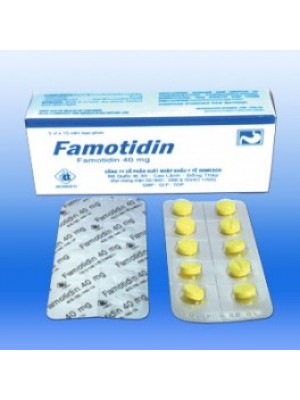
Famotidine 40mg. 20 tablets
Product Code: Famotidine 40mg. 20 tablets
Availability: In Stock

Product viewed: 639


What Famotidine is and what it is used for
Famotidine belongs to a group of medicines called histamine H2-blockers, which reduce the amount of acid in the stomach.
Used for:
treatment of ulcers of the initial part of the small intestine connected to the stomach (duodenal ulcers);
treatment of benign active gastric ulcer;
treatment of gastroesophageal reflux (return of gastric contents into the esophagus);
treatment of Zollinger-Ellison syndrome;
prevention of gastric contents entering the lungs (Mendelssohn's syndrome) in case of surgery under general anesthesia;
prevention of recurrence of duodenal and gastric ulcers;
prevention of possible inflammation and ulceration of the esophagus associated with the return of gastric contents into it.
2. What you need to know before you take Famotidine Sopharma
Do not take Famotidine if:
you are allergic to famotidine or any of the other ingredients of this medicine (listed in section 6);
you are allergic to other medicines in this group, such as ranitidine, cimetidine.
Warnings and precautions
Talk to your doctor or pharmacist before using Famotidine Sopharma:
if you have kidney problems;
if you have impaired liver function.
Tell your doctor immediately if you notice any of the following symptoms before or after taking this medicine, which may be a sign of another, more serious illness:
unwanted weight loss (unrelated to diet or exercise);
recurrent vomiting, especially of blood. it may look like coffee grounds in the vomit;
if you notice blood in your stools, which may look black or resinous in appearance;
you look pale or feel tired (anemia), with stomach pain.
Your doctor may decide that you need further tests.
Your doctor will insist that you do not stop treatment suddenly if your ulcer has been present for a long time, even if your symptoms have disappeared after treatment.
During long-term treatment with high doses, your doctor will order a blood test and liver function test.
Children
The product is not used in children due to lack of data on efficacy and safety.
Other medicines and Famotidine Sopharma
Tell your doctor or pharmacist if you are taking, have recently taken or might take any other medicines.
Tell your doctor if you are taking the following products:
ketoconazole and itraconazole (used to treat fungal infections) - these medicines must be taken 2 hours before famotidine;
atazanavir (an antiviral agent) - Famotidine may reduce the effects of atazanavir;
antacids (to reduce stomach acid) - antacids may reduce the action of famotidine, so famotidine should be taken 1-2 hours before them;
probenecid (used for gout);
sucralfate (used for ulcers) - to avoid its use two hours after taking famotidine.
Famotidine Sopharma with food, drink and alcohol
Food and fluid intake do not affect the absorption of famotidine
When used with alcohol, famotidine does not alter blood alcohol concentrations.
Pregnancy, lactation and fertility
If you are pregnant or breast-feeding, think you may be pregnant or are planning to have a baby, ask your doctor or pharmacist for advice before taking this medicine.
Pregnancy
Famotidine should be used during pregnancy only if your doctor decides it is necessary.
Breastfeeding
Traces of the product are found in the milk of lactating women. Due to the potential risk to the infant, breast-feeding should be discontinued.
Fertility
There is no evidence that famotidine affects fertility.
Driving and using machines
Famotidine Sopharma has no influence on the ability to drive and use machines.
Famotidine Sopharma contains lactose
If you have been told by your doctor that you have an intolerance to some sugars, contact your doctor before taking this medicinal product.
3. How to use Famotidine Sopharma
Always use this medicine exactly as your doctor has told you. If you are not sure, talk to your doctor or pharmacist.
The medicine is taken orally, usually at bedtime, and the tablets are swallowed whole, without chewing, with a little water.
The recommended doses are:
Adults:
For the treatment of duodenal ulcer - 40 mg in the evening before bedtime or 20 mg twice a day (morning and evening) for 4-8 weeks. The expected effect is achieved after 4 weeks, but your doctor may decide whether to continue your treatment after endoscopic examination.
For the treatment of benign gastric ulcer - 40 mg at night before bed for 4-8 weeks.
For the treatment of gastroesophageal reflux - 20 mg twice daily (morning and evening) for 6 -12 weeks; in inflammation of the esophagus - 20 - 40 mg twice a day for 12 weeks.
For the prevention of recurrence of duodenal and gastric ulcers - 20 mg
4. Possible side effects
Like all medicines, Famotidine can cause side effects, although not everybody gets them.
If you notice any of the following, although very rare serious side effects, stop taking Famotidine and contact a doctor immediately:
severe allergic reaction - difficulty breathing, swelling of the face or throat;
blistering of the skin, mouth, eyes and genitals - this can be toxic epidermal necrolysis.
Other side effects, grouped by frequency.
Common (may affect up to 1 in 10 people): headache, dizziness, diarrhea, constipation.
Uncommon (may affect up to 1 in 100 people): dry mouth, nausea, vomiting, abdominal discomfort or bloating, loss of appetite and progressive weight loss, rash, itching, hives, tiredness, excessive flatulence .
Rare (may affect up to 1 in 1,000 people): breast enlargement in men that is reversible upon completion of treatment.
Very rare (may affect less than 1 in 10,000 people): hair loss, acne, dry skin, blood disorders, such as a reduced number of all cell types (pancytopenia), white blood cells (all types of leukopenia or of a certain type - agranulocytosis), platelets (changes in the number of blood cells can cause weakness, frequent infections, bruising), abnormal liver enzymes, hepatitis, jaundice due to bile stasis, impotence, reversible mental disorders (depression, anxiety disorders, agitation, confusion, hallucinations), arrhythmias - irregular or slow pulse, disturbances in the conduction of the heart muscle (AV block), joint pain, muscle cramps, mild fever.
5. How to store Famotidine Sopharma
Keep out of reach of children!
Do not use this medicine after the expiry date which is stated on the carton. The expiry date refers to the last day of that month.
Store in the original package at a temperature not exceeding 25 ° С.
Do not throw away any medicines via wastewater or household waste.
Ask your pharmacist how to dispose of medicines no longer required.
These measures will help protect the environment.
6. Contents of the package and additional information
What Famotidine Sopharma contains
The active substance is: famotidine 40 mg.
The other ingredients are: lactose monohydrate, microcrystalline cellulose, talc, magnesium stearate, sodium starch glycolate (type A), hydroxypropylmethylcellulose, anhydrous silica; film coating (Opadry white 85F18422) - polyvinyl alcohol, macrogol 3350, titanium dioxide (H171), talc.
What Famotidine Sopharma looks like and contents of the pack
White, round, biconvex, film-coated tablets of 10 in a blister of PVC / aluminum foil in cartons of 2 or 3 blisters per pack.
Write a review
Your Name:Your Review: Note: HTML is not translated!
Rating: Bad Good
Enter the code in the box below:
Related Products