Your shopping cart is empty!
Welcome visitor you can login or create an account.
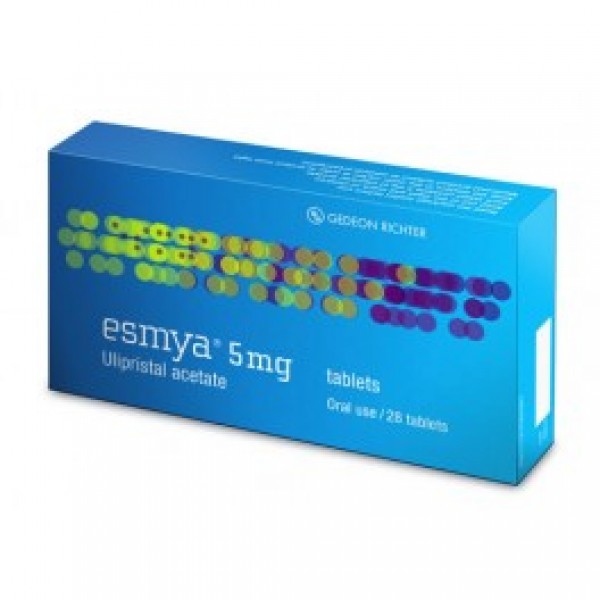
ESMYA 5 mg. 28 tablets
Product Code: ESMYA 5 mg. 28 tablets
Availability: In Stock
Product viewed: 1919


ESMYA 5 mg. 28 tablets
What is Esmya and what it is used
Esmya contains the active substance ulipristalov acetate. It is used to treat moderate to severe symptoms of uterine fibroid tumors (known as myomas), which are non-cancerous tumors of the uterus.
Esmya is used in adult women (over 18 years) before reaching menopause, requiring surgery fibroids.
In some women, uterine fibroids can cause heavy menstrual bleeding (menstruation), pelvic pain (discomfort in the abdomen) and to exert pressure on other organs.
This drug acts by modifying the activity of progesterone - a hormone naturally occurring in the body. Used for a maximum of 3 months for reducing the size of the myomas, stopping or reducing bleeding and an increase of the total number of red blood cells prior to surgery.
2. What you need to know before you take Esmya
You should know that during treatment and for several weeks after most women have no menstrual bleeding (menstruation).
Do not take Esmya:
if you are allergic to ulipristalov acetate or any of the other ingredients of Esmya (listed in section 6);
if you are pregnant or breast-feeding;
if you have vaginal bleeding that is not due to uterine fibroids;
if you have cancer of the uterus, cervix (cervical cancer), ovarian or breast;
if you have already received treatment with Esmya for 3 months.
Warnings and Precautions
If you are currently taking hormonal contraception (for example birth control pills) (see "Other medicines and Esmya"), you should use an alternative reliable barrier method of birth control (such as condoms) while taking Esmya;
If you have liver or kidney disease, tell your doctor or pharmacist before taking Esmya;
If you suffer from severe asthma, treatment with Esmya may not be suitable for you. You should discuss this with your doctor.
Treatment with Esmya usually leads to a significant reduction or even cessation of menstrual bleeding (menses) during the first 10 days of treatment. However, if you still have too profuse bleeding, tell your doctor.
Overall menstruation should resume within 4 weeks after stopping treatment with Esmya. Following the adoption of Esmya inner lining of the uterus may thicken or modify. These changes are normal after stopping treatment and resumption of menstruation.
Children and adolescents
Esmya should not be taken by children under 18 years.
Other medicines and Esmya
Tell your doctor or pharmacist if you are taking, have recently taken or might take any other medicines.
Tell your doctor or pharmacist if you are taking any of the medicines listed below, as it can affect Esmya or be affected by it:
certain drugs used for treatment of the heart (e.g., digoxin);
certain drugs used for the prevention of stroke and blood clots (eg dabigatran etexilate);
some drugs used for the treatment of epilepsy (e.g., phenytoin, fosphenytoin, phenobarbital, carbamazepine, oxcarbazepine, and primidone);
certain drugs used to treat HIV infection (such as ritonavir, efavirenz, nevirapine);
drugs used for treating certain bacterial infections (for example, rifampicin, telithromycin, clarithromycin, erythromycin, rifabutin);
some drugs for the treatment of fungal infections (e.g. ketoconazole (except shampoo), itraconazole);
herbal medicines containing St. John's wort (Hypericum perforatum) and used for depression or anxiety;
certain drugs used for treatment of depression (e.g., nefazodone);
certain drugs used to treat high blood pressure (e.g., verapamil).
Esmya is possible to reduce the effectiveness of some hormonal contraceptives. Moreover, it is probably hormonal contraceptives and progestagens (eg norethindrone or levonorgestrel) may reduce the effectiveness of Esmya. Therefore, during treatment with Esmya advised hormonal contraceptives and should use an alternative reliable barrier method of birth control such as condoms.
Esmya with food and drink
You should avoid drinking grapefruit juice while their treatment with Esmya.
Pregnancy and lactation
If you are pregnant, do not take Esmya. Treatment of pregnant women can affect the pregnancy (not known whether Esmya may harm your baby or cause a miscarriage). If you become pregnant during treatment with Esmya, should immediately stop taking it and contact your doctor or pharmacist.
Esmya is possible to reduce the effectiveness of some hormonal contraceptives (see "Other medicines and Esmya"). Esmya passes into breast milk. So do not breast-feed your baby while taking Esmya.
Ask your doctor or pharmacist before taking any medicine.
Driving and using machines
Esmya may cause mild dizziness (see section 4 "Possible Side Effects"). Do not drive or operate machinery if you experience these symptoms.
3. How to take Esmya
Always take this medicine exactly as prescribed by your doctor. If you are not sure, ask your doctor or pharmacist.
The recommended dose is one 5 mg tablet per day for up to 3 months. You should start taking Esmya within the first week of menstruation. The tablet should be swallowed with water and may be taken with or without food.
If you take more dose Esmya
Experience with taking several doses of Esmya at once is limited. No serious adverse effects from taking several doses of this medicine at once. However, you should consult with your doctor or pharmacist if you take more than the amount of Esmya.
If you forget to take Esmya
If you miss a dose and have passed less than 12 hours, take it as soon as you remember. However, if you miss a dose and it has been more than 12 hours, do not take the missed tablet and take only one, as usual. Do not take a double dose to make up for a forgotten tablet.
If you stop taking Esmya
Esmya can be taken for a maximum of 3 months. Do not stop taking the tablets without consulting your doctor even if you feel better, as symptoms may reappear at a later stage.
If you have any further questions on the use of this medicine, ask your doctor or pharmacist.
4. Possible side effects
Like all medicines, this medicine can cause side effects, although not everybody gets them.
Very common (may affect more than 1 in 10 people) side effects:
reduction or absence of menstrual bleeding (amenorrhea);
thickening of the lining of the uterus (endometrial thickening).
Common (may affect up to 1 in 10 people) side effects:
headache;
dizziness;
stomach pain, nausea;
skin wound;
acne;
increased sweating;
muscle and bone pain;
bag of fluid within the ovaries (ovarian cyst), stress / pain in the chest, pain in the lower abdomen (pelvis), uterine bleeding;
hot flashes;
swelling due to fluid retention (edema);
fatigue;
increase blood cholesterol found in blood tests.
Uncommon (may affect up to 1 in 100 people) side effects:
anxiety;
mood swings;
dizziness;
nosebleeds;
indigestion, dry mouth, abdominal distension, constipation;
back pain;
urinary incontinence;
rupture of the bag of fluid within the ovaries (ovarian cyst);
vaginal discharge, abnormal vaginal bleeding;
breast swelling, discomfort in the chest;
extreme weakness (asthenia);
weight gain;
increased fats (triglycerides) in the blood found in blood tests.
Adverse event reporting
If you get any side effects, tell your doctor or pharmacist. This includes any possible effects not listed in this leaflet. You can also report adverse events directly through the national reporting system. As reported adverse reactions, you can do your bit to get more information on the safety of this medicine.
5. How to store Esmya
Keep out of the reach and sight of children.
Do not use this medicine after the expiry date stated on the carton and blister after "EXP". The expiry date refers to the last day of that month.
Keep the blister in the outer carton to protect from light.
Do not dispose of medications in wastewater or household waste. Ask your pharmacist how to dispose of medicines no longer required. These measures will help to protect the environment.
6. Contents of the pack and other information
What Esmya
The active substance is ulipristalov acetate. One tablet contains 5 mg ulipristalov acetate.
Other ingredients are: microcrystalline cellulose, mannitol, croscarmellose sodium, talc and magnesium stearate.
Write a review
Your Name:Your Review: Note: HTML is not translated!
Rating: Bad Good
Enter the code in the box below:
Related Products

SPIRAL MIRENA intrauteralna - SCHERING PLOUGH What is Miren..
199.00€