Your shopping cart is empty!
Welcome visitor you can login or create an account.
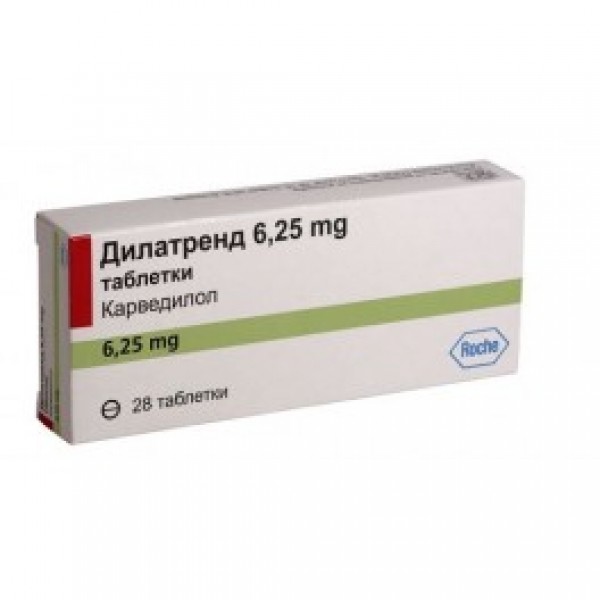
DILATREND 6.25 mg. 28 tablets
Product Code: DILATREND 6.25 mg. 28 tablets
Availability: In Stock
Product viewed: 2266


DILATREND 6.25 mg. 28 tablets
What is Dilatrend and what is it used?
The name of this medicine is Dilatrend. Dilatrend contain drug carvedilol, which is a beta-blocker and dilates blood vessels (vasodilator).
It is used to treat angina (angina) and mild, moderate or severe heart failure. Dilatrend is used to treat high blood pressure (hypertension).
2. What you should know before using Dilatrend
Do not use Dilatrend:
- If you are allergic to carvedilol or any of the other ingredients of this medicine (listed in section 6);
- If you had wheezing due to asthma or other lung disease; if you have recently worsening heart failure or severe fluid retention and you were administered drugs into a vein (intravenously) to assist the work of the heart; if you have liver disease;
- If you have impaired conduction of the heart (or heart block); if you have very low blood pressure.
- If any of these apply to you, please consult your doctor or pharmacist.
- If you have any doubt before using Dilatrend, consult your doctor or pharmacist.
Warnings and Precautions
If any of these conditions apply to you, do not take this medicine before checking with your doctor:
- If you have a very slow heart rate (bradycardia); if you suffer from a disease called variant angina Prinzmetal; if you have any other heart problems;
- If you have liver problems, kidney or thyroid gland;
- If you have diabetes; if you have pheochromocytoma (tumor of the adrenal gland, causing high blood pressure;
- If you have a skin condition called psoriasis;
- If you have poor circulation (poor blood supply to the fingers and toes) called Raynaud's phenomenon;
- If you have ever had a severe allergic reaction or desensitisation treatment to allergy;
- If you wear contact lenses;
- If you are pregnant. Consult a doctor immediately if you become pregnant during treatment with this medicine.
- If you are breast-feeding.
Other medicines and Dilatrend
Please tell your doctor or pharmacist if you are taking, have recently taken or might take any other medicines.
Tell your doctor or pharmacist if you are taking any of the following medications:
- If you are taking any other medicines to treat heart or high blood pressure, including diuretics (water tablets), calcium channel blockers (eg, diltiazem or verapamil), amiodarone or digoxin;
- If you are taking a drug called fluoxetine (used to treat depression); if you are taking a drug called rifampicin (for tuberculosis);
- If you are taking a medicine called cimetidine (for stomach ulcers);
- If you have made a catecholamine-depleting drugs (e.g., reserpine and monoamine oxidase inhibitors (MAOIs), used to treat depression);
- If you are taking a drug called clonidine (migraine, flushing menopause, hypertension);
- Medicines for diabetes (eg, insulin and others that are taken by mouth (orally), ciclosporin (used after organ transplants), non-steroidal anti-inflammatory drugs (NSAIDs);
- Bronchodilators, beta agonists (used to treat chest tightness and wheezing for asthma or other thoracic conditions).
operations
If you have surgery, tell your doctor that you take Dilatrend. This is necessary because some anesthetics can lower your blood pressure and may become too low.
Pregnancy, lactation and fertility
If you are pregnant or breast-feeding, think you may be pregnant or planning to become pregnant, talk to | b your doctor or pharmacist before taking any medicine.
Dilatrend not take if you are pregnant, plan to become pregnant or are breast-feeding, unless your doctor tells you.
Driving and using machines
If during treatment with Dilatrend feel tired or dizzy, you should not drive or operate any tools or machines. This is more likely to happen at the start of treatment, after dose increase, a change in medication and in combination with alcohol. You should avoid alcohol as it may worsen such complaints.
Dilatrend contains lactose and sucrose, which are a type of sugar.
If your doctor has told you that you have an intolerance to some sugars, contact your doctor before taking this product.
3. How to use Dilatrend?
Always use this medicine exactly as prescribed by your doctor. If you are not sure, ask your doctor or pharmacist. The packaging pharmacist will write, how many tablets to take.
Dilatrend is not suitable for children under the age of 18 years.
The container will help you find out if you have taken your tablets or not. Your pharmacist can also help if you are unsure about the dose of Dilatrend, you should take.
Take the tablets with a drink, without chewing or crushing.
Chronic heart failure
In the treatment of heart failure therapy is recommended Dilatrend be initiated by a physician specialist in the hospital.
• You should try to take the tablets at the same time with some food. You should take your tablets even if you have no appetite.
• The recommended starting dose is 3,125 mg, twice daily for two weeks.
• Then your doctor will gradually increase the dose over several weeks, until it reaches 25 mg BID.
• In patients weighing more than 85 kg, the recommended maximum dose is 50 mg twice daily.
• If you stop taking Dilatrend for more than one or two weeks, you should consult your doctor to tell you how to resume treatment (see "If you stop taking Dilatrend").
Sometimes in the course of treatment with Dilatrend heart failure may deteriorate, especially early treatment. Symptoms may worsen (eg, fatigue, shortness of breath) with manifestations of fluid retention (eg, weight gain and edema of the legs).
If your symptoms or condition gets worse, you should inform your doctor as it may be necessary to change the dose of your other medicines or Dilatrend.
Tell the hospital that you are being treated with Dilatrend if you should receive anesthesia regarding surgery.
Simultaneously received Dilatrend should continue treatment with other medicines for heart failure prescribed by your doctor.
High blood pressure (hypertension)
• The recommended starting dose is 12,5 mg once daily for the first two days.
• After two days, the recommended dose is 25 mg once daily.
• If necessary your doctor may increase your dose slowly over a few weeks, until it reaches a maximum of 50 mg once daily or in divided doses.
• If you are elderly patient, the recommended starting dose is 12,5 mg daily. If necessary, the dose may be increased to a maximum of 50 mg once daily or in divided doses.
angina
• The recommended starting dose is 12,5 mg twice daily for the first two days.
• After two days, the recommended dose is 25 mg twice daily.
• If you are an elderly patient Your doctor will decide the best dose for you. The recommended maximum daily dose for elderly patients is 50 mg in divided doses.
If you take more dose Dilatrend
If you take more tablets than prescribed (drug overdose), you may experience dizziness, weakness, shortness of breath / wheezing or pronounced weakness. Tell your doctor or contact the nearest emergency room.
If you forget to take Dilatrend
If you forget to take a dose, do not worry. Take it as soon as you remember. If possible then you should not take the next dose. Take the next tablet at the usual time, but do not take a double dose to make up for a forgotten tablet.
Discontinuation of treatment
If you stop taking Dilatrend
Do not stop treatment abruptly Dilatrend tablets before checking with your doctor. If you suddenly stop treatment, you may develop side effects. The doctor will advise you how to gradually reduce the intake and then stopping treatment.
If you take clonidine, never stop treatment with it unless your doctor tells you.
If you have any further questions on the use of this medicine, ask your doctor or pharmacist.
4. Possible side effects
Like all medicines, Dilatrend can cause side effects, although not everybody gets them.
a) The risk of most adverse reactions associated with the use of carvedilol was similar in all indications. The exceptions are set out below in point b
According to their frequency side effects are defined as:
Common (affects less than 1 in 10 people);
Very common (affects more than 1 in 10 people);
Uncommon (affects less than 1 in 100 people);
Rare (affects less than 1 in 1000 people);
Very rare (affects less than 1 in 10,000 people).
Infections and infestations
Common: bronchitis, pneumonia, upper respiratory tract infection, urinary tract infection.
Blood and lymphatic system
Common: anemia.
Rare: abnormal reduction in the number of blood platelets (thrombocytopenia), which increases the risk of bleeding or bruising.
Very rare: Isolated cases of leukopenia - a condition in which the number of white blood cells (leukocytes) in the blood decreases, which increases the likelihood of infection.
Immune system
Very rare: hypersensitivity (allergic reaction).
Metabolism and nutrition disorders: weight gain; in some patients with heart failure slightly increase the level of cholesterol (lipids) in the blood (hypercholesterolaemia). In patients with diabetes may be an increase (hyperglycemia) or decrease (hypoglycemia) levels of glucose (sugar) in the blood.
Psychiatric disorders
Common: depression, depressed mood.
Uncommon: sleep disorders.
Nervous system
Very common: dizziness, headache.
Uncommon: In individual cases may occur dizziness or vertigo without fainting (pre-syncope), fainting (syncope), numbness and tingling in the feet (paresthesia).
Eye disorders
Common: impaired vision, decreased tears (ie. Dry eye), eye irritation. cardiac disorders
Very common manifestation of heart disease which can lead to fatigue, shortness of breath, swelling of ankles and others. (heart failure).
Common: sometimes there is a strong slow heart rate (bradycardia), swelling (edema) of the body, increasing the total blood volume in the body (overload), fluid overload. Uncommon: in some cases there may be signs of atrioventricular block; angina pectoris (including chest pain).
vascular disorders
Very common: low blood pressure (hypotension).
Common: low blood pressure upon standing (orthostatic hypotension), which may cause dizziness, fainting, general weakness or fainting; disorders of peripheral circulation (with onset of cold extremities, peripheral vascular disease, Raynaud's phenomenon); if you suffer from a condition called intermittent claudication (sudden pain in the leg muscles that occurs in walking due to insufficient blood supply), your symptoms during treatment may worsen.
Respiratory, thoracic and mediastinal disorders
Common: may occur feeling of shortness of breath (dyspnoea), pulmonary edema, asthma in susceptible patients. Rare: stuffy nose.
Gastrointestinal disorders
Nesta: nausea, diarrhea, vomiting, indigestion (dyspepsia), abdominal pain. Hepatobiliary disorders
Very rare: increased levels of alanine aminotransferase (ALT), increased levels of aspartate aminotransferase (AST) and gamma-glutamyl transferase (GGT), which indicates changes in the functioning of the liver.
Skin and subcutaneous tissue disorders
Uncommon: sometimes can occur skin reactions (eg allergic exanthema, dermatitis, urticaria, pruritus, psoriatic skin lesions and lesions similar to lichen planus), hair loss (alopecia).
Disorders of the musculoskeletal system and connective tissue
Common: pain in extremity.
Renal and urinary tract
Common: may develop renal failure or renal dysfunction in patients with diffuse vascular disease and / or impaired renal function disturbances in urination.
Very rare seen isolated cases of urinary incontinence in women (urinary incontinence), which resolved upon discontinuation of the drug.
Reproductive system and breast disorders
Uncommon: males have been reported cases of sexual impotence (erection difficulties).
General disorders and administration site conditions
Very common: fatigue (asthenia). Common: pain.
b) Other
Dizziness, fainting (syncope), headache and fatigue (asthenia) are usually mild and are more likely to occur early in treatment.
Reversible deterioration of renal function when treated with carvedilol in patients with chronic heart failure with low blood pressure, ischemic heart disease and diffuse vascular disease and / or renal dysfunction.
Dilatrend can also cause a manifestation of the signs of diabetes in people with very mild form of diabetes called "latent diabetes" in the presence of existing diabetes his condition may deteriorate because in the manifestation of such symptoms immediately tell your healthcare doctor.
If you encounter any of these symptoms or others that are troublesome, tell your doctor.
If you get any side effects, tell your doctor or pharmacist. This includes any possible effects not listed in this leaflet.
5. How to store Dilatrend?
Keep out of the reach and sight of children.
Keep the blisters in the outer carton to protect from light and moisture. Do not use this medicine after the expiry date stated on the carton after EXP. The expiry date refers to the last day of that month.
Do not use this medicine if the tablets show signs of impaired quality and seek the advice of a pharmacist who will tell you what to do.
If your doctor decides to stop treatment, return the remaining tablets to the pharmacist. Only keep them if your doctor tells you to.
Do not dispose of medications in wastewater or household waste. Ask your pharmacist how to dispose of medicines no longer required. These measures will help to protect the environment.
6. Contents of the pack and other information
What Dilatrend?
The active substance is carvedilol. Each tablet contains 6,25 mg carvedilol.
The other ingredients are lactose monohydrate, sucrose, povidone K25, crospovidone type A, silica colloidal anhydrous, magnesium stearate and iron oxide yellow (E172).
Dilatrend looks like and contents of the pack?
Dilatrend 6,25 mg tablets are round, yellow, scored on both sides, labeled VM on one side and F1 on the other side.
Dilatrend 6,25 mg tablets are available in blister packs of aluminum / aluminum containing 28 tablets.
Write a review
Your Name:Your Review: Note: HTML is not translated!
Rating: Bad Good
Enter the code in the box below:
Related Products
DILATREND table. 12.50 mg. 28 tablets DILATREND WHAT IS AND ..
16.00€
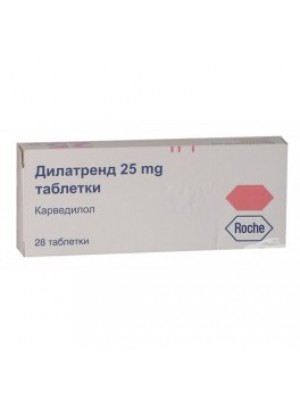
DILATREND table. 25 mg. 28 tablets What you should know bef..
22.00€