Your shopping cart is empty!
Welcome visitor you can login or create an account.
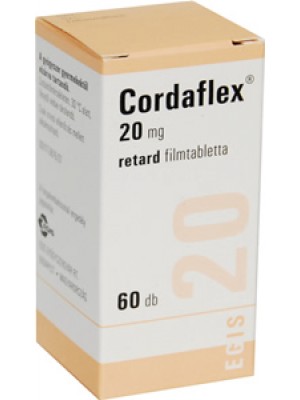
Cordaflex 20mg. 60 tablets

Product viewed: 3412


What Cordaflex is and what it is used for
Nifedipine, the drug's active substance, is a calcium channel blocker of the dihydropyridine type. Because of its vasodilating effect and improved oxygen supply to the heart, this drug can be used to prevent stiff chest pain that occurs with physical exercise of the same strength, then disappears (angina attacks) and for treatment of high blood pressure pressure (hypertension).
2. What you need to know before you take Cordaflex
Do not take Cordaflex:
If you are allergic to nifedipine and other dihydropyridine medicines or to any of the other ingredients of this medicine (listed in section 6.1);
In some cardiovascular diseases: acute heart failure (cardiogenic shock);
If you are taking rifampicin;
The medicine is not recommended for the treatment of acute chest pain (acute attack of angina).
Warnings and precautions
Talk to your doctor, pharmacist or nurse before taking Cordaflex. Before you start using Cordaflex, tell your doctor if any of the following apply to you:
If you have very low blood pressure (systolic pressure below 90 mmHg);
If you suffer from severe heart failure;
If you have severe heart valve disorders (aortic stenosis);
If you suffer from kidney and / or liver disease and diabetes mellitus;
If you are pregnant. Nifedipine should not be taken during pregnancy unless the clinical condition of the woman requires treatment with it. Nifedipine should be used in women with severe hypertension who are not responding to standard treatment;
If you are breastfeeding. The use of nifedipine during the lactation period is not recommended as it falls into breast milk;
If you take certain medicines (see "Other medicines and Cordaflex").
Children and adolescents
Cordaflex is not recommended for use in children and adolescents under the age of 18 as safety and efficacy data for this group of patients are limited.
Other medications and Cordaflex
Tell your doctor or pharmacist if you are taking, have recently taken or might take any other medicines.
It is very important to tell your doctor if you are using or have recently taken any of the medicines listed below as they may interact with nifedipine:
Other medicines for the treatment of high blood pressure, diuretics;
Rifampicin (an antibiotic). Cordaflex should not be given concomitantly with rifampicin (see "Do not take Cordaflex");
Cimetidine (for the treatment of gastric ulcer);
Digoxin, diltiazem, quinidine or beta-blockers (to treat heart problems);
Quinupristine / dalfopristine (a combined antibiotic);
Phenytoin, carbamazepine or valproic acid (to treat epilepsy);
Cisapride (for treatment of decreased motility of the esophagus and stomach);
Magnesium sulphate in the form of injections during pregnancy (can cause serious drop in blood pressure);
Erythromycin (antibiotic);
Ketoconazole, itraconazole or fluconazole (antifungal medicines);
Indinavir, nelfinavir, ritonavir, saquinavir or amprenavir (for AIDS treatment);
Fluoxetine or nefazodone (to treat depression);
Tacrolimus (to prevent rejection of a transplanted organ);
Phenobarbital (usually used to treat insomnia or anxiety).
Cordaflex with food and beverages
One of the ingredients of grapefruit and juice inhibits the degradation of nifedipine, so their consumption should be avoided.
Pregnancy, breastfeeding and fertility
Cordaflex should not be used during pregnancy unless the clinical condition of the woman is treated with nifedipine. Nifedipine should be used in women with severe hypertension who are not responding to standard treatment.
The use of Cordaflex is not recommended during lactation as it falls into breast milk.
In men with multiple unsuccessful attempts to in vitro fertilization, and if no other explanation is available, calcium antagonists such as nifedipine may be taken as a possible cause.
If you are pregnant or are breast-feeding, think you may be pregnant or plan to become pregnant, ask your doctor or pharmacist for advice before taking this medicine.
Driving and using machines
Drug reactions that vary in strength among people may interfere with the ability to drive and use machines. This applies mostly to the onset of treatment, change of the drug or in combination with alcohol. For example, if you have dizziness, blurred vision, feeling unwell, you should not drive or operate machinery.
Cordaflex contains lactose.
Each tablet contains 30 mg of lactose.
If you have been told by your doctor that you have an intolerance to some sugars, talk to him / her before taking this medicine.
3. How to take Cordaflex
Always take this medicine exactly as your doctor has told you. If you are not sure, ask your doctor or pharmacist.
The recommended dose is:
The recommended starting dose is Cordaflex 2 x 1 (2 x 20 mg). If necessary, your doctor will increase the daily dose of 2 x 2 tablets. The maximum daily dose of nifedipine is 80 mg.
It is recommended that the daily dose of the tablets be taken in 12 hours. The tablets should be taken whole without chewing, with a little water before a meal.
Taking this medicine should be discontinued gradually - especially when receiving high doses.
Elderly patients, patients with liver and kidney disease:
The absorption of nifedipine may change in elderly patients so that lower doses are satisfactory.
Nifedipine is mainly metabolised in the liver, so the dose should be determined by the physician based on the liver function of the patient.
No dose adjustment of nifedipine is necessary for impaired renal function.
If you take more Cordaflex than you should
Besides side effects, the following symptoms may also occur depending on the degree of poisoning: severe blood pressure decrease, rapid heartbeat, chest pain (angina), collapse, loss of consciousness, slow heart beat, heart beat, increased blood level sugar. In severe cases - disturbance of consciousness to the degree of coma.
Call your doctor immediately if you take more Cordaflex than you should, as overdose requires a complex treatment, preferably in a hospital, which should start as soon as possible.
If you forget to take Cordaflex
If you forget to take Cordaflex in your usual time, do not take a double dose to make up for the forgotten dose. Compensate the missed dose only if there is enough time before the next dose, otherwise you risk overdosing.
If you stop taking Cordaflex
Do not stop taking Cordaflex before your doctor tells you, even if you feel better.
The use of this medicine should be discontinued gradually, as directed by your doctor, especially with high doses.
If you have any further questions on the use of this product, ask your doctor or pharmacist.
4. Possible side effects
Like all medicines, this medicine can cause side effects, although not everyone gets them.
If you experience any of the following serious side effects, stop taking the medicine and seek medical advice immediately:
Uncommon (may affect up to 1 in 100 people):
Swelling of the face, lips, tongue or throat, which may cause difficulty breathing (angioneurotic edema);
Faptism (syncope).
Not known (can not be estimated from the available data):
General allergic reaction, incl. life-threatening reaction (in severe cases - drop in blood pressure, breathing collapse and blood circulation) - anaphylactic reaction);
Inflammation of the throat, mouth sores or fever. This may be a sign that you have a deficiency of a certain type of white blood cell (leucopenia / agranulocytosis), which increases the risk of infections;
Chest pain (angina); dyspnoea (dyspnoea);
Serious disease with blistering or flaking of the skin, the mouth, around the eyes and genitals (toxic epidermal necrolysis).
The following list includes the other side effects reported:
Common (may affect up to 1 in 10 people):
Headache, vasodilatation (redness), peripheral edema (edema of the limbs), constipation, malaise.
Uncommon (may affect up to 1 in 100 people):
Allergic reaction, allergic edema, sleep disturbances, anxiety, dizziness, vertigo, migraine, tremor, visual disturbances, fast heart beat, palpitations (palpitation), low blood pressure, nasal bleeding, nasal congestion, stomach and abdominal pain, nausea , indigestion, gas, dry mouth, transient elevation of liver enzymes, redness of the mouth, muscle stiffness, swelling of the joints, excessive urine output, painful or difficulty urinating (polyuria, dysuria) olka, chills.
Rare (may affect up to 1 in 1,000 people):
Pruritus, rash, urticaria, tingling or stiffness (paraesthesia / dysaesthesia), swelling of the gums (gingival hyperplasia).
Not known (can not be estimated from the available data):
Increased blood sugar (hyperglycaemia), decreased skin sensitivity (hypoaesthesia), dizziness, eye pain, shortness of breath, vomiting, gastroesophageal sphincter insufficiency, jaundice, photodermatitis may develop when exposed to sunlight or UV rays allergic reaction due to sensitivity to light); small areas of relief with bleeding on the skin (pronounced purpura), joint pain, muscle pain.
How to store Cordaflex
This medicine does not require any special storage conditions.
Keep out of the reach and sight of children.
Do not use this medicine after the expiry date which is stated on the pack. The expiry date refers to the last day of that month.
Do not use this medicine if you notice a change in color.
Do not dispose of medicines in the sewage system or in the household waste container. Ask your pharmacist how to dispose of medicines you no longer use. These measures will help to protect the environment.
6. Package Contents and Additional Information
What Cordaflex contains
The active substance is: 20 mg nifedipine in each prolonged-release tablet.
The other ingredients are: hydroxypropylcellulose, magnesium stearate, talc, polyacrylate (as a 30% dispersion), croscarmellose sodium, lactose monohydrate (30 mg), microcrystalline cellulose.
Tablet coating: magnesium stearate, iron oxide, red (E172), iron oxide, black (E172), titanium dioxide (E171), hypromellose.
What Cordaflex looks like and what it contains
Description: Pale, round, biconvex tablets with a matt or slightly glossy finish, without any physical defects and mechanical impurities.
Contents: 30 or 60 prolonged-release tablets in a brown bottle, put in carton together with the patient leaflet.
Write a review
Your Name:Your Review: Note: HTML is not translated!
Rating: Bad Good
Enter the code in the box below:
Related Products