Your shopping cart is empty!
Welcome visitor you can login or create an account.
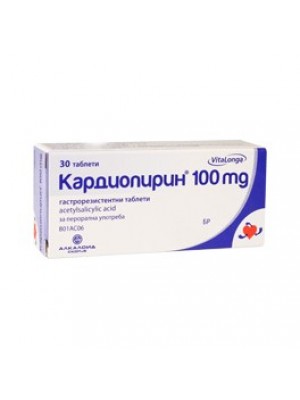
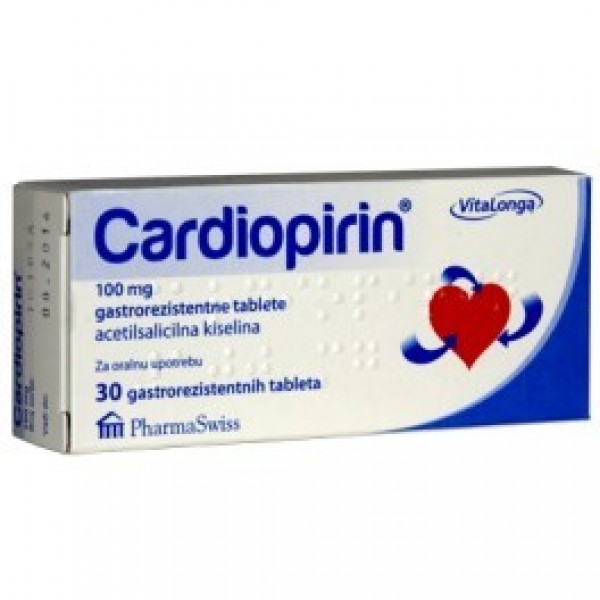
CARDIOPIRIN 100 mg. 30 tablets
Product Code: CARDIOPIRIN 100 mg. 30 tablets
Availability: In Stock
Product viewed: 2142


CARDIOPIRIN 100 mg. 30 tablets
What is Cardiopirin and what is it used?
Cardiopirin contains acetylsalicylic acid in low doses belongs to a group of medicines called anti-platelet agents. Platelets are small cells in the blood that cause blood to clot and are involved in thrombosis. When the artery is a blood clot, it stops the flow of blood and oxygen supply interrupted. When it happens in the heart, it can cause a heart attack or angina; in the brain can result in stroke.
Cardiopirin be taken to reduce the risk of blood clots, and thus to prevent the further occurrence of:
- Heart attacks;
- Strokes;
- Cardiovascular problems in patients who suffer from stable or unstable angina (a type of chest pain).
Cardiopirin is also used to prevent the formation of blood clots after certain types of heart surgery, in order to increase or to unblock the blood vessels.
This medicine is not recommended in emergency situations. It can only be used as a prophylactic treatment.
2. Before you take Cardiopirin
Do not take Cardiopirin
- If you are allergic to aspirin or any of the other ingredients of this medicine
- If you currently have or have ever had a stomach ulcer or intestine or some other kind of bleeding, like stroke
- If you have ever had a problem with blood clotting
- If you have severe liver problems or kidney;
- If you are in the last 3 months of pregnancy, you should not use doses that are higher than 100 mg per day (see. Section "Pregnancy and lactation");
- Take a medicine called methotrexate (for example in cancer or rheumatoid arthritis) at doses greater than 15 mg per week.
Warnings and Precautions
Talk to your doctor or pharmacist before taking Cardiopirin if:
- Have kidney problems, liver or heart;
- You have or have ever had problems with your stomach or intestines;
- Have high blood pressure;
- You have asthma, are allergic to other drugs, in particular to other salicylates or nonsteroidal anti-inflammatory drugs (NSAIDs), hay fever, nasal polyps or other chronic respiratory diseases; acetylsalicylic acid can cause an asthma attack;
- You have ever had gout;
- You have heavy menstrual cycles.
Should immediately seek medical help if your symptoms get worse or if you have severe or unexpected adverse reactions, such as unusual symptoms of bleeding, serious skin reactions or any other sign of a serious allergy (see. "Possible side effects").
Tell your doctor if a surgery (even insignificant, such as tooth extraction) because aspirin thins the blood and may have an increased risk of bleeding.
Children and adolescents
Aspirin can cause Reye's syndrome (Reye), when given to children. Reye's syndrome is a very rare disease that affects the brain and liver, and can be life-threatening. Therefore Kardiopirin should not be given to children under the age of 16 years, except on the advice of a doctor.
Must be careful not to get dehydrated (you may feel thirst, with dry mouth), since the use of acetylsalicylic acid while time may result in deterioration of renal function.
This product is not suitable for use as a painkiller or to reduce temperature.
If any of these apply to you or if you are not sure, talk to your doctor or pharmacist.
Other medicines and Cardiopirin
Tell your doctor or pharmacist if you are taking, have recently taken or might take any other medicines other medicines.,
The effect of treatment can be influenced if acetylsalicylic acid is taken at the same time as some other medicines for:
- Dilution of the blood / prevention of clots (such as warfarin, heparin, clopidogrel);
- Organ rejection after transplantation (cyclosporine, tacrolimus);
- High blood pressure (such as diuretics and ACE-inhibitors);
- Regulation of the heartbeat (digoxin);
- Manic-depressive illness (lithium);
- Pain and inflammation (such as, for example, NSAIDs such as ibuprofen or steroids);
- Gout (such as probenecid);
- Epilepsy (valproate, phenytoin);
- Glaucoma (acetazolamide);
- Cancer or rheumatoid arthritis (methotrexate at a dose lower than 15 mg per week);
- Diabetes (such as glibenclamide);
- Depression (inhibitors of serotonin reuptake inhibitors, such as paroxetine or sertraline);
- Use as hormone replacement therapy when the adrenal gland or pituitary gland have been destroyed or removed, or for treating inflammation, including rheumatic diseases, and inflammatory bowel disease (corticosteroids).
Cardiopirin with food, drinks and alcohol
Tablets can be taken with or without food.
It is possible that alcohol can increase the risk of gastrointestinal bleeding and increase bleeding time.
Pregnancy, lactation and fertility
If you are pregnant or breast-feeding, think you may be pregnant or planning to become pregnant, ask your doctor or pharmacist before taking this medicine.
Pregnant women should not take aspirin during pregnancy unless advised by your doctor.
You should not take Kardiopirin if you are in the last 3 months of pregnancy, unless you are advised to do so by your doctor and then the daily dose should not exceed 100 mg (see. Section "Do not take Kardiopirin"). Regular consumption or high doses of this medicine during late pregnancy can cause serious complications in the mother or baby.
Women who are breastfeeding should not take aspirin unless advised by your doctor.
Driving and using machines
Should Cardiopirin affect your ability to drive or operate machinery.
3. How to take Cardiopirin?
Always take this medicine exactly as prescribed by your doctor or pharmacist. If you are not sure, ask your doctor or pharmacist.
Adults
Prevengrlya of heart attacks: The recommended dose is 75- 150 mg once daily.
Prevention of stroke:
The recommended dosage is 75-300 mg once daily.
Prevention of cardiovascular events in patients who suffer from stable or unstable angina (a type of chest pain): The recommended dose is 75- 150 mg once daily.
Prevent blood clots after certain types of heart surgery: The recommended dose is 75- 150 mg once daily.
Elderly
As with adults. Overall, acetylsalicylic acid should be used with caution in elderly patients who are more susceptible to adverse drug reactions. Treatment should be reviewed at regular intervals.
Use in children and adolescents
Aspirin should not be taken by children and adolescents under the age of 16 years, unless medically indicated (see. Point "Precautions and warnings").
Route of administration: Oral use
The tablets should be swallowed whole with sufficient fluid (1/2 cup water). The tablets have a gastro-resistant coating, which prevents irritation of the intestines and therefore should not be crushed, broken or chewed.
If you take more dose Kardiopirin
If you (or someone else) accidentally take too many tablets you should tell your doctor or immediately contact the nearest emergency room. Show the rest of the tablets or empty container to the doctor.
Symptoms of overdose may include ringing in the ears, hearing problems, headaches, dizziness, confusion, nausea, vomiting and abdominal pain. Serious overdose can lead to more rapid breathing than normal (hyperventilation), fever, excessive sweating, anxiety, seizures, hallucinations, low blood sugar, coma and shock.
If you forget to take Kardiopirin
If you miss a dose, wait until the next scheduled dose and continue as usual. Do not take a double dose to make up for a forgotten tablet.
If you have any further questions on the use of this medicine, ask your doctor or pharmacist.
4. Possible side effects
Like all medicines, this medicine can cause side effects, although not everybody gets them.
If you notice any of the following serious side effects, stop taking Kardiopirin and contact a doctor immediately:
Sudden difficulty breathing, swelling of the lips, face or body, rash, fainting or difficulties in swallowing (severe allergic reaction) (rare).
Skin redness, blistering or peeling, it may be associated with high fever and joint pains. This could be erythema multiforme, Stevens-Johnson syndrome or Lyell (rare).
Unusual bleeding, such as coughing blood, vomit or blood in the urine or black stools (not known).
Mouth ulcers, fever and infection (s) (agranulocytosis - drastic reduction in the number of white blood cells) (rare).
Possible side effects listed below are grouped according to the frequency of occurrence.
Common side effects (affects 1 to 10 of 100 users):
- Indigestion.
- Increased bleeding.
Uncommon side effects (affects 1 to 10 of 1000 users):
- Hives (rash)
- Fever
- Difficulty in breathing.
Rare side effects (affects 1 to 10 of 10,000 users):
severe bleeding in the stomach or intestines, brain hemorrhage, changes in blood counts, nausea and vomiting, cramps in the lower respiratory tract, asthma attack, blood vessel inflammation, bruising with red-purple spots (bleeding under the skin), severe skin reactions such as rash known as erythema multiforme, and life-threatening forms Stevens-Johnson syndrome and Lyell, hypersensitivity reactions such as swelling of lips, face or body, or shock, unusually heavy or prolonged menstrual periods.
Side effects with unknown frequency (frequency can not be estimated from the available data): - ringing in the ears (tinnitus) or reduced ability to hear. headache, dizziness.
- Ulcers in the stomach or small intestine and perforation.
- Increased bleeding time.
- Impaired renal function.
- Impaired liver function.
- High levels of uric acid in the blood.
If you get any side effects, tell your doctor or pharmacist. This includes any possible effects not listed in this leaflet.
5. HOW TO STORE CARDIOPIRIN?
Keep out of the reach and sight of children. Do not store above 25 ° C.
Tablet container: Keep the container tightly closed in order to protect from moisture. Blister: Store in the original package in order to protect from moisture.
Do not use this medicine after the expiry date stated on the carton or container with tablets / blister after EXP. The expiry date refers to the last day of that month.
Write a review
Your Name:Your Review: Note: HTML is not translated!
Rating: Bad Good
Enter the code in the box below:
Related Products
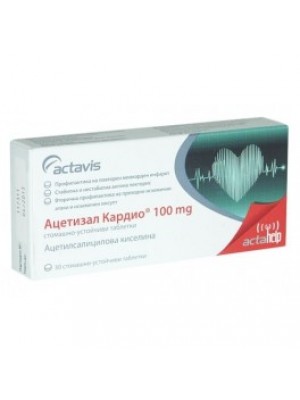
Acetysal CARDIO. 100 mg. 30 tablets WHAT acetysal CARDIO AN..
15.00€
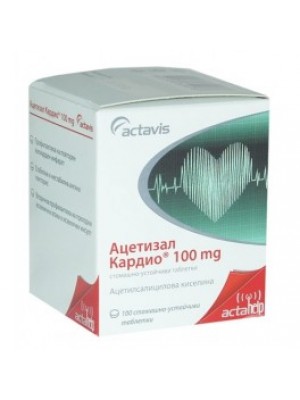
Acetysal CARDIO. 100 mg. 100 tablets WHAT acetysal CARDIO A..
39.00€