Your shopping cart is empty!
Welcome visitor you can login or create an account.
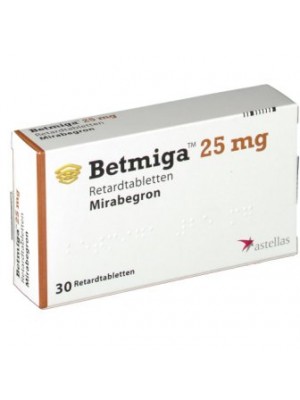
Betmiga 50mg. 30 tablets
Product Code: Betmiga 50mg. 30 tablets
Availability: In Stock

Product viewed: 4646


What Betmiga is and what it is used for
Betmiga contains the active substance mirabegron. It relaxes the bladder muscle (the so-called beta 3-adrenoreceptor agonist), which reduces the activity of overactive bladder and treats the concomitant symptoms.
Betmiga is used to treat the symptoms of overactive bladder like:
Sudden need to empty the bladder (called urgency);
A need to empty the bladder more often than usual (called increased urination frequency);
Inability to control when to empty the bladder (called emergency urinary incontinence).
2. What you need to know before you take Betmiga
Do not take Betmiga:
If you are allergic to mirabegron or any of the other ingredients of this medicine (listed in section 6).
Warnings and precautions
Talk to your doctor or pharmacist before taking Betmiga:
If you have difficulty in emptying your bladder or have a small urine jet or if you are taking other overactive bladder medicines as anticholinergic medicines;
If you have kidney or liver problems. Your doctor may consider it necessary to reduce your dose or may tell you not to use Betmiga, especially if you are taking other medicines such as itraconazole, ketoconazole, ritonavir or clarithromycin. Tell your doctor about the medicines you are taking;
If you have very high, uncontrolled blood pressure;
If you have a heart attack (ECG) disorder known as a QT prolongation, or if you are taking any medicine that is known to cause it, such as:
Medicines used in heart rhythm disturbances such as quinidine, sotalol, procainamide, ibutilide, flecainide, dofetilide and amiodarone;
Medicines used in allergic rhinitis;
Antipsychotic drugs (medicines for mental illness) such as thioridazine, mesoridazine, haloperidol and chlorpromazine;
Antibiotics such as pentamidine, moxifloxacin, erythromycin and clarithromycin.
Children and adolescents
Do not use this medicine in children and adolescents under 18 because the safety and efficacy of Betmiga in this age group have not been established.
Other medicines and Betmiga
Tell your doctor or pharmacist if you are taking, have recently taken or might take any other medicines.
Betmiga may affect the way other medicines work, and other medicines may affect the action of this medicine.
Tell your doctor if you are using thioridazine (a medicine for mental illness), propafenone or flecainide (medicines for heart rhythm disorders), imipramine or desimipramine (medicines used for depression). These specific medicines may require a dose adjustment by your doctor;
Tell your doctor if you are using digoxin (a medicine for heart failure or heart rhythm disturbance). Blood levels of this medicine are measured by your doctor. If the blood levels are out of range, your doctor may adjust the digoxin dose;
Tell your doctor if you are using dabigatran etexilate (a medicine used to reduce the risk of blockage of a blood vessel in the brain or the body of a blood clot in adults with heart rhythm abnormalities and additional risk factors). This medicine may require a dose adjustment from your doctor.
Pregnancy and breastfeeding
If you are pregnant, think you may be pregnant or plan to have a baby, you should not use Betmiga.
If you are breast-feeding, talk to your doctor or pharmacist before using this medicine. It is likely that this medicine will pass into breast milk. You and your doctor should decide whether to take Betmiga or to breast-feed. You do not have to do both.
Driving and using machines
There is no information to suggest that this medicine affects your ability to drive or use machines.
How to take Betmiga
Always take this medicine exactly as your doctor has told you. If you are not sure, ask your doctor or pharmacist.
The recommended dose is one 50 mg oral tablet once a day. If you have kidney or liver problems, your doctor may need to reduce your dose to one 25 mg oral tablet once a day. You should take this medicine with fluids and swallow the whole tablet. Do not crush or chew the tablet. Betmiga can be taken with or without food.
If you take more Betmiga than you should
If you take more tablets than you were told to take or if someone accidentally took your tablets, talk to your doctor, pharmacist or hospital immediately.
Symptoms of overdose may include palpitation, increased pulse rate or increased blood pressure.
If you forget to take Betmiga
If you forget to take your medicine, take the missed dose as soon as you remember. If it is less than 6 hours before your next dose, skip the dose and continue to take your medicine at the usual time.
Do not take a double dose to make up for the missed dose. If you have missed several doses, tell your doctor and follow your advice.
If you stop taking Betmiga
Do not stop treatment with Betmiga earlier if you do not see an immediate effect. Your bladder may need some time to adapt. You should continue taking your tablets. Do not stop taking them when your bladder condition improves. Stopping treatment may cause the symptoms of overactive bladder to reappear.
Do not stop taking Betmiga without first consulting your doctor as symptoms of overactive bladder may resume.
If you have any further questions on the use of this medicine, ask your doctor or pharmacist.
4. Possible side effects
Like all medicines, this medicine can cause side effects, although not everyone gets them.
The most serious side effects may include irregular heartbeat (atrial fibrillation). This is an uncommon side effect (may affect up to 1 in 100 people), but if this occurs, stop taking the medicine immediately and seek medical advice.
Other side effects include:
Common side effects (may affect up to 1 in 10 people):
Increased heart rate (tachycardia);
Infection of urinary tract infections (urinary tract infections).
Uncommon side effects (may affect up to 1 in 100 people):
Bladder infection (cystitis);
Palpitation;
Vaginal infection;
Poor digestion (dyspepsia);
Gastric infection (gastritis);
Joint swelling;
Pruritus vulva or vagina (vulvavaginal pruritus);
Increased blood pressure;
Elevated liver enzymes (GGT, AST and ALT);
Pruritus, rash or hives (urticaria, rash, macular rash, papular rash, pruritus).
Rare side effects (may affect up to 1 in 1,000 people):
Edema of the eyelids (edema of the eyelids);
Swelling of the lips (edema of the lips);
Edema of deeper layers of skin caused by accumulated fluid that may affect any part of the body, including the face, tongue or throat, and may cause breathing difficulties (angioedema);
Small purple spots on the skin (purple);
Inflammation of small blood vessels mainly affecting the skin (leukocytoclastic vasculitis).
Betmiga may increase your chance of bladder emptying if you have clogged the bladder outlet or if you are taking other medicines to treat overactive bladder. Tell your doctor immediately if you can not empty your bladder.
Reporting of side effects
If any of the side effects gets serious, tell your doctor or pharmacist. This includes all possible side effects not listed in this leaflet. You can also report side effects directly through the national reporting system. As you report side effects, you can contribute to getting more information about the safety of this medicine.
5. How to store Betmiga
Keep out of the reach and sight of children.
Do not use this medicine after the expiry date which is stated on the carton, blister or bottle after EXP. The expiry date refers to the last day of that month.
This medicinal product does not require any special storage conditions.
After the first opening of the bottle, the tablets can be stored for 6 months.
Do not dispose of medicines in the sewer or in the household waste container. Ask your pharmacist how to dispose of medicines you no longer use. These measures will help to protect the environment.
6. Package Contents and Additional Information
What Betmiga contains
The active substance is mirabegron. Each tablet contains 25 mg or 50 mg of mirabegron.
The other ingredients are:
Tablet core: macrogols, hydroxypropylcellulose, butylhydroxytoluene, magnesium stearate;
Film coating: Hypromellose, Macrogol, Yellow Iron Oxide (E172), Red Iron Oxide (E172) (25 mg tablet only).
What Betmiga looks like and contents of the pack
Betmiga 25 mg prolonged-release film-coated tablets are oval, brown film-coated tablets with the embossed logo of the company logo and "325" on the same side.
Betmiga 50 mg prolonged-release film-coated tablets are oval, yellow film-coated tablets with a debossed logo of the company logo and "355" on the same side.
Betmiga is available in aluminum-aluminum blisters in cartons containing 10, 20, 30, 50, 60, 90, 100 or 200 tablets and high density polyethylene (HDPE) bottles with child-resistant caps containing 90 tablets .
Not all packs may be marketed in your country. The bottle may not be available in your country.
Write a review
Your Name:Your Review: Note: HTML is not translated!
Rating: Bad Good
Enter the code in the box below:
Related Products