Your shopping cart is empty!
Welcome visitor you can login or create an account.
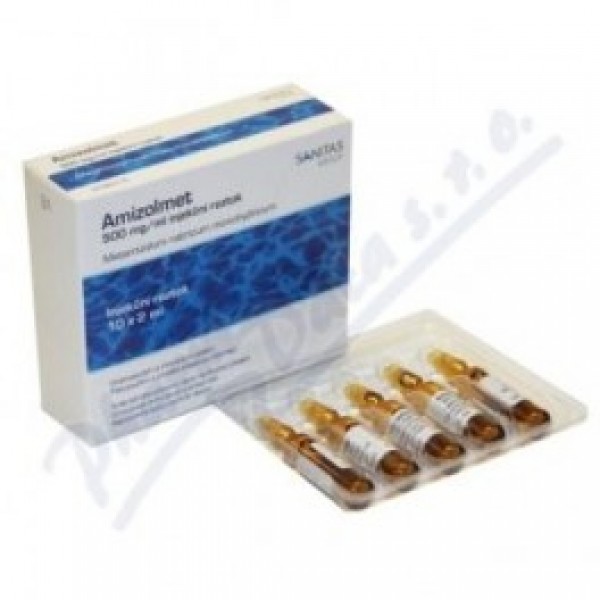
AMIZOLMET 500 mg. / Ml. 2 ml. 10 ampoules
Product Code: AMIZOLMET 500 mg. / Ml. 2 ml. 10 ampoules
Availability: In Stock
Product viewed: 1310


AMIZOLMET 500 mg. / Ml. 2 ml. 10 ampoules
WHAT AMIZOLMET AND WHAT IT IS USED
Amizolmet is a medicinal product with analgesic (pain relieving), antipyretic (reduces fever) and antispasmodic (relieves spasms of smooth muscles) act whose use is not addictive.
It is used to relieve severe pain and temperature, which is not affected by other treatments. Used in the form of injections, as oral administration is not shown.
2. BEFORE YOU TAKE AMIZOLMET
Do not take Amizolmet:
if you are allergic (hypersensitive) to metamizole or any of the other ingredients of Amizolmet or similar active substances (phenazone, propilfenazon, phenylbutazone, oksifenilbutazon);
if your bone marrow function is impaired (eg after cancer treatment) or the ability to produce blood cells is impaired;
if you have ever had asthma or allergic reactions (such as rash or swelling of the face or mucous membranes of the respiratory or digestive tract) to analgesics such as salicylates, acetaminophen or other non-narcotic analgesics;
if you suffer from severe liver disease, or have severe kidney or liver failure;
if you have no inheritance enzyme called glucose-6-phosphate dehydrogenase;
if you have low blood pressure or circulatory problems;
during pregnancy and lactation.
This product should not be used in children and adolescents aged under 16 years.
Take special care with Amizolmet
rarely can occur change in the number of certain types of white blood cells (see Possible side effects). This reaction can occur at any time during the treatment, can be serious and life-threatening. The risk of these changes increased after prolonged use or use of higher doses of the product. Therefore, this product should not be used longer than seven days;
You are at higher risk of developing allergic reactions if you have any of the following violations:
asthma, especially when simultaneously the inflammation of the nasal mucosa;
Chronic urticaria;
intolerance to alcohol, i. e. if you react to small amounts of alcoholic beverages with sneezing, watery eyes and a strong flushing;
intolerance to dyes (eg. tartrazine) or preservatives (eg. benzoates);
if you have low blood pressure, loss of volume due to dehydration, unstable circulation, starting circulatory failure or high temperature, the risk of serious hypotensive response to you is higher (reaction associated with lower blood pressure);
if you have severe coronary disease or significant narrowing of the arteries supplying blood to the brain, reducing blood pressure should be avoided. Therefore this product you may be applied only under close supervision of circulation;
if you have kidney or liver impairment should avoid high doses Metamizole.
Using other medicines
Please tell your doctor or pharmacist if you are taking or have recently taken any other medicines, including medicines obtained without a prescription.
It is particularly important to tell your doctor if you take:
cyclosporine (a drug used to suppress the body's immune response);
coumarin anticoagulants (drugs that prevent blood clots), oral antidiabetics, phenytoin (used for epilepsy), sulfonamides (antibiotics);
barbiturates (sleeping pills), monoamine oxidase (MAO) inhibitors (antidepressants);
chlorpromazine (drug affecting the central nervous system).
Pregnancy and lactation
Seek advice your doctor or pharmacist before using any medicine.
Amizolmet should not be used during pregnancy and lactation.
Driving and using machines
No adverse effects on the ability to drive and use machines Amizolmet when taken in recommended doses. However, when they are prescribed higher doses, your ability to drive and concentration can be affected, especially if you drink alcohol. In such case do not drive or operate machinery.
3. HOW TO USE AMIZOLMET
Always use Amilzolmet just as you told your doctor. If you are unsure about something, ask your doctor or pharmacist.
The dosage depends on the desired analgesic effect and your health. Amizolmet can be administered intramuscularly or by slow intravenous injection.
The dose is always determined by the physician. You should be lying down and under medical observation after injection of Amizolmet.
If you take more than the amount Amizolmet
Your medicine will be given by the doctor, so an overdose is unlikely. If you take higher doses, it can lead to nausea, vomiting, abdominal pain, impairment of renal function / kidney failure, nervous system disorders (dizziness, drowsiness, coma, convulsions), sharply lowering blood pressure arrhythmia.
When used in high doses may appear harmless red-colored urine.
If you have further questions about the use of this product, ask your doctor or pharmacist.
4. POSSIBLE SIDE EFFECTS
Like all medicines Amizolmet can cause side effects, although not everybody gets them.
If symptoms such as fever, chills, sore throat and mouth ulcers, immediately stop using the medication and consult your doctor. These symptoms may be related to the lack of certain white blood cells (agranulocytosis). This reaction is a rare but very serious and life-threatening. The reaction is dose-independent and can occur at any time during treatment. Increased bleeding and / or pinpoint hemorrhages in the skin and mucous membranes can also occur as a result of the reduced number of platelets.
The following other side effects have been observed regarding the application of this product:
Rarely can develop allergic reactions. Less severe reactions typically include symptoms related to skin and mucous membranes (itching, burning sensation, redness, hives and swelling), shortness of breath and rare gastrointestinal complaints. Milder reactions may progress to more severe forms of generalized urticaria, severe swelling (also in the area of the larynx), severe bronchospasm, arrhythmias, low blood pressure (which is preceded by increased blood pressure) and circulatory shock. In asthmatic patients with intolerance to analgesics, these reactions usually occur in the form of an asthma attack.
In the injection site can occur pain and local reactions - sometimes in the form of inflammation of a vein.
Drop in blood pressure occurs mainly during intravenous administration.
Other side effects may include: nausea, vomiting, gastric irritation, diarrhea, deterioration of renal function.
Red staining and acidic ph of urine may be due to the presence of a metabolite.
If any of the side effects gets serious, or you notice other effects not listed in this leaflet, please tell your doctor or pharmacist.
5. HOW TO STORE AMIZOLMET
Do not store above 25 ° C.
Store in the original container to protect from light.
Keep out of reach of children.
Do not use Amizolmet after the expiry date which is stated on the box and on the label. The expiry date refers to the last day of that month.
Medicines should not be disposed of in wastewater or household waste. Ask your pharmacist how to dispose of medicines no longer required. These measures will help to protect the environment.
6. FURTHER INFORMATION
What Amizolmet
The active substance is metamizole sodium. 1 ml of solution contains 500 mg metamizole sodium.
The other ingredient is water for injections.
Amizolmet looks like and contents of the pack
Clear, colorless to slightly brownish-yellow solution, practically free of particles.
The solution is contained in amber glass ampoules placed in the insert of PVC, packed in a cardboard box.
Package size: 10 ampoules with 2 ml.
Marketing Authorisation Holder:
Pharmaswiss Ceska republika s.r.o., Czech Republic.
manufacturer:
SANITAS AB, Lithuania.
Date of leaflet was last approved: July 2011.
The following information applies only to medical and healthcare professionals.
usual dosage
In adults the single parenteral dosage regimen 0.5 to 1 g (1-2 ml). The unit dose can be repeated every 6-8 hours as needed. If necessary, can be given a single dose of 2,5 g (5 ml).
The onset of the analgesic or antipyretic effect can be expected between 30 and 60 minutes after administration. Typically, the duration of action is about 4 hours.
If a single dose is not effective or analgesic effect subsides, the dose can be repeated every 6-8 hours until the maximum daily dose of 5 g (10 ml).
Since the hypotensive response after injection may depend on the administered dose, administration of a single dose for parenteral administration higher than 1 g metamizole must be carefully considered. See also Method of administration.
Use in children
Amizolmet should not be used to treat children and adolescents aged under 16 years.
Patients with renal and hepatic impairment
In patients with impaired renal or hepatic function, it is recommended to avoid high doses metamizole, since the elimination rate in these patients may be lower. In short-term treatment is not necessary dose reduction. There is no experience with long-term treatment of patients with renal or hepatic insufficiency.
Elderly patients and patients in poor health should be viewed as patients with impaired renal and hepatic function.
Method of administration
It is necessary to ensure that after the first symptoms of anaphylactic / anaphylactoid reaction (see Adverse Reactions) injection can be interrupted and the risk of isolated hypotensive response - minimized. During parenteral administration required that patients be closely monitored by medical personnel and lying down. To avoid hypotensive response, intravenous injection must be administered slowly, for example 1 ml (500 mg metamizole) per minute maximum speed.
Special precautions
Agranulocytosis caused by metamizole is immunoallergic process lasting at least a week. These effects are very rare but life-threatening and can even be fatal. If you develop neutropenia (<1500 neutrophils / mm3), use of the product should be discontinued immediately and requires regular monitoring hematologic normalization of blood values.
Anaphylactic / anaphylactoid reactions
When choosing a method of administration should be considered higher risk of anaphylactic / anaphylactoid reactions associated with parenteral administration.
Prior to administration of metamizole doctor needs to know the medical history of the patient. In patients with increased risk of anaphylactic reactions, metamizole can be used only after careful consideration of the potential risk to the expected benefit. If Metamizole apply in these cases need close medical supervision and be provided emergency aid in shock.
Isolated hypotensive reactions
Patients who need to avoid a sharp drop in blood pressure, ie patients with severe coronary disease or significant stenosis of the arteries supplying the brain, metamizole may be used only under strict monitoring of hemodynamic parameters.
Write a review
Your Name:Your Review: Note: HTML is not translated!
Rating: Bad Good
Enter the code in the box below:
Related Products
Metamizole amp. 500 mg. / Ml. 2 ml. 10 amp INGREDIENTS:1 ml ..
19.00€
Ibuprofen 50% ampoules 2 ml. 10 amp Ibuprofen WHAT IS AND WH..
19.00€