
Your shopping cart is empty!
Welcome visitor you can login or create an account.
Lorista 100 mg. 28 tablets

Product viewed: 2594


What is Lorista and what it is used for
Lorista belongs to a group of medicines known as angiotensin-II receptor antagonists. Angiotensin-H is a substance produced in the body that binds to receptors in the blood vessels, causing them to contract. As a result, pressure in the blood vessels increases. Losartan prevents the binding of angiotensin-II to these receptors by relaxing the blood vessels, and consequently decreases blood pressure. Losartan slows the decline in renal function in patients with high blood pressure and type 2 diabetes.
Lorista is used:
for the treatment of patients with high blood pressure (hypertension) in adults and children and adolescents aged 6-18 years;
for kidney protection in hypertensive type 2 diabetic patients with laboratory evidence of impaired renal function and proteinuria> 0.5 g per day (a condition where the urine contains an abnormally high amount of protein);
to treat patients with chronic heart failure when treatment with certain medicines called angiotensin converting enzyme inhibitors (ACE inhibitors - medicines used to lower blood pressure) are not considered appropriate by your doctor. If your heart failure has been stabilized with an ACE inhibitor. You should not go to losartan
in patients with high blood pressure and thickening of the wall of the left ventricle, losartan has been shown to reduce the risk of stroke (stroke) (LIFE study).
2. What you need to know before you take it
Lorissa Do not take Lorista
- if you are allergic (hypersensitive) to losartan or any of the other ingredients of this medicine (listed in section 6);
- if your liver function is severely impaired;
- if you are more than 3 months pregnant (it is a good idea to avoid Losartan tablets during early pregnancy - see section "Pregnancy and breast-feeding");
- if you have diabetes or have impaired kidney function and are being treated with a blood pressure lowering medication containing aliskiren.
Warnings and precautions
Talk to your doctor or pharmacist before taking Loris.
You should tell your doctor if you think you are (or may be) pregnant. Losartan is not recommended in early pregnancy and should not be taken if you are more than 3 months pregnant, as it may cause serious harm to your baby if used at this stage (see section "Pregnancy").
It is important to tell your doctor before taking Lorista:
if you have a history of angioedema (swelling of the face, lips, throat and / or tongue) (see also section 4, Possible side effects)
if you suffer from severe vomiting or diarrhea leading to excessive loss of fluid and / or salts of your body,
if you are taking diuretics (medicines that increase the amount of kidney fluid) or are on a low-salt diet leading to excessive fluid and body loss (see section 3, "Dosage in special patient groups"),
if you are known to have narrowing or blockage of the blood vessels to your kidneys or if you have recently had a kidney transplant,
if your liver function is impaired (see section 2 "Do not take Lorraine" and section 3 "Dosing in special patient groups"),
if you suffer from heart failure, with or without renal impairment or with accompanying cardiovascular cardiac arrhythmias. Special care should be taken when you are treated with a B-blocker,
if you have problems with your heart valves or heart muscle,
if you suffer from coronary heart disease (caused by reduced blood flow in the blood vessels of the heart) or from cerebrovascular disease (caused by reduced blood circulation in the brain)
if you suffer from primary hyperaldosteronism (a syndrome associated with increased adrenal hormone aldosterone secretion caused by abnormalities in the glands) if you are taking any of the following medicines used to treat high blood pressure:
- ACE inhibitor (eg enalapril, lisinopril, ramipril), especially if you have kidney problems associated with diabetes;
- aliskiren.
Your doctor may periodically check your kidney function, blood pressure, the amount of electrolytes (eg potassium) in your blood.
See also the information titled "Do not take Loris".
Children and adolescents
Losartan has been studied in children. For more information, you should check with your doctor.
Other medications and Loris
Tell your doctor or pharmacist if you are taking, have recently taken or might take any other medicines.
Take special care if you are taking the following medicines while you are taking Lorasta: other medicines to lower your blood pressure as they may further lower your blood pressure. Blood pressure may be lowered by one of the following drugs / class of medicines: tricyclic antidepressants, antipsychotics, baclofen, amifostine, medicines that retain potassium or may increase levels
Driving and using machines
No studies on the effects on the ability to drive and use machines have been performed.
It is unlikely that Lorraine will have an effect on your ability to drive or use machines. As with many other medicines used to treat high blood pressure, losartan may cause dizziness or drowsiness in some people. If you experience dizziness or drowsiness, you should consult your doctor before attempting to do this.
Lorca contains lactose
If you know from your doctor that you have an intolerance to some sugars, you must tell it before taking this medicine.
3. How to take Lorista
Always take this medicine exactly as described in this leaflet or as your doctor or pharmacist has told you. If you are not sure, ask your doctor or pharmacist. Your doctor will decide what is the right dose of Lorithm, depending on your condition and whether you are taking other medicines. It is important that you continue to take Losartan as long as your doctor has prescribed it to maintain a smooth control of your blood pressure.
Losartan is available in the following concentrations: 12.5 mg, 25 mg, 50 mg and 100 mg. Adult patients with high blood pressure
Treatment usually starts with 50 mg of losartan (one Losartan 50 mg tablet) once a day. A maximum blood pressure lowering effect should be reached 3-6 weeks after the start of treatment. In some patients the dose may be increased to 100 mg losartan (two Losartan tablets or one Losartan 100 mg tablet) once a day.
If you have the impression that the effect of losartan is too strong or too weak, please consult your doctor or pharmacist.
Use in landfills and adolescents
Use in landfills and adolescents aged 6-18 years
The recommended starting dose for patients weighing between 20 and 50 kg is 0.7 mg / kg losartan once daily (up to 25 mg of Lorant). The doctor may increase the dose if the blood pressure is not controlled.
Adult patients with high blood pressure and type 2 diabetes
Treatment usually starts with 50 mg of losartan (one Losartan 50 mg or one Losartan 100 mg tablet) once a day. The dose may be increased to 100 mg losartan (two Losartan tablets 50 mg) once a day depending on your blood pressure.
Losartan tablets can be used with other blood pressure lowering medicines (eg diuretics, calcium channel blockers, alpha or beta blockers and central nervous system medicines) as well as insulin and other commonly used medicines to lower blood pressure blood sugar levels (eg, sulfonylureas, glitazones and glycosidase inhibitors).
Adult patients with heart failure
Treatment usually starts with 12.5 mg of losartan (one Lorithta 12.5 mg tablet) once a day. Usually, the dose should be increased weekly (ie 12.5 mg daily in the first week, 25 mg daily in the second week, 50 mg daily in the third week 100 mg daily in the fourth week, 150 mg daily in the fifth week) to a maintenance dose determined by your doctor. A maximum dose of 150 mg of losartan (eg three Losartan tablets 50 mg or one Losartan 100 mg and Losartan 50 mg) can be used once a day.
In the treatment of heart failure, losartan is usually combined with diuretics (medicines that increase the amount of kidney fluid) and / or digitalis (a medicine used in chronic heart failure and heart rhythm disorders) and / or beta-blocker.
Dosing in special patient groups
The doctor may recommend a lower dose, especially when starting treatment for certain patients, such as those treated with high dose diuretics, patients with hepatic impairment or patients over 75 years of age. The use of losartan is not recommended in patients with severe hepatic impairment (see section "Do not take Lorraine").
Application
The tablets should be taken with a glass of water. You should try to take the tablets at the same time each day. It is important that you continue to take Losartan until your doctor advises you otherwise.
If you take more Losartan than you should
If you inadvertently take too many tablets or a child swallows several, tell your doctor immediately. Symptoms of overdose include decreased blood pressure, accelerated cardiac activity, and possibly cardiac arrest.
If you have forgotten to accept the Lorraine
Do not take a double daily dose to make up for the missed tablet.
If you accidentally miss a daily dose, just take the next dose as usual.
If you have any further questions on the use of this product, talk to your doctor. 4.
4. Possible side effects
Like all medicines, this medicine can cause side effects, although not everyone gets them
Rare (may occur in up to 1 in 1,000 people):
hypersensitivity angioedema
inflammation of the blood vessels (vasculitis including Henoch-Schonlein purpura),
sensation of constipation or numbness (paraesthesia), loss of consciousness (syncope),
very fast and uneven heartbeat (atrial fibrillation)
stroke (stroke),
inflammation of the liver (hepatitis),
elevated ALA, usually passing on discontinuation.
Not known (frequency can not be estimated from the available data):
decreased platelet migraine,
abnormal liver function abnormalities, muscle and joint pain, influenza like symptoms, back pain and urinary tract infection, increased sensitivity to the sun (photosensitivity), unexplained muscle pains with dark (tea-like) urine (rhabdomyolysis), impotence,
inflammation of the pancreas (pancreatitis),
low levels of sodium in the blood (hyponatraemia),
depression,
feeling of general malaise (anxiety),
ringing. buzzing, clapping, or ringing in the ears (tinnitus), disturbed taste (dysgeusia).
Adverse drug reactions in children are similar to those seen in adults.
Keep out of the reach and sight of children.
Do not use this medicine after the expiry date which is stated on the carton after EXP. The expiry date refers to the last day of the month.
This medicine does not require any special storage conditions.
Do not dispose of medicines in the sewage system or in the household waste container. Ask your pharmacist how to dispose of medicines you no longer use. These measures will help to protect the environment.
5. How to store the Lorista
Laurista 12.5 mg: oval, convex, yellow film-coated tablets.
What Lorista looks like and what the package contains
Lorrastan 25 mg: oval, convex, yellow film-coated tablets scored with one
The tablet can be divided into two equal doses.
Losartan 50 mg round, convex, white film-coated tablets scored on one side with bevelled edges. The spreadsheet is not intended to break the tablet. Losartan 100 mg: oval, convex, white film-coated tablets.
Lorasta 12.5 mg / 25 mg / 50 mg / 100 mg
PVC / PVDC blister transparent foil with aluminum foil used for coating; box. Packaging size:
Loritha 12.5 mg: 7, 10. 14, 15, 20, 21. 28, 30, 50, 56, 60, 84, 90, 98, 100, 112 film-coated tablets, 20, 28, 30, 50, 56, 60, 84, 90, 98, 100, 112 film-coated tablets, Losartan 50 mg: 10,14,15,20,28,30,50,66,60,84, 90, 98, 100, 112 film-coated tablets, Losartan 100 mg: 7, 10, 14, 15, 20, 28, 30, 50, 56, 60, 84, 90, 98, 100, 112 film-coated tablets.
Polyethylene (HDPE) tablet pack with polypropylene closure. Envelope made of polyethylene with a desiccant, silica gel. Pack size: 250 film-coated tablets.
Not all pack sizes may be marketed.
6. Package Contents and Additional Information
What the Loris contains
The active substance is losartan potassium. Each tablet contains 12.5 mg, 25 mg, 50 mg or 100 mg of losartan potassium equivalent to losartan equivalent to 11.4 mg, 22.9 mg, 45.8 mg, or 91.5 mg.
The other ingredients of Lorasta 12.5 mg / 25 mg are: corn starch, pregelatinized maize starch, microcrystalline cellulose, colloidal anhydrous silica, magnesium stearate, cellulose (cellulose and lactose monohydrate) in the tablet core and hypromellose, talc, propylene glycol, titanium dioxide (E171) and quinoline yellow (E104) in the film coating,
The other ingredients of Lorasta 50 mg / 100 mg are: corn starch, pregelatinised maize starch, microcrystalline cellulose, colloidal anhydrous, magnesium stearate, cellulose (cellulose and lactose monohydrate) in the tablet core and hypromellose, talc, propylene glycol and titanium dioxide (E171) in the film coating
Write a review
Your Name:Your Review: Note: HTML is not translated!
Rating: Bad Good
Enter the code in the box below:
Related Products
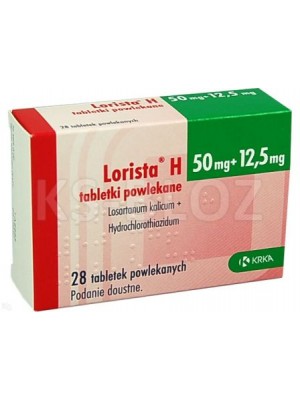
WHAT LORISTA IS AND WHAT IT IS USED FOR?
Lorista H is a c..
14.00€