
Your shopping cart is empty!
Welcome visitor you can login or create an account.
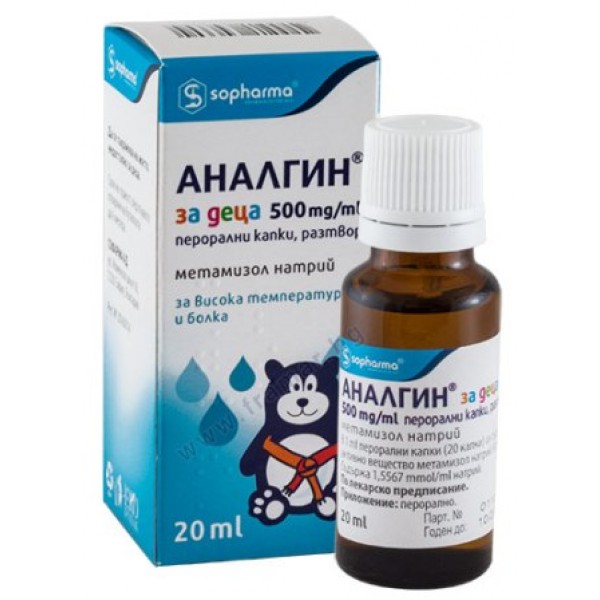
Analgin kids droops 500 mg / ml. 20 ml.
Product Code: Analgin kids droops 500 mg / ml. 20 ml.
Availability: In Stock
Product viewed: 2


1. What is Analgin for children and what is it used for
Analgin for children contains the active substance metamizole, which has a pronounced analgesic and antipyretic effect.
Analgin for children is used for:
reducing high fever;
reducing moderate to severe pain of various origins: headache, toothache, neuralgia, neuritis, migraine and migraine symptoms, muscle pain, injuries, burns, postoperative pain, phantom pain, menstrual pain, pain in oncological diseases, renal and biliary colic.
2. What you need to know before you take Analgin for children
Do not take Analgin for children:
if your child is allergic (hypersensitive) to the active substance metamizole or any of the other ingredients of this medicine (listed in section 6);
if your child has previously had a significant decrease in the number of a type of white blood cell called granulocytes, which was caused by metamizole or similar medicines called pyrazolones or pyrazolidines;
if your child has a known intolerance to painkillers (analgesic asthma or analgesic intolerance type urticaria-angioedema). In this case, he reacts to painkillers (analgesics) such as salicylates, paracetamol, diclofenac, ibuprofen, indomethacin or naproxen with bronchospasm (narrowing of the bronchi, resulting in difficulty breathing) or other hypersensitivity reactions;
if your child has problems with the bone marrow or has a disease that affects the way blood cells are formed or function;
if your child has congenital glucose-6-phosphate dehydrogenase deficiency (a rare metabolic disease), due to the risk of haemolysis (destruction of red blood cells);
if your child has acute hepatic porphyria (a rare metabolic disorder) as there is a risk of a porphyria attack.
This product is intended for children up to 9 years of age. In case of pregnancy, do not use this product during the last trimester of pregnancy.
Warnings and precautions
Talk to your doctor or pharmacist before taking Analgin for children.
Unusually low white blood cell count (agranulocytosis)
The use of Analgin for children may cause agranulocytosis, in which the level of a type of white blood cell called granulocytes, which are important in fighting infections, is very low (see section 4). You should stop taking metamizole and see a doctor immediately if you experience the following symptoms, as these may be signs of possible agranulocytosis: chills, fever, sore throat and painful sores on the mucous membranes, especially in the mouth, nose and throat or in the genital or anus area. Your doctor will order laboratory tests to check the level of blood cells. If metamizole is taken for a high temperature, some symptoms of developing agranulocytosis may go unnoticed. Similarly, if you are being treated with antibiotics, the symptoms may also be masked.
Agranulocytosis can develop at any time while using Analgin for children and even shortly after stopping metamizole. You may get agranulocytosis even if you have not had problems with metamizole in the past.
Analgin for children contains the pyrazolone derivative metamizole and is associated with a rare but life-threatening risk of shock (circulatory collapse).
If you react to Analgin for children with hypersensitivity (anaphylactoid reactions), you are at increased risk of a similar reaction to other analgesics.
If signs of thrombocytopenia occur, the use of Analgin for children should be discontinued immediately.
Patients with analgesic intolerance (see section “Do not take Analgin for children”) are at increased risk of severe hypersensitivity reactions to Analgin for children.
The risk of possible severe hypersensitivity reactions to Analgin for children is significantly increased if you have the following diseases/intolerances:
intolerance to analgesics and antirheumatic products, manifested as e.g. itching and swelling (urticaria, angioedema);
shortness of breath due to narrowing of the small airways (bronchial asthma), especially if you suffer from inflammation of the nose and nasal sinuses (rhinosinusitis) and nasal polyps;
chronic urticaria;
hypersensitivity to dyes (e.g. tartrazine) or preservatives (benzoates);
alcohol intolerance - if you react even to small amounts of alcohol with symptoms such as sneezing, watery eyes and severe redness of the face. Such alcohol intolerance may be a sign of undiagnosed analgesic asthma syndrome.
Analgin for children can cause a decrease in blood pressure (see section 4). The risk of such reactions is increased:
if you have low blood pressure (hypotension) or fluid loss, impaired blood circulation or symptoms of circulatory collapse (e.g. as in myocardial infarction or severe injuries);
if you have a high temperature.
Therefore, the use of
should be carefully considered and closely monitored. Prophylactic measures may be necessary to reduce the risk of a drop in blood pressure.
Patients in whom a drop in blood pressure must be avoided, such as patients with severe coronary artery disease or narrowing of the cerebral vessels leading to impaired perfusion, this product can only be used with careful monitoring of cardiovascular function.
If you have kidney or liver disorders, Analgin for children should only be used after a careful assessment of the benefit/risk ratio and after appropriate precautions (see section 3).
Liver problems
In patients taking metamizole, inflammation of the liver has been reported, with symptoms developing within a few days to a few months after the start of treatment.
Stop using Analgin for children and contact a doctor if you have symptoms of liver problems such as nausea or vomiting, fever, feeling tired, loss of appetite, dark urine, light-colored stools, yellowing of the skin or whites of the eyes, itching, rash or pain in the upper abdomen. Your doctor will check your liver function.
You should not take Analgin for children if you have previously taken a medicine containing metamizole and have had liver problems.
Serious skin reactions
Serious skin reactions, including Stevens-Johnson syndrome, toxic epidermal necrolysis, drug reaction with eosinophilia and systemic symptoms (DRESS), have been reported in association with metamizole treatment. Stop using metamizole and seek medical help immediately if you notice any of the symptoms associated with these serious skin reactions described in section 4.
If you have ever developed severe skin reactions, you should never start treatment with Analgin for children again (see section 4).
Other medicines and Analgin for children
Please tell your doctor or pharmacist if you are taking, have recently taken or might take any other medicines.
Taking Analgin for children at the same time as chlorpromazine (a medicine for treating mental illnesses) may lead to a sharp drop in body temperature.
The pyrazolone group, to which Analgin for children also belongs, is known to interact with some medicines:
which inhibit blood clotting (oral anticoagulants);
which lower high blood pressure and are used in some heart diseases (captopril);
for the treatment of mental disorders (lithium);
for the treatment of cancer and rheumatism (methotrexate);
for drainage (triamterene).
It is not known to what extent this also applies to Analgin for children.
Analgin for children may reduce the plasma concentrations of cyclosporine (a product that suppresses immune reactions in organ transplants), therefore cyclosporine levels should be monitored when used simultaneously with the product.
Metamizole (a substance to reduce pain and fever) may reduce the effect of acetylsalicylic acid on platelet aggregation (blood cell clumping and blood clot formation) when taken simultaneously. Therefore, this combination should be used with caution in patients who are taking low-dose aspirin for cardioprotection (prevention).
Metamizole should be used with caution with the following medicines, as it may reduce their effect:
bupropion, a medicine used to treat depression or as an aid to stop smoking;
efavirenz, a medicine used to treat HIV/AIDS;
methadone, a medicine used to treat addiction to illicit substances (so-called opioids);
valproate, a medicine used to treat epilepsy or bipolar disorder;
tacrolimus, a medicine used to prevent organ rejection in transplant patients;
sertraline, a medicine used to treat depression.
Analgin for children with food, drink and alcohol
This medicine is intended for infants from 3 months to 9 years of age. Concomitant use with alcohol should be avoided as a negative interaction cannot be ruled out.
Pregnancy and breast-feeding
If you are pregnant or breast-feeding, think you may be pregnant or are planning to become pregnant, ask your doctor or pharmacist for advice before taking this medicine.
This medicine is intended for infants from 3 months to 9 years of age.
Pregnancy
The available data on the use of metamizole during the first three months of pregnancy are limited, but do not indicate harmful effects on the embryo. In certain cases, when there are no other treatment options, it is possible to accept the administration of single doses of metamizole during the first and second trimesters after consultation with a doctor or pharmacist and after a careful assessment of the benefits and risks of using metamizole. However, the use of metamizole is generally not recommended.
during the first and second trimester.
During the last three months of pregnancy, you should not take Analgin oral drops for children due to an increased risk of complications for the mother and child (bleeding, premature closure of an important blood vessel, the so-called ductus Botali in the unborn child, which closes naturally only after birth).
Breastfeeding
The breakdown products of metamizole pass into breast milk in significant quantities and a risk to the infant cannot be excluded. Therefore, repeated use of metamizole during breastfeeding should be avoided. In the case of a single administration of metamizole, mothers are advised to collect and discard breast milk for 48 hours after administration of the dose.
Driving and using machines
This medicine is intended for the treatment of infants from 3 months to children aged 9 years. When using the recommended dose, there are no known disturbances in concentration and reaction time. As a precaution, when taking high doses, driving, operating machinery or other hazardous activities should be avoided, especially after consuming alcohol.
Analgin for children contains 1.5567 mmol sodium per 1 ml (20 drops).
To be taken into account by patients on a controlled sodium diet.
3. How to take Analgin for children
Always take this medicine exactly as your doctor or pharmacist has told you. If you are not sure, ask your doctor or pharmacist.
The dose depends on the intensity of the pain or fever and on the individual sensitivity to Analgin. The lowest dose necessary to control the pain and fever should be chosen. Your doctor will tell you how to take Analgin.
The following table shows the recommended single doses and maximum daily doses depending on weight or age:
Body weight Single dose Maximum daily dose
kg age drops mg drops mg
< 9 < 12 months 1 - 5 25 - 125 4 - 20 100 - 500
9 - 15 1 - 3 years 3 - 10 75 - 250 12 - 40 300 - 1,000
16 - 23 4 - 6 years 5 - 15 125 - 375 20 - 60 500 - 1,500
24 - 30 7 - 9 years 8 - 20 200 - 500 32 - 80 800 - 2,000
Single doses may be taken up to four times a day depending on the maximum daily dose.
A pronounced effect can be expected 30 to 60 minutes after oral administration.
Use in children and adolescents
For the treatment of pain in children and adolescents up to 9 years of age, 8 to 16 mg of Analgin per kilogram of body weight can be taken as a single dose (see table above).
In case of fever, a dose of 10 mg Analgin per kilogram of body weight is usually sufficient for children:
Body weight Single dose
kg age drops mg
< 9 < 12 months 1-3 25-75
9-15 1-3 years 4-6 100-150
16-23 4-6 years 6-9 150-225
24-30 7-9 years 10-12 250-300
Special populations
In case this product is administered in the elderly and in patients with a deteriorated general health condition/with renal impairment, it should be known that:
The dose should be reduced in elderly patients, in debilitated patients and in patients with reduced renal function, since the excretion of metamizole degradation products may be delayed.
Patients with impaired renal and hepatic function
Since the excretion rate is reduced in patients with impaired renal or hepatic function, repeated high doses should be avoided. No dose reduction is necessary only for short-term use. There is no experience with long-term use.
Method of administration and duration of treatment
Analgin for children should be taken with sufficient fluid.
The duration of treatment with metamizole is determined by the attending physician.
If you have taken more than the required dose of Analgin for children
Nausea, vomiting, abdominal pain, impaired renal function up to acute renal failure (manifested as, for example, interstitial nephritis), in rare cases dizziness, drowsiness, weakness up to loss of consciousness, convulsions, a sharp decrease in blood pressure up to shock and disturbances in the heart rhythm (tachycardia) may occur.
After taking very high doses, the excretion of the harmless metabolite rubzonic acid may cause red urine.
If you forget to take Analgin for children
Do not take a double dose to make up for a forgotten dose.
If you have any further questions on the use of this medicine, ask your doctor or pharmacist.
4. Possible side effects
Like all medicines, this medicine can cause side effects, although not everybody gets them.
Stop taking Analgin for children and contact a doctor immediately if you experience any of the following symptoms:
Nausea or vomiting, fever, feeling tired, loss of appetite, dark urine, light stools, yellowing of the skin or whites of the eyes, itching, rash or pain in the upper abdomen. These symptoms may be signs of liver damage. See also section 2 “Warnings and precautions”.
The following side effects may have serious consequences. Do not take Analgin for children again and consult a doctor immediately.
Stop using metamizole and seek medical help immediately if you notice any of the following serious side effects:
Reddish, flat, target-like or circular spots on the torso, often with central blisters, peeling skin, ulcers of the mouth, throat, nose, genitals and eyes. These serious skin rashes may be preceded by fever and flu-like symptoms (Stevens-Johnson syndrome, toxic epidermal necrolysis).
Widespread rash, high body temperature and enlarged lymph nodes (DRESS syndrome or drug hypersensitivity syndrome).
If signs of thrombocytopenia (reduction in platelet count, which increases the risk of bleeding or bruising) are observed, the product should be discontinued immediately. You should not wait to interrupt treatment until the results of laboratory tests are available.
The assessment of adverse reactions is based on
and the following frequency information:
Very common (more than 1 in 10 patients treated)
Common (1 to 10 in 100 patients treated)
Uncommon (1 to 10 in 1,000 patients treated)
Rare (1 to 10 in 10,000 patients treated)
Very rare (less than 1 in 10,000 patients treated)
Not known (frequency cannot be estimated from the available data)
Immune system disorders
Allergic skin reactions
Uncommon: Violet to dark red, partly blistering skin rash (typical drug eruption).
Rare: Skin rash (maculopapular exanthema), hypersensitivity reactions (anaphylactic or anaphylactoid reactions) may develop even with repeated administration without complications.
Very rare: Asthma attacks (shortness of breath due to narrowing of the small airways), sudden circulatory shock.
Milder reactions are manifested by typical signs such as itching and redness of the eyes, cough, runny nose, sneezing, tightness of the chest, redness of the skin (especially of the face and head), hives and swelling of the face, and less commonly, nausea and abdominal pain. Specific warning signs are itching and a feeling of warmth on and under the tongue, and especially on the palms and soles.
Milder reactions may progress to more severe forms with severe urticaria, severe angioedema (also in the larynx), severe bronchospasm (spastic narrowing of the small airways), rapid heart rate (sometimes too slow pulse), arrhythmias, drop in blood pressure (sometimes first starting as hypertension), loss of consciousness and circulatory shock.
In patients with analgesic asthma (see section 2 "Do not take Analgin for children"), hypersensitivity reactions usually manifest themselves in the form of asthma attacks.
Blood and lymphatic system disorders
Rare: Decrease in white blood cells (leukopenia).
Very rare: Significant decrease in some white blood cells (agranulocytosis) or decrease in platelets (thrombocytopenia).
Typical signs of thrombocytopenia are increased bleeding and pinpoint hemorrhages on the skin and mucous membranes.
Cardiovascular disorders
Uncommon: A drop in blood pressure (hypotonic reactions) caused directly by the drug and not accompanied by other signs of hypersensitivity reactions. Such a reaction may lead to severe hypotension. The risk of a critical drop in blood pressure may be increased by very high fever.
Typical symptoms of low blood pressure are rapid pulse, pallor, tremor, dizziness, nausea and loss of consciousness.
Skin and subcutaneous tissue disorders
Not known: Serious skin reactions.
Hepatobiliary disorders
Not known: Inflammation of the liver, yellowing of the skin and whites of the eyes, increased levels of liver enzymes in the blood.
Kidney and urinary tract disorders
Very rare: Acute deterioration of kidney function with insufficient or no urine output, excretion of blood proteins in the urine or acute renal failure, inflammation of the kidneys (interstitial nephritis).
Reporting of side effects
If you get any side effects, tell your doctor or pharmacist. This includes any possible side effects not listed in this leaflet. You can also report side effects directly via the Medicines Executive Agency.
By reporting side effects, you can contribute to obtaining more information on the safety of this medicine.
5. How to store Analgin for children
Keep out of the reach and sight of children.
This medicinal product does not require any special storage conditions.
Do not use this medicine after the expiry date which is stated on the carton after “EXP”. The expiry date refers to the last day of that month.
The solution can be used for up to 6 months after first opening the bottle.
Do not throw away any medicines via wastewater or household waste. Ask your pharmacist how to dispose of medicines you no longer use. These measures will help protect the environment.
6. Contents of the pack and other information
What Analgin for children contains
The active substance is: metamizole sodium 500 mg in 1 ml solution.
The other ingredients are: disodium phosphate dodecahydrate, sodium dihydrogen phosphate monohydrate, sucralose, liquid essence "Raspberry", purified water.
What Analgin for children looks like and contents of the pack
Transparent, colourless to pale yellow solution.
20 ml of solution in a brown glass bottle with a dropper, with a plastic screw cap, in a cardboard box, together with a leaflet.
Write a review
Your Name:Your Review: Note: HTML is not translated!
Rating: Bad Good
Enter the code in the box below: